

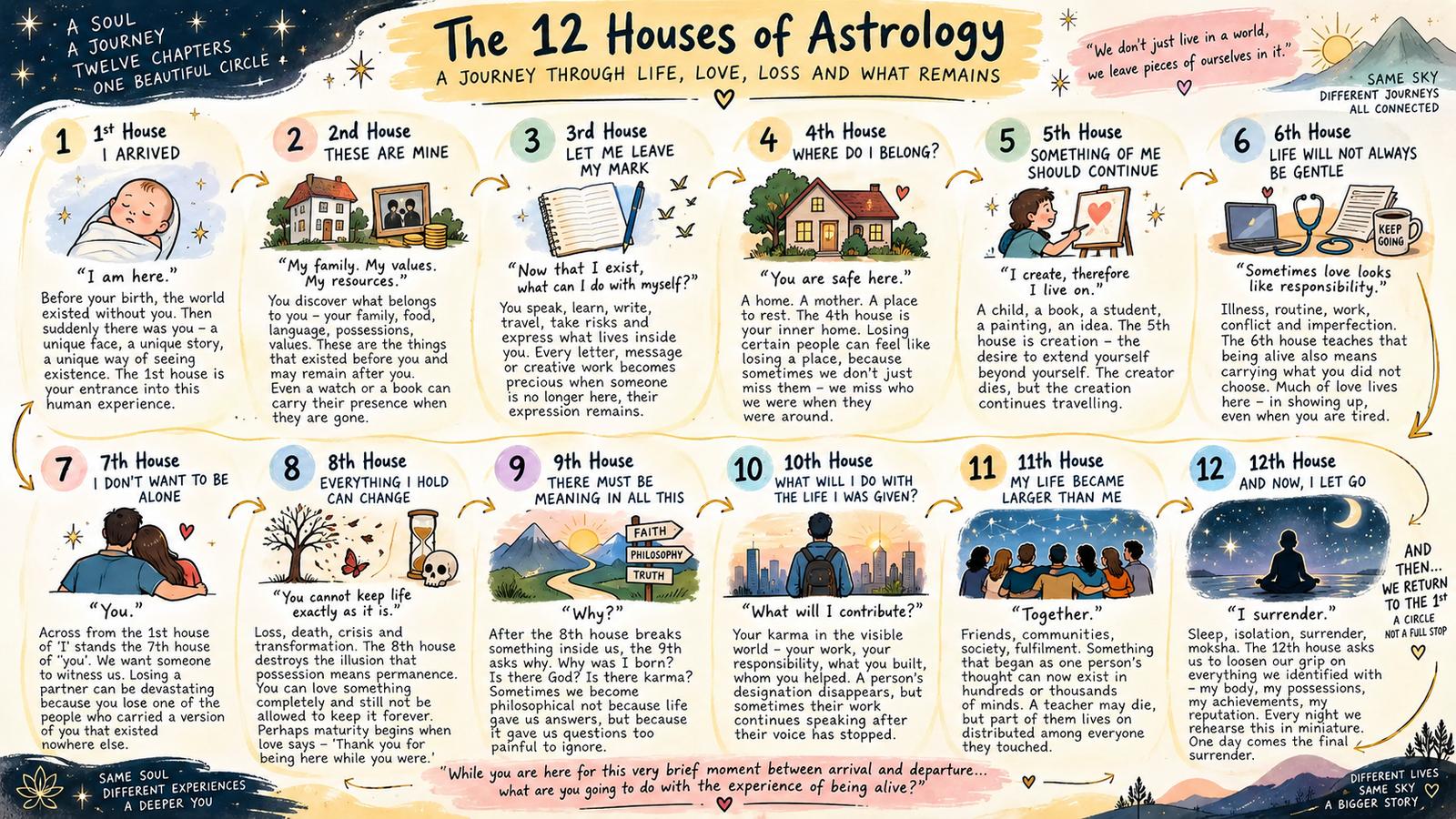
Most people are introduced to the twelve houses of astrology as twelve different areas of life. The first house represents the self, the second family and wealth, the fourth home and mother, the seventh relationships, the tenth career and the twelfth loss, isolation and liberation. These meanings are useful, but perhaps they are only the surface. If we look at the houses as a sequence rather than twelve separate compartments, something much more beautiful begins to appear. Perhaps the twelve houses are actually telling the story of what it means to be alive. They begin with consciousness saying, “I am here,” and eventually end with the same consciousness learning to say, “I let go.”
1st House — “I Arrived”
Before you were born, the world existed perfectly well without you. People were falling in love, families were eating together, children were being born, people were dying, wars were being fought and the Sun continued rising every morning. And then, on one particular day, you arrived. Suddenly there was a new face, a new body, a new temperament and, most importantly, a completely new point from which existence could be experienced. Nobody before you had ever looked at the universe through exactly your eyes.
Perhaps this is the deeper meaning of the first house. Lagna is not merely our appearance or personality. It is our entrance into the human experience. Before there can be my family, my money, my relationship, my career or my spirituality, there first has to be me. The first house is therefore consciousness making its first declaration: “I am here.”
2nd House — “These Are Mine”
Once we arrive, we slowly begin building a world around ourselves. A child starts recognizing: this is my mother, this is my father, this is my family, this is my food, this is my language, this is my name and these are my people. Eventually the same instinct expands into possessions, savings, traditions and values. We begin gathering things around ourselves that provide continuity and security. The second house therefore isn’t simply about money. It represents the things through which we begin saying, “This belongs to my world.”
We understand this house differently after someone dies. Your father’s watch may have been an ordinary watch while he was alive. Afterwards, you may not exchange it for something ten times more expensive. Your grandmother’s handwritten recipe suddenly becomes precious. An old voice recording becomes something you are terrified of accidentally deleting. Nothing about these objects has materially changed, but their meaning has. Human beings leave emotional fingerprints on things, and sometimes possessions become containers of memory. The second house reminds us that what we call mine is rarely valuable only because of what it costs.
3rd House — “Let Me Leave My Mark”
Once there is a self and a world around that self, we want to interact with it. We speak, write, learn, experiment, travel, develop abilities and discover what our hands and minds are capable of doing. The third house asks a very simple question: “Now that I am here, what can I do with myself?” It is the house where the individual begins reaching outward.
Think about finding an old handwritten letter from someone who is no longer alive. Their hand once moved across that paper. Their mind chose those particular words. Their personality existed in the shape of those sentences. The person may no longer be physically present, yet their expression remains. Perhaps this is one of the deeper meanings of the third house. Every time we communicate, create a skill or take an initiative, we leave a tiny fingerprint upon a world that existed before us and will continue after us.
4th House — “Where Do I Belong?”
Eventually, however, every human being needs somewhere they can stop performing. We need a place where achievement doesn’t matter, where the outside world becomes quiet and where our nervous system can simply say, “I am safe here.” We usually call that place home, but home isn’t necessarily a building. Sometimes home is a person. It can be your mother’s voice, your father’s presence, a familiar room, the smell of food from childhood or simply hearing your family talking in another room while you fall asleep.
That is why the fourth house is much deeper than property. It is our emotional foundation, our inner home, our experience of belonging. And perhaps this is why losing certain people hurts in such a peculiar way. Sometimes you don’t only miss your mother; you miss who you were when your mother was around. There was a version of you that existed effortlessly in her presence. When certain people leave, the house may remain exactly where it was, the furniture may still be there and nothing about the address may have changed, yet somehow home no longer feels completely like home.
5th House — “Something of Me Should Continue”
After belonging comes creation. Human beings have a remarkable desire to produce something that wasn’t here before them. We create children, art, businesses, books, knowledge, ideas, teachings and memories. Perhaps somewhere inside us exists an awareness that our individual life is temporary, and creation becomes one way of extending ourselves beyond ourselves.
One day you will leave, but perhaps your child will repeat one of your sentences. Perhaps a student will teach something you once taught them. Perhaps somebody will make a completely different decision because they met you twenty years earlier. The fifth house is therefore not merely creativity or children. It represents something profoundly human: the creator knows, consciously or unconsciously, that they cannot remain forever, so they create something that might. The creator eventually disappears, but creation can continue travelling.
6th House — “Life Will Not Always Be Gentle”
Then life introduces resistance. Illness appears. Responsibilities accumulate. Conflict happens. Bodies become tired. Bills arrive. People depend upon us. Some things need to be done regardless of whether we feel inspired to do them. The sixth house teaches us something the earlier houses cannot: being alive also means carrying things we did not choose.
Strangely, some of the purest forms of love are hidden here. Giving someone medicine every morning is not romantic. Taking an ageing parent repeatedly to the hospital isn’t glamorous. Working when you are exhausted because your family depends upon you rarely receives applause. Sitting beside someone who is sick, cleaning their wounds, preparing their food or quietly completing responsibilities they can no longer perform may never appear in a love poem. Yet perhaps these are among the deepest forms of love. The sixth house reminds us that sometimes love doesn’t look like emotion; sometimes love looks like responsibility.
7th House — “I Don’t Want to Experience Existence Alone”
Directly opposite the first house of “I” stands the seventh house of “you.” Eventually, knowing ourselves isn’t enough. Human beings want to be known by somebody else. We want someone who recognizes our footsteps, notices from our face that something is wrong and understands why we suddenly became quiet. We want at least one person beside whom silence doesn’t need an explanation.
This may be why losing a life partner can be so devastating. You haven’t merely lost another human being. You have lost one of the people who carried a version of you that existed nowhere else. They remembered stories about you that everyone else had forgotten. They knew what frightened you, what made you laugh and what you looked like before the rest of the world knew you. Some memories exist only between two people. When one leaves, the other becomes their only remaining home.
8th House — “Everything I Hold Can Change”
And then we arrive at the house people often fear: the eighth. Death, crisis, loss, transformation, inheritance and circumstances outside our control are associated with this house. But perhaps the deepest lesson of the eighth house isn’t simply death. It is the realization that you cannot keep life exactly as it is.
Parents age. Children grow up. Bodies change. Relationships transform. Certainties collapse. People who once seemed permanent suddenly become memories. The eighth house destroys one of the most comforting illusions human beings carry: the belief that loving something somehow gives us the right to keep it forever. It doesn’t. You can love someone with everything inside you and still one day have to say goodbye.
Perhaps maturity begins when love slowly stops saying, “Please stay forever,” and learns to say, “Thank you for being here while you were.” The eighth house doesn’t necessarily ask us to love less because everything changes. Perhaps it asks us to love more deeply precisely because everything does.
9th House — “There Must Be Meaning in All This”
Something fascinating happens after the eighth house. After experiencing circumstances beyond our control, we enter the ninth house and begin asking why. Why was I born? Why did this happen to me? Why did this particular person enter my life? Why did they leave? Is there God? Is there karma? Does suffering have meaning? Is consciousness larger than the body? Is there something beyond what I can see?
Perhaps this sequence is not accidental in the symbolic architecture of astrology. First life breaks our certainty in the eighth house, and then consciousness searches for meaning in the ninth. Sometimes we don’t become philosophical because life gave us answers. We become philosophical because life gave us questions too painful to ignore. The ninth house is therefore our attempt to find an understanding large enough to hold experiences that the rational mind alone cannot comfortably contain.
10th House — “What Will I Do With the Life I Was Given?”
Eventually philosophy must become action. We can spend decades asking why we are here, but eventually another question arrives: “What am I going to do while I am here?” This is where the tenth house becomes much larger than career. Career is one expression of it, but contribution is perhaps closer to its philosophical meaning.
What did you build? Whom did you help? What responsibility did you accept? What problem did you solve? What became different because you existed? Eventually your job title will disappear. Someone else will sit at your desk. Your visiting card will become meaningless. The position that once seemed enormously important will belong to another person. Yet the consequences of what you did can continue long after your designation disappears. The tenth house asks us not merely what profession we chose, but what we did with the life we were given.
11th House — “My Life Became Larger Than Me”
Then the individual expands into the collective. Friends, communities, networks, audiences and society enter the story. Something that began inside one human being can now exist inside hundreds or thousands of others. Imagine a teacher who spends decades teaching students. Eventually the teacher dies, but twenty years later hundreds of people may still be using something that person taught them. Some of those students may become teachers themselves. Their students may then teach others.
At that point, where exactly does the original teacher end? Perhaps human beings don’t end completely at the boundaries of their skin. Throughout our lives we are constantly depositing pieces of ourselves into other people: an idea here, a kindness there, a sentence somebody remembers for thirty years. Unfortunately, wounds can travel this way too. The eleventh house shows us that eventually our existence can become larger than our individual identity. Something that began as “me” can eventually become “us.”
12th House — “And Now, I Let Go”
And finally, astrology brings us to the twelfth house. Interestingly, the astrological journey doesn’t end with achievement. It ends with release. Sleep, isolation, expenditure, surrender, dissolution and moksha all carry a common theme: something that was once held within our boundaries is now leaving them.
Everything the previous houses encouraged us to identify with — my body, my possessions, my family, my creations, my relationships, my achievements and my reputation — the twelfth house quietly asks us to loosen our grip upon.
Perhaps we practise this every night without realizing it. We close our eyes and surrender control. Our profession temporarily disappears. Our possessions become irrelevant. Our social identity becomes quiet. For several hours, the person we spend the entire day constructing dissolves into sleep. And one day comes the final surrender, when the body itself must be released.
What happens after that remains one of humanity’s deepest questions. Science can describe what happens biologically when the body and brain cease functioning. Philosophy asks what consciousness ultimately is. Spiritual and religious traditions offer different ideas about soul, rebirth, heaven, karma and liberation. Astrology cannot turn those beliefs into scientific certainty. But symbolically, the twelfth house leaves us with a powerful image: everything we spend a lifetime learning to hold must eventually be released.
From “I Am Here” to “I Let Go”
Seen together, the houses suddenly tell one continuous story. The first house says, I arrived. The second says, I gathered. The third says, I expressed. The fourth says, I belonged. The fifth says, I created. The sixth says, I endured and served. The seventh says, I loved another. The eighth says, I discovered that I cannot keep everything. The ninth says, I searched for meaning. The tenth says, I contributed. The eleventh says, I became part of something larger. And finally, the twelfth says, I surrendered.
And then comes something beautiful. After the twelfth house, the astrological wheel returns to the first.
Astrology draws this journey as a circle rather than a straight line. That should not be presented as scientific proof that consciousness reincarnates, but philosophically it creates a remarkable image. We move from “I am here”, through attachment, communication, belonging, creation, struggle, love, transformation, meaning and contribution, until eventually arriving at “I let go.” And the wheel begins again.
Perhaps this also changes the kind of questions we should ask astrology. We usually approach a horoscope wanting to know when we will marry, how much money we will earn, whether our career will succeed or when our difficulties will end. These are understandable questions. But perhaps the horoscope is capable of asking us something far more important.
One day, everything we accumulated will belong to somebody else. Someone else may live in our house. Someone else may sit in our chair. Our photographs will slowly become old photographs. People who never personally knew us may someday look at our face and ask who we were.
And yet something may remain.
Perhaps your child will carry your values. Perhaps your student will carry your knowledge. Perhaps somebody will treat another human being differently because of kindness you once showed them. Perhaps a sentence you said casually will remain inside somebody for the rest of their life.
Maybe this is why astrology should not make us obsessed with predicting life.
Perhaps it should make us more conscious while living it.
We arrive with empty hands. We spend a lifetime filling them with people, possessions, identities, achievements, relationships, memories and dreams. And eventually life asks us to open those hands again.
Between those two moments lies everything.
Between “I am here” and “I let go” lies an entire human lifetime.
So perhaps the deepest question hidden inside the twelve houses isn’t:
“What is going to happen to me?”
Perhaps it is:
“While I am here for this brief moment between arrival and departure, what am I going to do with the experience of being alive?”