

The past-life and karmic sections below are Jyotish interpretations, not historically verifiable facts. They are best understood as symbolic karmic archetypes — a way of teaching the psychology of each Nakshatra, not a literal record of a previous life.
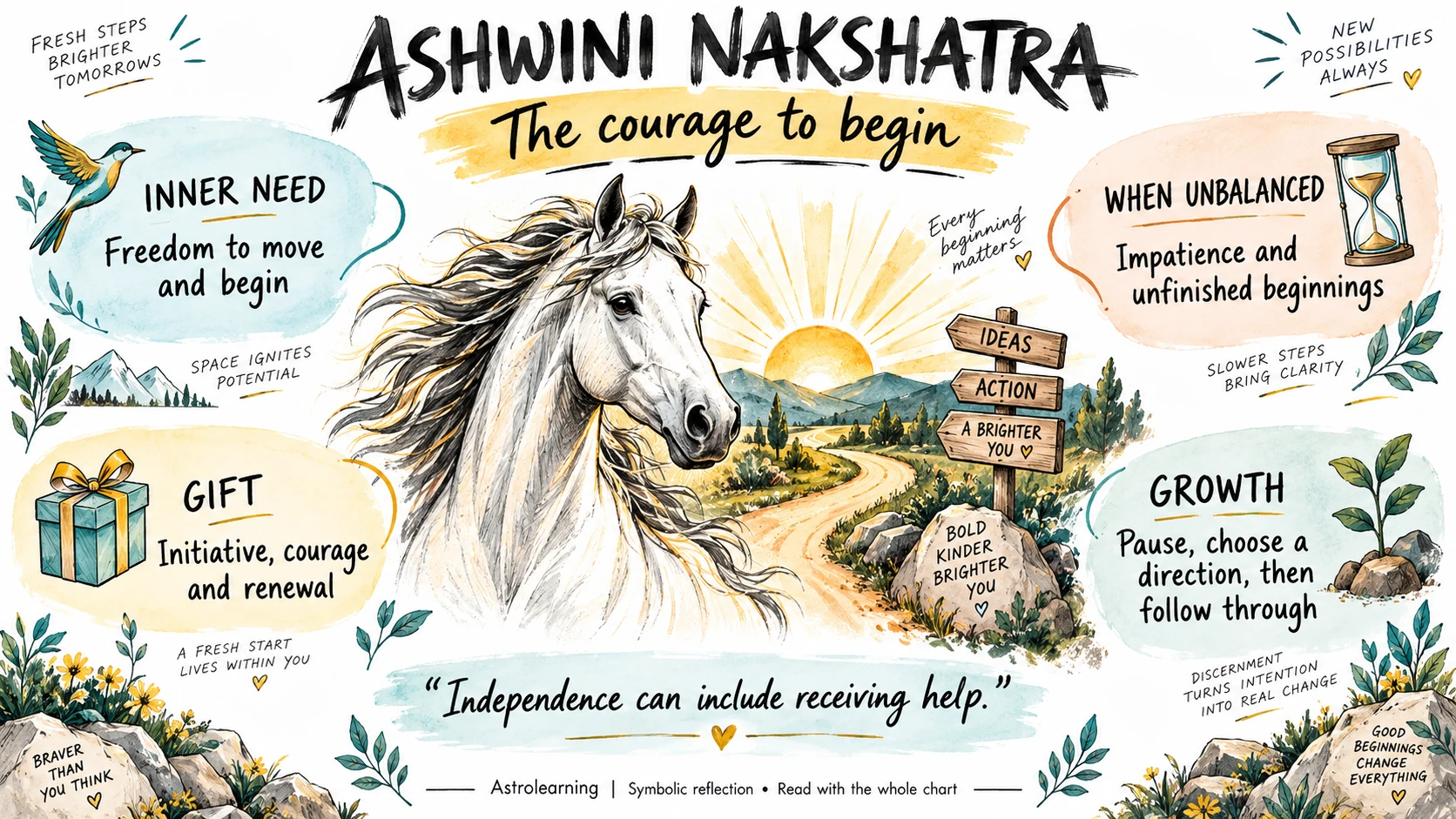
The First Spark — The Soul That Knows How to Begin
Core Details
| Factor | Ashwini |
|---|---|
| Sanskrit | अश्विनी |
| Nakshatra Number | 1 |
| Zodiac Span | 0°00′ – 13°20′ Aries |
| Nakshatra Lord | Ketu |
| Deity | Ashwini Kumaras |
| Symbol | Horse’s Head |
| Shakti | Shidra Vyapani Shakti — Power of Quickly Reaching the Destination |
| Gana | Deva |
| Guna | Sattva |
| Yoni | Horse |
| Elemental Nature | Fire |
| Purushartha | Dharma |
| Main Theme | Beginning, speed, healing, instinct, independence |
| Deity Mantra | Om Ashwinibhyam Namah |
| Higher Expression | Healing, courage, initiative, freedom |
| Lower Expression | Impulsiveness, impatience, restlessness, avoidance |
The Fundamental Nature of Ashwini
Ashwini is the first Nakshatra of the zodiac, and that position itself tells us something profound. It represents the moment consciousness decides to move from potential into experience.
Before Ashwini, there is no beginning.
Ashwini is the first impulse: “Let me go.”
This is why Ashwini rarely wants to spend excessive time waiting for certainty. There is an instinctive quality to it. The person often understands something through experience rather than prolonged analysis. They may make a decision, take the first step and understand the consequences afterward.
There is something youthful about Ashwini even when the person is chronologically mature. It carries curiosity, speed, enthusiasm and the willingness to start again.
The horse is not interested in standing still simply because the road ahead is uncertain.
Ashwini says: “I will understand the road by travelling it.”
This is one of its greatest strengths and one of its greatest weaknesses.
The Horse’s Head — The Symbol of Ashwini
The horse represents speed, instinct, freedom and movement, while the head gives the symbol an additional dimension: direction.
Ashwini therefore isn’t simply about moving quickly. It is about the first impulse toward a destination.
When Ashwini is healthy, this creates tremendous initiative. Such a person can often act when everyone else is still discussing whether action is necessary.
But the lower expression can become impulsiveness. The person may mistake movement for progress. They may start something simply because they are bored with what they are currently doing. They may leave before understanding what they are leaving. They may begin five things because beginning feels exciting, but completion feels restrictive.
The evolutionary lesson is therefore not: “Stop being fast.”
It is: “Learn where your speed is taking you.”
The Ashwini Kumaras — The Divine Physicians
The Ashwini Kumaras are traditionally understood as divine healers or physicians. This gives Ashwini a profound restorative quality.
But healing doesn’t always mean medicine.
At a psychological level, Ashwini represents the ability to restore movement where life has become stuck.
Someone is emotionally frozen. Ashwini says: Move.
Someone has lost confidence. Ashwini says: Try again.
Someone is trapped in the past. Ashwini says: There is another road.
This is why Ashwini can have an almost instinctive desire to rescue, repair or restart things. Its healing energy is immediate rather than contemplative. It doesn’t necessarily sit beside the wound for years. It wants to know: “What can we do now?”
There is a cost to this kind of healing, though. Because Ashwini moves toward the next remedy so quickly, it can underestimate how much time some wounds genuinely require. A friend going through grief may not want a solution on day one — they may simply need someone to sit with them in the difficulty. Learning to heal without immediately fixing is one of Ashwini’s quieter, harder lessons.
Ashwini and the Psychology of Independence
Ashwini usually dislikes feeling helpless. Being dependent on someone else can sometimes feel psychologically uncomfortable because the Nakshatra carries a strong instinct toward self-directed movement.
The person may think: “I should be able to handle this myself.”
This can create tremendous resilience. But it can also create difficulty receiving help.
Consider the Ashwini native who falls ill and still insists on managing every task alone rather than delegating or resting. The body is asking for care; the mind is arguing that stopping is weakness. Underneath the refusal to ask for help sits an old, unspoken belief: “If I stop moving under my own power, I might not start again.” The healing here isn’t forced surrender. It is discovering that leaning on someone else doesn’t erase the self Ashwini worked so hard to build.
The higher Ashwini understands: Independence doesn’t mean doing everything alone. Sometimes allowing another person to help you is also an expression of strength.
Past-Life Karma of Ashwini
From a symbolic Jyotish perspective, Ashwini can carry karmic themes connected with movement, healing, rescue, independence, service and rapid response.
The archetype may resemble someone who previously had to act quickly when circumstances demanded it: a healer, messenger, traveller, protector, rescuer or someone whose role required immediate decisions.
The deeper karmic issue, however, isn’t simply speed. It is the relationship between speed and responsibility.
If the soul has become accustomed to immediately reacting to circumstances, this life may repeatedly create situations where reaction alone isn’t enough.
Ashwini may therefore experience a recurring lesson: “Just because you can act quickly doesn’t mean you should.”
The soul must learn the difference between instinct and impulse.
Childhood Imprint
Ashwini children often need room to explore. Excessive restriction can feel suffocating. They may ask: “Why can’t I?” rather than “Am I allowed to?”
This can produce an adventurous and independent personality. But if repeatedly criticized for being impulsive, they may develop an unusual relationship with authority: they may obey outwardly but internally remain determined to do things their own way.
This early pattern often shows up first in small domestic battles — the child who insists on tying their own shoes even when it takes three times as long, who would rather fail at something attempted alone than succeed at something guided by someone else’s hand. Parents sometimes misread this as defiance, when it is closer to an early, urgent need for authorship.
As adults, this can become entrepreneurship of the mind — the need to feel that their life belongs to them.
Ashwini in Relationships
Ashwini needs movement even inside relationships. It doesn’t necessarily mean physical freedom or non-commitment. It means psychological breathing space.
The person needs to feel: “I can still be myself while being with you.”
A relationship that becomes excessively controlling can trigger withdrawal. Ashwini may also fall in love quickly because it responds strongly to excitement and possibility.
This can create a recognizable pattern: intense early chemistry, rapid emotional investment, and then a quiet withdrawal once the relationship settles into routine. It isn’t that the feeling was false. It is that ordinary, steady closeness can register, mistakenly, as boredom rather than as safety. The mature Ashwini partner learns to recognize this moment for what it is — not the end of love, but the point where love asks for a different kind of energy — and stays through it rather than exiting toward the next spark.
Its deeper relationship lesson is learning that the beginning of love and the maintenance of love are two different skills. Starting is Ashwini. Staying consciously is maturity.
Ashwini and the Fear Beneath the Speed
It is tempting to read Ashwini purely as courage — the fearless first mover, always ready to leap. But underneath much of its forward motion is something quieter: a discomfort with stillness that can look like fear in disguise.
Stillness asks a question that speed never has to answer: “What am I actually feeling right now?” For Ashwini, movement can become an efficient way of never finding out. Starting a new project, ending a conversation, changing the subject, leaving the room — each can quietly function as an escape from whatever is sitting underneath, unexamined.
This doesn’t make Ashwini cowardly. Its courage in the outer world is often real and considerable. But real courage, at the psychological level, eventually has to include the willingness to stay: to sit with an uncomfortable feeling for exactly as long as it takes to understand it, rather than outrunning it toward the next beginning. The Ashwini who learns this doesn’t lose its speed. It simply stops using speed as a hiding place.
Lower Expression of Ashwini
The lower Ashwini becomes impatient, impulsive, restless, easily bored, excessively independent, unfinished, reactive, and constantly searching for the next experience.
The person may repeatedly abandon things at the exact point where patience becomes necessary. They may unconsciously believe: “If it isn’t exciting anymore, it isn’t right for me.”
In practice, this can look like a talented person who has started and abandoned four different careers, each time leaving right around the point where real skill was about to develop. The lower Ashwini rarely experiences this pattern as a problem in the moment — each new start feels completely justified, completely different from the last one. Only in hindsight, seen from a distance, does the repetition become visible.
But sometimes boredom is simply the beginning of mastery.
Higher Expression of Ashwini
The higher Ashwini becomes the healer who brings movement back into life. It can restore hope quickly. It can begin again after failure. It can enter a difficult situation without becoming paralyzed.
It can say: “Yes, this happened. But what can we do now?” That is extraordinary resilience.
The highest Ashwini doesn’t simply move quickly. It becomes precise in its movement. It knows when to act. It knows when to wait. It knows when something needs healing. And it knows when something needs to be left behind.
“The courage to begin is powerful, but the wisdom to begin at the right moment is mastery.”