

The past-life and karmic sections below are Jyotish interpretations, not historically verifiable facts. They are best understood as symbolic karmic archetypes — a way of teaching the psychology of each Nakshatra, not a literal record of a previous life.
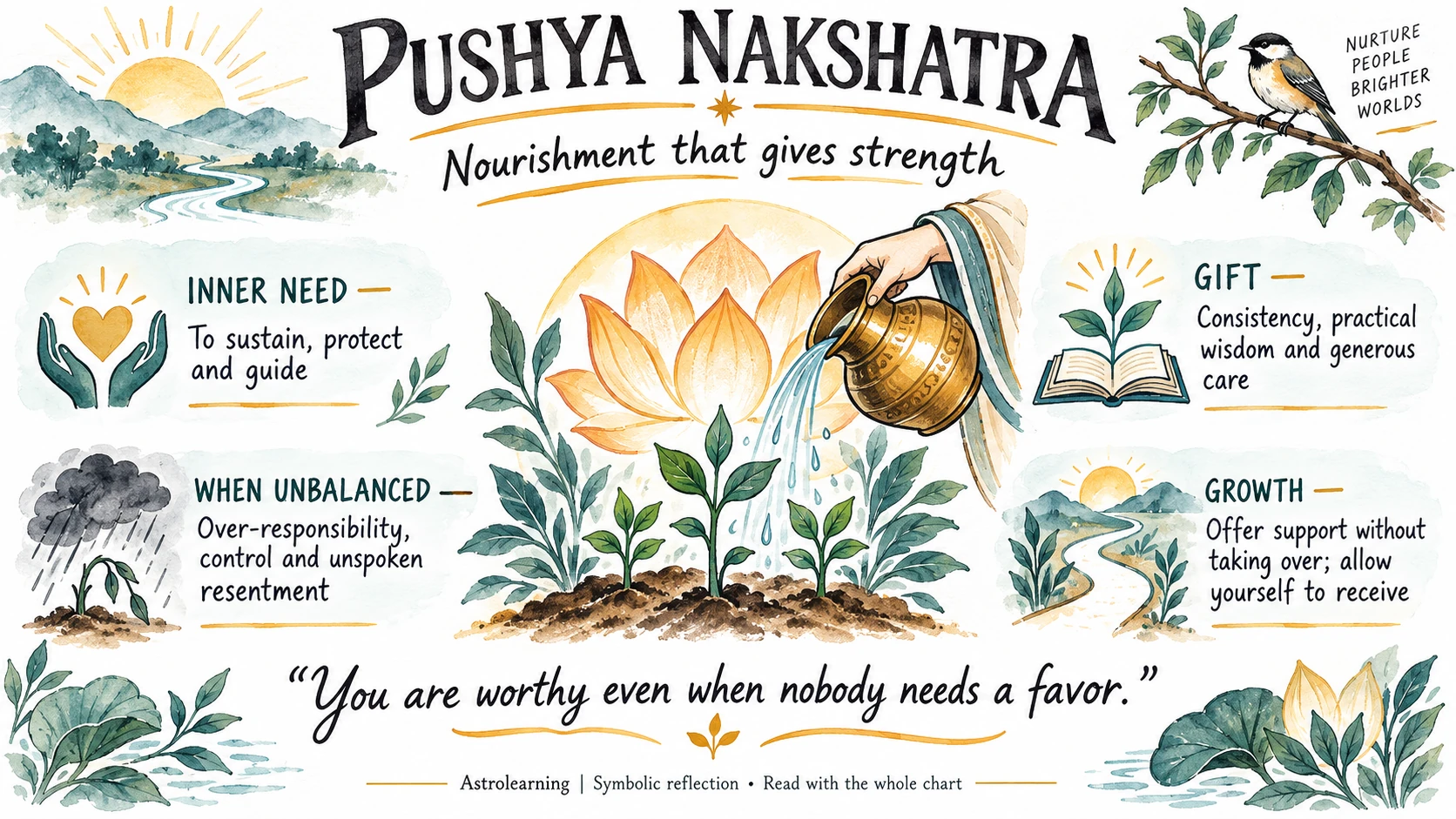
The Nourisher — The Soul That Learns to Sustain
Core Details
| Factor | Pushya |
|---|---|
| Sanskrit | पुष्य |
| Nakshatra Number | 8 |
| Zodiac Span | 3°20′ – 16°40′ Cancer |
| Nakshatra Lord | Saturn |
| Deity | Brihaspati |
| Symbol | Cow’s Udder / Lotus |
| Shakti | Brahmavarchasa Shakti — Power of Spiritual Radiance |
| Gana | Deva |
| Guna | Sattva |
| Main Theme | Nourishment, duty, protection, wisdom |
| Deity Mantra | Om Brihaspataye Namah |
| Higher Expression | Guidance, stability, nourishment, wisdom |
| Lower Expression | Over-responsibility, control, suppression, burden |
The Fundamental Nature of Pushya
Pushya is about something extremely different from Ashwini. Ashwini asks: “Can I begin?” Pushya asks: “Can I sustain what has begun?”
Starting something is exciting. Maintaining it requires discipline. A child needs years of nourishment. A relationship requires repeated care. Knowledge requires practice. Spirituality requires discipline. Pushya understands the quiet work that happens after the excitement has disappeared. Its fundamental message is: “Growth requires nourishment.”
This is not a glamorous placement. Nobody throws a celebration for the ninth month of showing up. There is no ceremony for the version of care that simply continues — the school lunch packed for the four hundredth time, the bill paid on schedule, the promise kept quietly instead of loudly. Pushya’s gift lives exactly there, in the unphotographed middle of things, where most people’s attention has already wandered elsewhere.
Psychologically, this creates a mind oriented toward continuity rather than novelty. Where other placements chase the next beginning, Pushya keeps returning to the same commitment and asking what it needs today. That orientation is a genuine strength. But it can also become a trap — a person can mistake their capacity to sustain something for an obligation to sustain everything, and slowly lose track of which commitments were actually theirs to carry.
The Cow’s Udder
The cow’s udder is one of Pushya’s traditional symbols. It represents nourishment. Not dramatic nourishment. Continuous nourishment. Something that keeps giving.
This makes Pushya naturally protective. The person may feel responsible for other people’s wellbeing. They may become the one everyone calls when something goes wrong. This can create deep fulfillment. But it can also create a dangerous identity: “I am valuable because everyone needs me.” That must be healed.
Consider what the udder actually does: it does not create milk in a single dramatic burst and then rest. It replenishes, cycle after cycle, responding to need rather than performing for an audience. That is the emotional texture of Pushya — a steady, almost invisible replenishment that only becomes visible in its absence, the way a family only notices the person who quietly kept things running once that person stops.
The danger is subtle because it wears the shape of virtue. A Pushya-influenced person rarely announces, “I need to be needed.” It shows up instead as an inability to say no, a reflex to solve other people’s problems before being asked, a quiet resentment that builds when the caretaking goes unnoticed. The healing is not to stop giving — giving is the nature — but to give from fullness rather than from the fear of being irrelevant if the giving ever stopped.
Brihaspati — The Teacher
Brihaspati is the guru of the Devas. Therefore Pushya carries the archetype of guidance through wisdom. But Pushya’s wisdom isn’t necessarily flashy. It is practical. It says: “This is what you need to do consistently.” That is why Pushya can have an old-soul quality. It understands responsibility.
This is why Pushya so often becomes the reference point in a family or a friend group — the one people call before making a decision, not because Pushya demands the role, but because its counsel tends to be sound. Brihaspati’s wisdom is not clever; it is reliable. It does not need to win an argument. It needs the outcome to actually work.
But a teacher who is only ever teaching never gets taught. The shadow side of carrying Brihaspati’s archetype is a quiet loneliness — being surrounded by people who come for guidance but rarely think to offer any in return, simply because Pushya has trained everyone, including itself, to see it as the source. Part of its growth is allowing itself to be a student again, to ask for help without first proving it has earned the right to need it.
Past-Life Karma
Symbolically, Pushya can represent karmic themes around teaching, guardianship, family responsibility, spiritual duty and supporting others. The soul may be accustomed to being the provider or protector. Therefore life may repeatedly put people in its path who require support.
The karmic lesson becomes: “Can you nourish others without making yourself responsible for their entire life?”
Sometimes this shows up as an old, wordless fluency with responsibility — a sense, present since early childhood, of already knowing how to run a household or hold a family together, as though the skill were inherited rather than learned. The unfinished business is rarely about the giving itself. It is about learning that worth does not have to be earned through indispensability.
Childhood Imprint
Pushya children can become responsible very early. They may naturally care for siblings or become emotionally dependable. Sometimes they don’t feel permitted to be weak. They learn: “Someone has to handle this.” And they become that person. The problem comes later when nobody remembers to ask: “Who is taking care of the caretaker?”
A common pattern: the Pushya child is praised specifically for being “no trouble.” Not for their curiosity, not for their opinions — for their convenience. A parent overwhelmed by circumstance leans on the one child who does not add to the load, and that child learns, correctly, that being needed is safer than being seen. Decades later, that same person may still find it easier to ask “What do you need from me?” than “What do I need right now?”
Healing this imprint does not require abandoning the caretaking instinct. It requires separating it from survival. The adult task is to discover that people can still love Pushya on a day it has nothing to give — and that testing this, even once, is not selfish. It is overdue.
Relationships
Pushya expresses love through responsibility. It may not say: “I love you.” It may say: “Did you eat?” “Did you reach safely?” “Take this with you.” This is nourishment as love. But it can become controlling when care turns into management. The higher Pushya understands: Support does not mean control.
Consider two partners after a hard week. One says, “I’m exhausted, can we just order food and not talk about anything heavy tonight?” Pushya, even bone-tired, may find itself cooking anyway, checking in anyway, managing the mood of the room anyway — not because it was asked to, but because stillness while someone else is struggling feels almost unbearable. The tell is this: Pushya often finds it easier to take care of a partner’s pain than to sit beside it and simply witness it.
This deepens further in long partnerships, where consistency can quietly curdle into control if left unexamined. A partner does not always want to be provided for; sometimes they want to be asked. The mature Pushya learns the difference between “Let me handle this for you” and “How would you like to handle this?” — a small shift that changes the relationship’s architecture from management to partnership.
The Discipline of Receiving
If there is a single skill that determines whether Pushya thrives or slowly burns out, it is this: learning to receive without immediately converting the gift into a debt to be repaid. Offer a Pushya-ruled person help, a compliment, or rest, and watch closely — there is often a visible flicker of discomfort before acceptance, a half-formed instinct to deflect, minimize, or immediately reciprocate so the balance sheet doesn’t stay open for long.
This is not humility. It is often fear wearing humility’s clothes — the fear that if Pushya is not useful in this exact moment, its place in the room becomes uncertain. Receiving well requires trusting that connection does not evaporate the moment usefulness pauses. Practically, this can be as small as letting a friend cook, taking a sick day without pre-clearing every task, or letting silence sit instead of filling it with solutions — each one a small act of self-trust, proof that its worth was never actually contingent on what it provided.
Lower Expression
The lower Pushya can become overly responsible. It may interfere in other people’s lives because it genuinely believes it knows what is best. It may suppress its own needs and then become resentful when nobody recognizes its sacrifice.
Left unchecked, this can calcify into a quiet martyrdom — a running, unspoken ledger of everything given and never acknowledged. The lower Pushya may not ask directly for appreciation, but its absence is felt everywhere: in the sigh before a favor, in the sense that its love always arrives with fine print attached. Ironically, this makes the people it cares for pull away, which only confirms Pushya’s deepest fear — that without the giving, it would be left alone.
Higher Expression
The higher Pushya nourishes without possessing. It guides without controlling. It supports without creating dependence. It becomes the person whose presence makes others stronger.
This is Pushya at its most quietly powerful — not the loudest person in the room, but the one whose steadiness makes the room possible in the first place. It learns to ask for what it needs before resentment forces the question out sideways, and it celebrates a loved one’s independence rather than experiencing it as rejection. It discovers, eventually, that the deepest nourishment it can offer anyone is proof that love, given freely enough, teaches people how to stand on their own.
“True nourishment does not make another person dependent upon you; it gives them the strength to stand without you.”