

The past-life and karmic sections below are Jyotish interpretations, not historically verifiable facts. They are best understood as symbolic karmic archetypes — a way of teaching the psychology of each Nakshatra, not a literal record of a previous life.
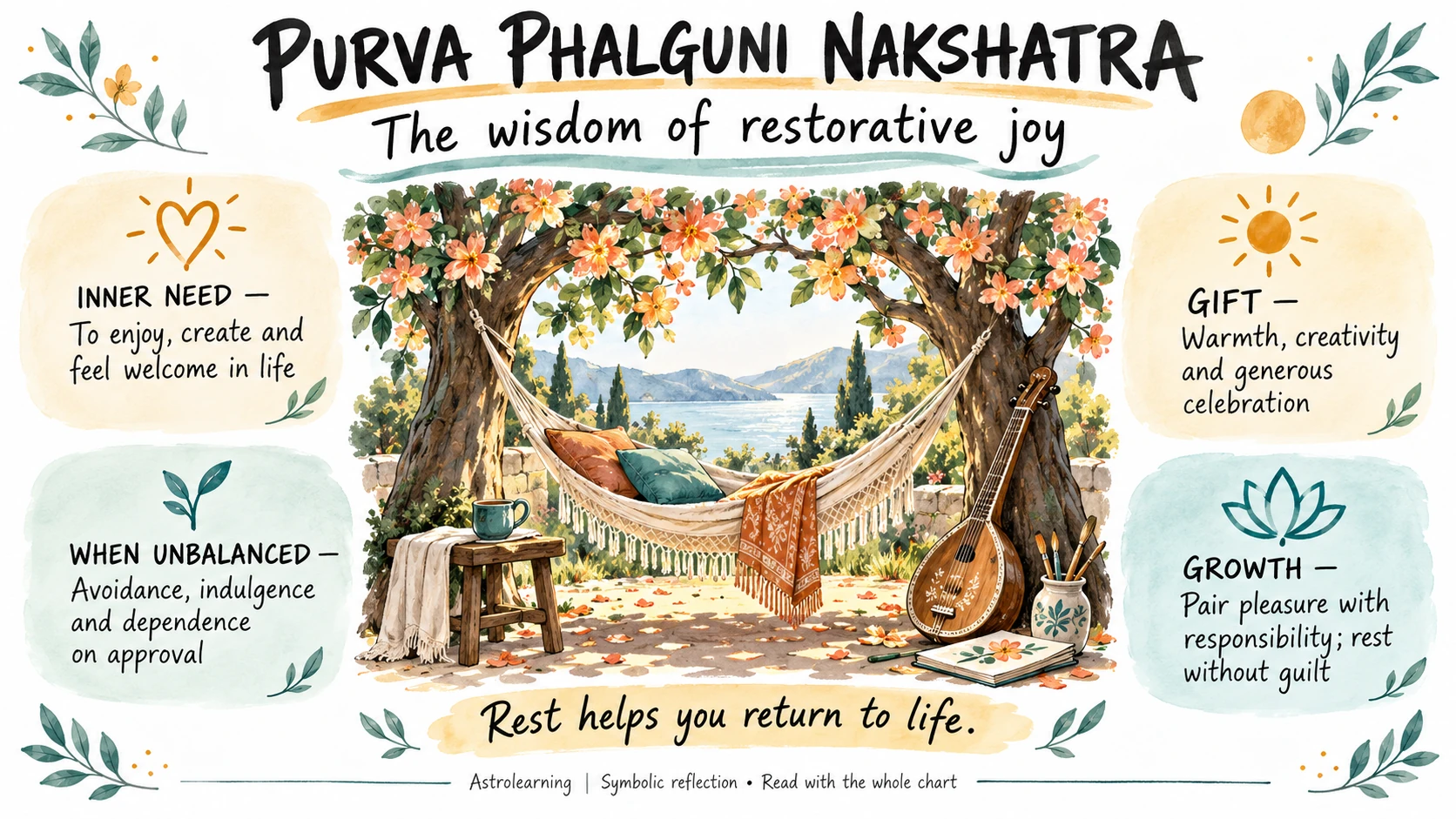
The Hammock — The Soul That Knows How to Rest
Core Details
| Factor | Purva Phalguni |
|---|---|
| Sanskrit | पूर्वाफाल्गुनी |
| Nakshatra Number | 11 |
| Zodiac Span | 13°20′ – 26°40′ Leo |
| Nakshatra Lord | Venus |
| Deity | Bhaga (god of fortune, enjoyment, and marital bliss) |
| Symbol | Front legs of a bed / a hammock or swing |
| Shakti | Prajanana Shakti — the Power of Procreation and Pleasure |
| Gana | Manushya |
| Guna | Rajas |
| Main Theme | Pleasure, rest, creativity, romance, restorative enjoyment |
| Deity Mantra | Om Bhagaya Namah |
| Higher Expression | Genuine joy, generosity, creative charm, the wisdom of rest |
| Lower Expression | Laziness, self-indulgence, vanity, avoidance of responsibility through pleasure-seeking |
The Fundamental Nature of Purva Phalguni
Magha carries the weight of ancestry. It kneels before the throne, aware that it inherited something it did not build, and it must prove worthy of the lineage behind it. That is a heavy kind of dignity.
Purva Phalguni comes next, and it asks a completely different question.
Not “What do I owe?” but “What actually feels good?”
This is not shallow. It is one of the bravest questions in the entire zodiac wheel, because so much of human conditioning teaches us to distrust pleasure, to treat rest as something earned only after exhaustion, to feel guilty the moment enjoyment arrives without a reason attached to it.
Purva Phalguni refuses that guilt.
It represents the part of consciousness that already knows life must include romance, laughter, comfort, art, and unstructured joy — not as a reward for good behavior, but as a basic ingredient of being alive.
The person may be warm, easygoing, socially magnetic, and genuinely allergic to unnecessary suffering. Where Magha insists on duty, Purva Phalguni insists on delight.
The Hammock — The Symbol of Rest as Sacred
The front legs of a bed. A hammock strung between two trees. A swing that goes nowhere and doesn’t need to.
This symbol is easy to misread as laziness. It is not.
A hammock exists for one purpose: to let the body stop performing and simply be held. That is a form of wisdom most of the zodiac never learns. The body has intelligence. It knows when it has given enough. It knows the difference between a moment to push through and a moment to lie down.
Purva Phalguni trusts that intelligence.
When this is healthy, the person becomes remarkably good at restoring themselves — and by extension, restoring the people around them. They know how to turn an ordinary evening into something soft and enjoyable. They know how to make a room feel comfortable. They understand, instinctively, that rest is not the opposite of productivity. It is what makes productivity sustainable.
But the lower expression can mistake the hammock for a permanent address.
Rest becomes avoidance. Comfort becomes the only acceptable state. The person may say: “I’ll deal with it later, when I feel like it.” And later keeps arriving, and the feeling never quite comes.
Bhaga — The Right to Enjoy
Bhaga is the deity of fortune, enjoyment, and marital happiness. But the deeper gift Bhaga offers Purva Phalguni is something more specific: permission.
Permission to enjoy what you have. Permission to want pleasure without apologizing for wanting it. Permission to believe that good fortune, once it arrives, is meant to be savored rather than hoarded, hidden, or immediately converted into more striving.
This is a genuinely important psychological gift. Many people accumulate comfort and never let themselves feel it — they are too busy bracing for the next demand. Purva Phalguni, at its best, breaks that pattern. It says: “This is good. Let it be good. Don’t rush past it.”
The distortion appears when enjoyment becomes entitlement — when the person believes fortune is owed to them regardless of what they contribute, or when pleasure is pursued as a substitute for genuine fortune rather than a celebration of it.
The Tension Between Rest and Avoidance
This is Purva Phalguni’s central psychological knot, and it deserves honesty rather than flattery.
Restorative pleasure and avoidance dressed up as relaxation can look identical from the outside. Both involve stepping back. Both involve softness. Both can involve the same hammock, the same wine, the same unhurried afternoon.
The difference is what happens afterward.
Genuine rest refills the person. They return to their responsibilities with more capacity than before. Avoidance depletes them further, because underneath the pleasure, something is quietly being postponed — a conversation, a decision, a piece of unfinished growth — and postponement has its own gravity. It accumulates.
The higher Purva Phalguni learns to ask itself, honestly: “Am I resting, or am I hiding?” That single question, asked often enough, becomes the whole path.
Past-Life Karma
From a symbolic Jyotish perspective, and not as a literal or historically verifiable claim, Purva Phalguni can carry karmic themes connected with deprivation or excess around pleasure and comfort.
One archetypal pattern resembles a soul that lived under severe austerity — a life of duty without softness, where enjoyment was treated as indulgent or even sinful, and comfort had to be earned through relentless sacrifice. This life responds with an almost gravitational pull toward ease, art, romance, and rest, as if the psyche is finally exhaling.
Another archetypal pattern resembles the opposite: a soul that had comfort in abundance and never learned its cost — pleasure without responsibility, fortune without gratitude. This life may repeatedly test whether enjoyment can coexist with contribution.
The deeper karmic question for Purva Phalguni is rarely “Do I deserve to enjoy life?” The soul usually does. The real question is: “Can I enjoy life and still show up for it?” Earning and deserving are not opposites here — they need to be learned as partners.
Childhood Imprint
Purva Phalguni children are often drawn to play, color, softness, and imaginative self-expression before anything else. They may build elaborate pretend worlds, love music and beauty, and instinctively understand how to make a space feel warm and inviting, even as small children.
If this instinct is welcomed, it grows into genuine creative confidence — the sense that joy is not frivolous, that beauty matters, that a life well-lived includes delight as a legitimate ingredient, not an afterthought.
But if joy was treated as frivolous in the household — if play was constantly interrupted for chores, if creative pursuits were dismissed as impractical, if the child learned that comfort had to be justified — something quieter can develop underneath the warmth. A private belief that pleasure must be hidden, or rationed, or earned through performance. As adults, these individuals may struggle to relax without guilt, even when nothing is demanding their attention. They may need to consciously relearn what came naturally to them at five years old.
Relationships
Purva Phalguni brings genuine romantic warmth into relationships. It is affectionate, generous, and often skilled at the small rituals that make love feel alive — thoughtful gestures, shared pleasures, a gift for making ordinary time together feel special.
Its deeper relationship lesson lies in the difference between generosity and validation-seeking. The healthy Purva Phalguni gives warmth because giving warmth feels good, without needing constant reassurance that the warmth was noticed. The unhealthy version can turn affection into a quiet transaction — charm offered in exchange for admiration, romance used to avoid the less pleasurable, more demanding parts of intimacy.
Every relationship eventually requires conflict, patience, and unglamorous repair. Purva Phalguni can be tempted to smooth over these moments with charm rather than actually resolve them — to keep things pleasant on the surface while something real goes unaddressed underneath. The mature Purva Phalguni learns that true intimacy sometimes feels worse before it feels better, and that avoiding all discomfort is its own kind of abandonment.
Lower Expression
The lower Purva Phalguni becomes lazy, self-indulgent, vain, and quietly allergic to responsibility whenever responsibility interferes with comfort. It may use charm as a shortcut — disarming criticism, softening consequences, and slipping past accountability through sheer likability rather than genuine correction.
The person may believe: “If I make this pleasant enough, no one will notice what I’m avoiding.” For a while, this works. Eventually, the unaddressed things — the postponed decisions, the undeveloped skills, the relationships coasting on charm instead of substance — catch up.
Vanity can become a related trap: an excessive investment in being admired, in looking effortless, in appearing to have a beautiful life rather than actually building one.
Higher Expression
The higher Purva Phalguni becomes a genuine source of renewal for everyone around it. It knows how to create joy without needing anything back — a rare and underrated gift. It can host, celebrate, comfort, and delight others simply because doing so feels natural, not because it is angling for approval.
It has also learned the hardest part: how to rest without guilt, and how to work without resentment. The two are no longer at war. Pleasure has become sustainable rather than escapist, because it is now paired with genuine responsibility rather than used to avoid it.
This is the mature hammock — strong enough to hold real weight, woven from both softness and substance.
“Rest is not what you take after life is finished with you; it is what makes you capable of meeting life at all.”