

The past-life and karmic sections below are Jyotish interpretations, not historically verifiable facts. They are best understood as symbolic karmic archetypes — a way of teaching the psychology of each Nakshatra, not a literal record of a previous life.
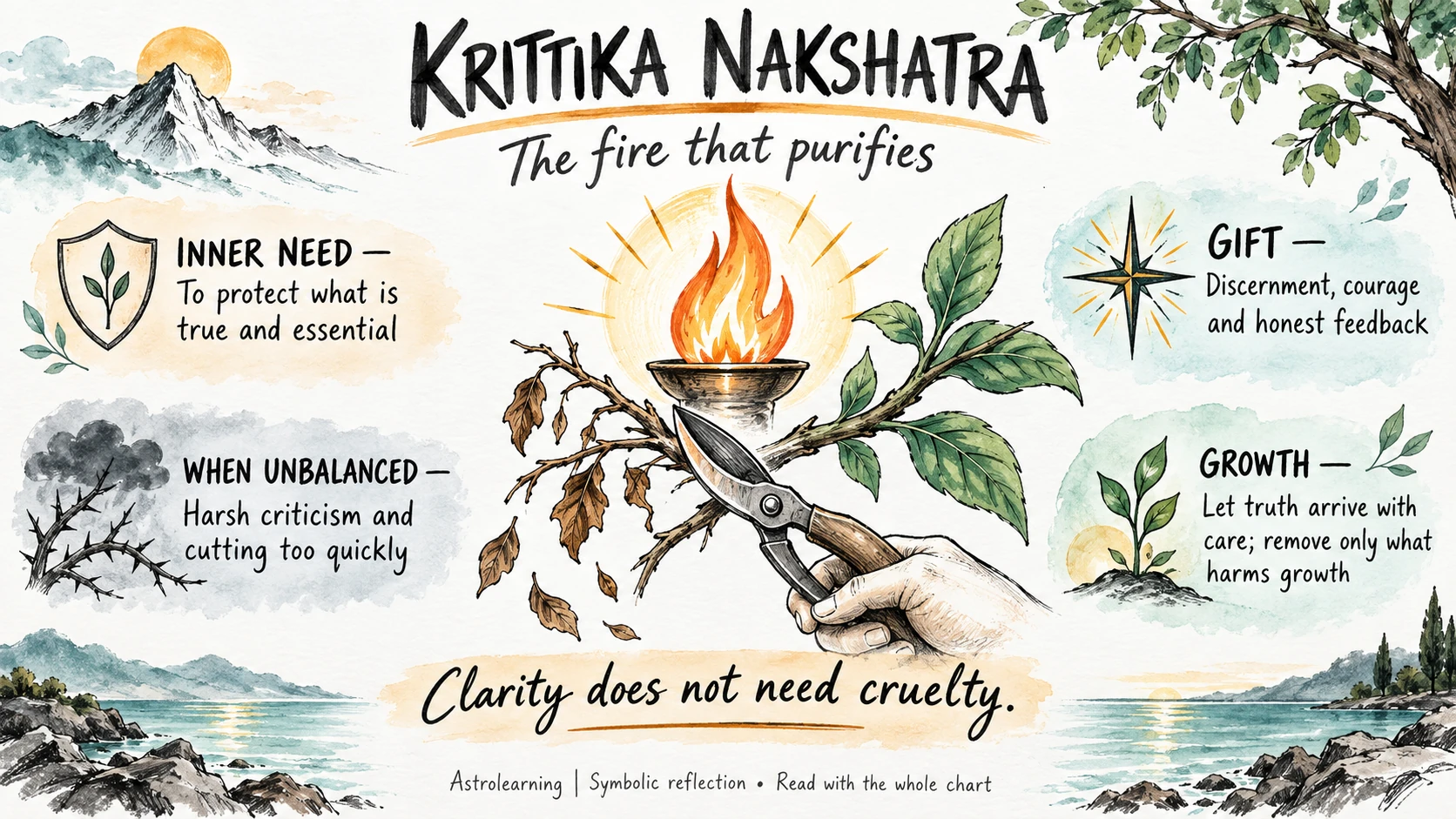
The Sacred Blade — The Fire That Purifies
Core Details
| Factor | Krittika |
|---|---|
| Sanskrit | कृत्तिका |
| Nakshatra Number | 3 |
| Zodiac Span | 26°40′ Aries – 10°00′ Taurus |
| Nakshatra Lord | Sun |
| Deity | Agni |
| Symbol | Knife / Razor / Blade |
| Shakti | Dahana Shakti — Power to Burn/Purify |
| Gana | Rakshasa |
| Guna | Rajas |
| Main Theme | Purification, separation, truth, courage |
| Deity Mantra | Om Agnaye Namah |
| Higher Expression | Discernment, purification, protection |
| Lower Expression | Criticism, harshness, judgment, destruction |
The Fundamental Nature of Krittika
Krittika is the point where the energy of the first two Nakshatras becomes refined through fire. Ashwini begins. Bharani carries. Krittika asks: “What should remain?” Its blade separates the essential from the unnecessary. Its fire burns away what has become impure.
This third movement differs from what came before it. Ashwini is pure impulse. Bharani is pure endurance. Krittika introduces what neither of the first two had to face: evaluation. Once a thing exists, a question becomes unavoidable — was it worth carrying, and what of it should continue?
A person with strong Krittika often lives this sequence internally, in miniature — something begins, is carried through difficulty, and then an inner blade quietly asks whether it should continue in its current form.
This is why Krittika is not fundamentally a Nakshatra of destruction. It is a Nakshatra of purification through separation. The blade itself is neutral. A surgeon uses it to heal. A farmer uses it to harvest. A warrior uses it to protect. A person can also use it to hurt. The consciousness behind the blade determines its expression.
The Blade — The Symbol of Krittika
Krittika’s symbol is unambiguous: a knife, a razor, a blade. Unlike many Nakshatra symbols, which carry a soft, layered mythology, this one is direct — it exists to separate, creating a line where none existed a moment before.
This gives Krittika a natural relationship with edges. Most people tolerate ambiguity — a friendship gone quietly stale, a commitment that no longer fits but hasn’t been named as outgrown. Krittika finds this unresolved middle uncomfortable, and keeps asking where the line actually is.
The blade is also small and precise, unlike a sword or an axe — built not for brute force but for the exact cut. Krittika at its best is not indiscriminate; its ideal is to take away the smallest amount necessary to restore what is essential.
Agni — The Deity of Krittika
Agni is one of the oldest deities in the Vedic tradition — the fire that carries offerings from the human world to the divine one. Fire, in this understanding, is not simply destructive. It is a translator: it changes one substance into another so it can move to a different plane entirely.
Krittika inherits this translating quality. It is rarely satisfied with feeling left raw and unprocessed — ambition, grief, disappointment, love all tend to get run through an inner fire, refined into something more concentrated and usable. This is uncomfortable while it happens. It is also why Krittika often emerges from difficulty with unusual clarity.
Fire consumes, but it also transforms. Raw food becomes cooked. Wood becomes ash. Metal can be purified. Therefore Krittika’s deeper message is: “Something must sometimes be destroyed in its old form before it can become something better.”
This can create people who experience powerful periods of internal purification. Old identities stop working. Old relationships become impossible to maintain. Old beliefs are burned away. The person may initially experience this as loss. Eventually, they understand: “I was not losing myself. I was losing what was no longer me.”
The Tension Between Discernment and Judgment
This is Krittika’s central psychological tension, and it can look identical from the outside in either form. Discernment says: “This isn’t working, and I can see why.” Judgment says: “This isn’t working, and someone is to blame.” The blade moves either way. What differs is what it is aimed at.
Krittika naturally asks: What is real? What is unnecessary? What is harmful? What should stay? This gives it extraordinary discernment. But its greatest psychological danger is assuming that everything it sees as imperfect must be removed.
Consider a Krittika manager reviewing a colleague’s work. The discerning version names precisely what isn’t functioning and helps rebuild it. The judgment-driven version notices the same flaw but experiences it as evidence of inadequacy — and the feedback, even when accurate, lands as an attack. The information can be identical. The intention behind it is not.
The mature Krittika learns that imperfection is not necessarily contamination. Sometimes something can be imperfect and still valuable. That is where the blade becomes a surgical instrument instead of a weapon. Learning to tell the two apart takes most of a lifetime — it requires a pause between noticing a flaw and reacting to it, long enough to ask whether it truly needs removing, or simply needs tolerating a while longer.
Past-Life Karma
Symbolically, Krittika can carry karmic themes around authority, judgment, protection, discipline, separation and the use of power. The deeper karmic question is: “How did you use your power to decide what should remain and what should be removed?”
The archetype often resembles someone who once held real consequence in their hands — a judge, a healer entrusted with a difficult diagnosis, a leader deciding who received scarce resources. Positions where a single decision determined what continued, and where hesitation could cost as much as cruelty.
The soul may have experienced situations where difficult decisions had to be made. The lesson in this life is not simply to become powerful. It is to become responsible with power. This life often asks Krittika to revisit that same decision internally — noticing where it is cutting from old habit rather than present necessity.
Childhood Imprint
This often begins with a good instinct. Krittika children notice details other children miss — the wobble in a drawing, the note slightly flat. In a supportive environment, this becomes the seed of real craft. In a harsher one, the same noticing turns inward and becomes a verdict.
Krittika can develop an internal critic early in life. The child may feel that there is a standard they need to reach. This can produce tremendous discipline. But if the environment is excessively critical, the person may internalize the criticism. They may grow into an adult who constantly sees what is wrong with themselves.
As an adult, this can show up as a sense that nothing is quite finished — a project that always needs one more revision, an effort never disciplined enough. The inner critic that once helped a child improve can, unaddressed, become an adult who cannot rest inside what has already been accomplished.
This creates an important healing principle: Improvement should not require self-hatred.
Relationships
Krittika can love protectively. It may express affection by correcting, advising or protecting. But there is a danger in turning love into constant correction. The person eventually needs to learn: “You can love someone without becoming responsible for fixing them.”
This tends to show up early as genuine, careful attentiveness — noticing when something is off before it is spoken aloud, a change in tone, a habit quietly becoming a problem. Named gently, at the right moment, this feels like being deeply seen.
Named too often, it starts to feel like surveillance. A partner may begin editing themselves before speaking, anticipating the correction before it arrives. Over time, this can produce a relationship where one person is constantly being improved and the other is constantly improving them — a very different thing from two people simply being together.
The healthier Krittika asks a quieter question before offering the blade: “Did this person ask to be fixed, or do I just find it hard to watch something imperfect stand uncorrected?” Often the most protective thing it can do is say nothing, and let a partner find their own way through what was never actually dangerous — only imperfect.
Lower Expression
The lower Krittika becomes the uncontrolled blade. It criticizes. It judges. It cuts. It becomes impatient with weakness. It may use truth as a weapon. The person can become very good at identifying what is wrong but poor at understanding why it exists.
This version mistakes cutting for clarity. It can dismantle a person’s confidence in a single sentence and feel, in the moment, as though it has simply told the truth. It rarely pauses to ask whether that truth needed to be spoken then, or whether silence would have served better.
Turned inward, this same pattern becomes self-punishment dressed as high standards. The lower Krittika can spend enormous energy correcting itself for ordinary human imperfection, treating each mistake as a contamination requiring removal rather than a step in learning something difficult.
Higher Expression
The higher Krittika still sees flaws. But it responds differently. It cuts patterns rather than people. It removes toxicity rather than relationships. It uses truth to liberate rather than humiliate. It becomes the purifier.
This version has learned to wait. It still notices the flaw, the inconsistency, the thing that isn’t working — but no longer treats noticing as an instruction to act immediately. It asks first whether removal serves the whole, or whether the flaw is simply evidence that something is still becoming.
At its best, higher Krittika becomes the person others actually want honest feedback from — not because it is softened, but because it arrives without cruelty. The blade is still sharp. It is simply no longer angry.
“The purpose of the blade is not to destroy everything; it is to remove what prevents the essential from remaining.”