

The past-life and karmic sections below are Jyotish interpretations, not historically verifiable facts. They are best understood as symbolic karmic archetypes — a way of teaching the psychology of each Nakshatra, not a literal record of a previous life.
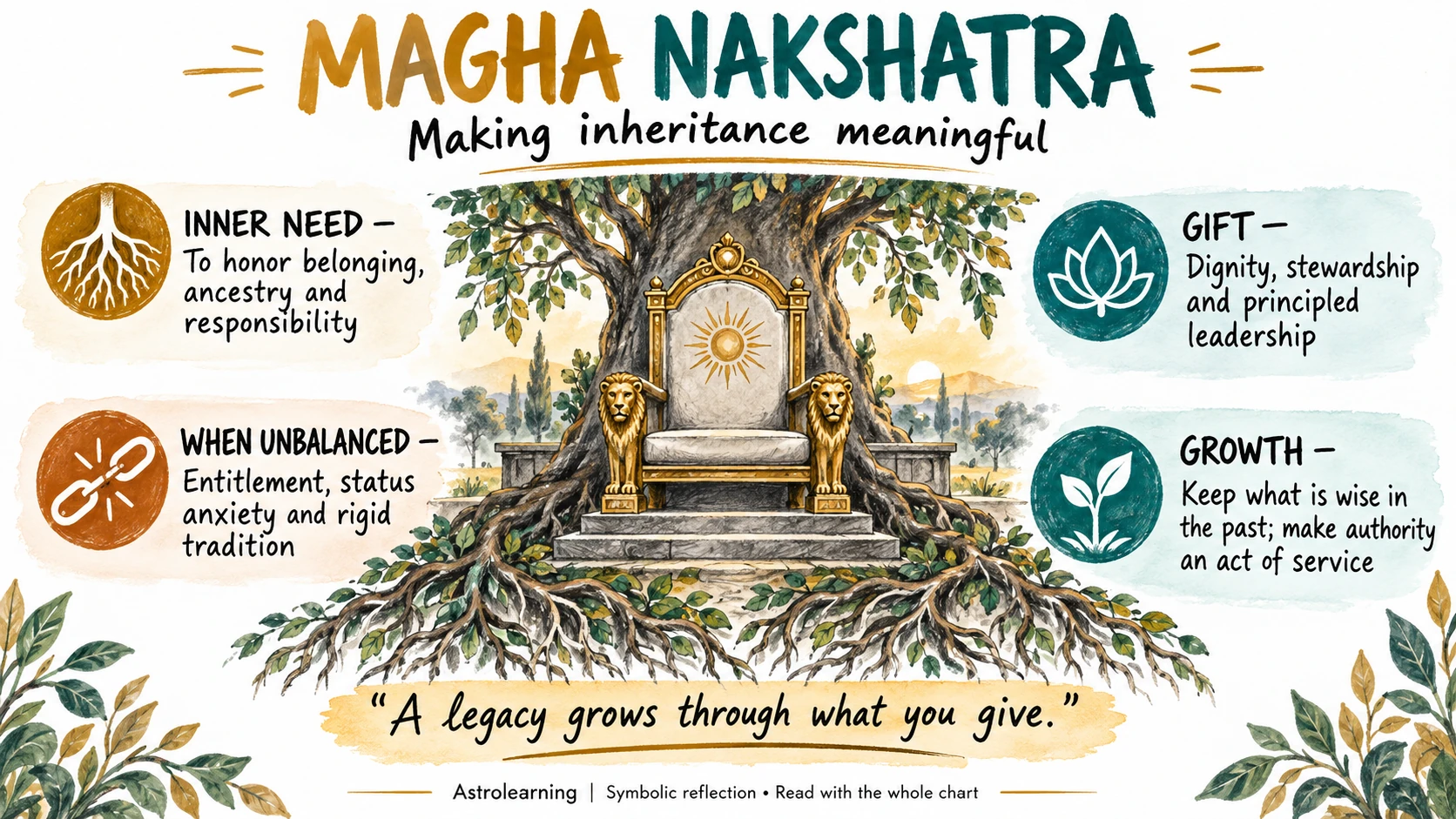
The Throne — The Soul That Carries What Came Before
Core Details
| Factor | Magha |
|---|---|
| Sanskrit | मघा |
| Nakshatra Number | 10 |
| Zodiac Span | 0°00′ – 13°20′ Leo |
| Nakshatra Lord | Ketu |
| Deity | Pitrs (the Ancestors) |
| Symbol | Royal Throne / Palanquin |
| Shakti | Tarpana Shakti — the Power to Bestow Honor and Legacy |
| Gana | Rakshasa |
| Guna | Tamas |
| Main Theme | Ancestry, authority, tradition, legacy, inherited power |
| Deity Mantra | Om Pitrubhyo Namah |
| Higher Expression | Dignified leadership, honoring one’s lineage, service rooted in tradition |
| Lower Expression | Arrogance, entitlement, obsession with status, rigid attachment to the past |
The Fundamental Nature of Magha
Ashlesha ends with the serpent that sees beneath the surface — the psychology of hidden motive, hidden wound, hidden self. Magha begins somewhere else entirely. It doesn’t ask “what is hidden?” It asks: “What have I inherited, and what do I owe it?”
The soul steps out of the underground and onto a throne.
This is the first Nakshatra of Leo, and Leo is the sign of the self that wants to be seen. But Magha isn’t simply about being seen as an individual. It is about being seen as part of a line — a family, a tradition, a lineage of names that came before it.
Magha instinctively feels connected to something larger than itself. There is often an innate sense of deserving respect, whether or not that respect has yet been earned in this particular lifetime. This isn’t always arrogance in its raw form. It is closer to a felt memory: “I have sat somewhere important before.”
The question Magha spends a lifetime answering is whether that memory becomes wisdom or vanity.
The Throne — The Symbol of Magha
A throne is not a chair. A chair is furniture. A throne is a claim.
The palanquin carries this same idea in motion — a royal figure lifted and carried by others, honored without having to walk the ordinary road. This is the core paradox of Magha: it is a Nakshatra of position, but position can be either earned or simply occupied.
When Magha is immature, it wants the throne without the years that usually justify one. It wants the deference, the title, the seat at the head of the table — and it can feel genuinely wounded when the world doesn’t automatically grant these things.
When Magha matures, it understands something different: a throne inherited is not the same as a throne held with dignity. Anyone can be seated. Not everyone can carry the weight of what the seat represents.
The evolutionary lesson is not: “Give up your sense of importance.”
It is: “Become someone worthy of the seat you already feel entitled to.”
The Pitrs — The Ancestors
The ruling deities of Magha are the Pitrs — the ancestors, the forefathers, the ones who have already crossed over and now watch from behind the visible generation. This gives Magha a psychological relationship with the past that few other Nakshatras carry so directly.
Magha often feels the presence of family history even when no one has explained it. A grandfather’s reputation. A mother’s unspoken sacrifice. A name that must not be dishonored. These things sit inside Magha almost like instructions written before birth.
This can be a profound gift. Magha can access strength that isn’t only its own — the accumulated dignity of everyone who came before it. Tarpana, the offering made to ancestors, literally means to satisfy or gratify — and Magha’s Shakti is the power to bestow honor precisely because it first knows how to receive honor from those who came before.
But there is a shadow side. Carrying a lineage is not the same as being trapped by one. Some Magha natives spend decades fighting battles that were never theirs, defending a family name more fiercely than they defend their own happiness, or repeating a pattern simply because “this is how it has always been done.”
The mature Magha learns to ask: “Am I honoring my ancestors, or am I simply afraid to become someone they wouldn’t recognize?”
The Psychological Tension of Magha
At the center of Magha sits a very human tension: the desire to be regarded as important, and the slower, harder maturity of realizing that true authority is earned through service, not claimed by birthright.
The unripe Magha performs importance. It needs the recognition, the title, the visible proof that it matters — and it can feel a quiet panic when these things are absent, as though its very identity depends on being acknowledged.
The ripening Magha discovers something quieter and far more powerful: that people who have genuinely earned their position rarely need to announce it. Real dignity doesn’t require an audience.
This is Rakshasa Gana beneath Tamas Guna doing its particular work — a fierce, sometimes forceful will, weighted by inertia, that must be slowly refined into something noble rather than merely dominant. Magha’s entire arc is the transformation of “I deserve this” into “I have made myself worthy of this.”
Past-Life Karma
From a symbolic Jyotish perspective, Magha may carry karmic themes connected with authority, ancestry, leadership and unfinished business with lineage or legacy. As with every Nakshatra, this is a teaching archetype, not a literal biography — a way of understanding present psychology, not a verifiable record of a former life.
The archetype often resembles someone who once held a position of considerable standing: a ruler, an elder, the head of a household or clan, someone whose word carried weight and whose name meant something. That memory does not disappear. It becomes an instinct.
The deeper karmic question isn’t simply “did you have power?” It is: “What did you do with the responsibility that came with it?” Did you lead with dignity, or did you rule through fear? Did you honor those beneath you, or did you use your position to be served rather than to serve?
Magha’s soul often returns with unfinished lessons about legacy — what it means to build something worth inheriting, and what it means to release a title once its purpose has been fulfilled.
Childhood Imprint
Magha children frequently carry an unusual relationship with family history. They may listen intently to stories about grandparents and ancestors, drawn to old photographs, old names, old houses. There is often a sense of “belonging to something important” long before the child can explain why.
If the family itself holds status, tradition or respected standing, the child may absorb this identity early and comfortably. If the family does not, the child may still feel — almost stubbornly — that it is meant for something significant, and may work to build the standing that wasn’t simply handed to it.
Elders matter enormously to Magha. A grandparent’s approval, or a grandparent’s disappointment, can shape this child more than almost any other influence. As adults, this often becomes a lifelong instinct to seek out mentors, elders and traditions worth belonging to — and eventually, a desire to become that respected elder for someone else.
Relationships
Magha brings deep loyalty to relationships, along with a strong sense of tradition — family rituals, respected roles, a certain formality about how love should be honored and displayed. This can create tremendous stability.
The lesson Magha must learn is that a partner is not a role in a lineage. A spouse, a child, a close friend cannot be reduced to “the person who fulfills this inherited expectation.”
The immature Magha may unconsciously cast people into positions — the dutiful spouse, the obedient child, the loyal subject — and feel betrayed when they insist on existing as themselves instead. The mature Magha learns to hold tradition with one hand and freedom with the other: “I can honor where we come from without demanding you perform it.”
Lower Expression
The lower Magha can become arrogant, entitled, status-obsessed and rigidly attached to the past. It may expect deference it hasn’t earned, judge others by pedigree rather than character, and mistake hierarchy for meaning.
It can become the person who never stops mentioning who their family was, what they used to have, or what they are owed. It may look backward so consistently that it forgets to build anything new. Snobbery, obsession with lineage, and an inability to accept correction from anyone perceived as “beneath” them are common shadows.
At its most wounded, Magha confuses being obeyed with being respected — and cannot understand why the throne feels so lonely.
Higher Expression
The higher Magha becomes a dignified carrier of legacy — someone who honors what came before while still having the courage to build something new. It leads not by demanding deference but by embodying the values worth deferring to.
It can hold tradition without becoming imprisoned by it, taking what was noble in the past and quietly leaving behind what no longer serves. It treats every position of authority as a responsibility rather than a reward. It serves the people beneath it as faithfully as it once wished to be served.
The highest Magha understands that a true throne was never furniture at all. It was always a promise — to those who came before, and to those who are still to come.
“A throne inherited is a beginning. A throne deserved is a legacy.”