

The past-life and karmic sections below are Jyotish interpretations, not historically verifiable facts. They are best understood as symbolic karmic archetypes — a way of teaching the psychology of each Nakshatra, not a literal record of a previous life.
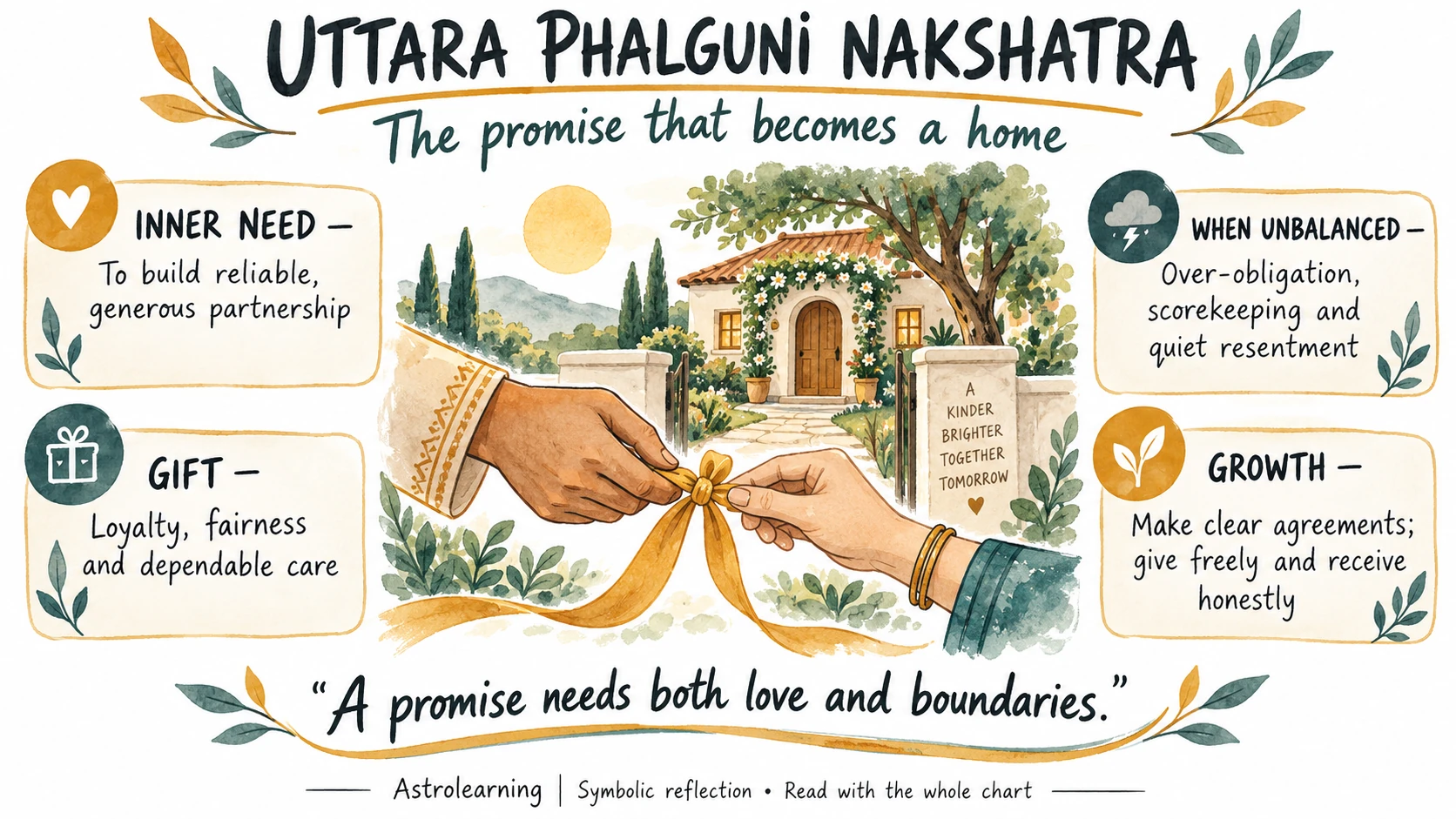
The Vow — The Soul That Keeps Its Word
Core Details
| Factor | Uttara Phalguni |
|---|---|
| Sanskrit | उत्तराफाल्गुनी |
| Nakshatra Number | 12 |
| Zodiac Span | 26°40′ Leo – 10°00′ Virgo |
| Nakshatra Lord | Sun |
| Deity | Aryaman (god of patronage, favors, and honorable contracts) |
| Symbol | Back legs of a bed / a bed |
| Shakti | Chayani Shakti — the Power of Prosperity through Alliance |
| Gana | Manushya |
| Guna | Rajas |
| Main Theme | Partnership, generosity, patronage, reliable duty, kindness that lasts |
| Deity Mantra | Om Aryamne Namah |
| Higher Expression | Loyalty, dependable generosity, healthy long-term partnerships |
| Lower Expression | Self-righteousness, over-obligation, quiet resentment when generosity isn’t reciprocated |
The Fundamental Nature of Uttara Phalguni
Purva Phalguni asks: “Does this feel good?” Uttara Phalguni asks a harder question. “Now that I know what feels good, what am I willing to be responsible for?”
This is the shift from pleasure to promise.
Where its predecessor lounges in the moment, Uttara Phalguni gets up, straightens the room, and stays. It is the Nakshatra of the person whose word functions like a contract, spoken or not. Not because they were taught to be reliable. Because unreliability, to them, feels like a kind of betrayal — of themselves as much as anyone else.
There is a quiet gravity to Uttara Phalguni. People lean on it without quite noticing they’re leaning. “Ask them, they’ll help.” “They always show up.” These sentences follow Uttara Phalguni through life, spoken by others, rarely by itself.
This is a deeply Rajasic energy, but not the restless kind. It is active generosity — the will to build something with another person and maintain it, season after season, long after the excitement of the beginning has faded.
The Bed — The Symbol of Uttara Phalguni
The symbol is easy to misread. A bed sounds like Purva Phalguni’s territory — rest, pleasure, indulgence. But Uttara Phalguni’s bed is specifically the back legs, the structural half, the part that bears weight after the front half has already been enjoyed.
This is the bed as a place of union that has become commitment. Not the bed of a single night. The marriage bed. The shared home. The place two lives actually merge, with all the domestic, financial, and emotional weight that merging requires.
Purva Phalguni furnishes the room. Uttara Phalguni pays the mortgage on it.
This is why Uttara Phalguni’s idea of intimacy is rarely just chemistry. It is structural. Can this hold weight? Can I build a life on this person, and can they build one on me?
Aryaman — The Sacred Contract
The presiding deity, Aryaman, governs patronage, alliance, and honorable dealing — the god invoked, in older tradition, at weddings and at the formation of bonds between families and friends. Aryaman is not charity in the anonymous sense. It is generosity with structure: a favor that creates a relationship, a gift that implies a bond, a promise that both sides intend to keep.
This gives Uttara Phalguni its particular flavor of kindness. It rarely helps as a stranger passing by. It helps as someone entering into relationship with you. “I am showing up for you, and I expect this means something between us now.”
At its best, this creates extraordinary networks of mutual support — marriages that function like true alliances, friendships that outlast decades, professional patronage that lifts people who couldn’t have risen alone. At its weakest, it creates a silent ledger. Every favor logged. Every kindness, quietly, expected to be returned.
The Tension: Service or Performance
Uttara Phalguni’s central psychological struggle rarely looks like a struggle from the outside, because it wears the costume of virtue.
The question underneath is simple and uncomfortable: “Am I doing this because it is genuinely good, or because I need to be seen as the reliable one?”
The two can look identical for years. The same dinners cooked, the same rides given, the same promises kept. But one comes from an open hand. The other comes from a fear that if the goodness stops, so does the love.
Genuine service asks nothing in return. Performed goodness keeps a ledger it never shows anyone — sometimes not even itself.
Past-Life Karma
As with every Nakshatra in this series, the karmic material here is a symbolic teaching device, not a literal claim about a previous existence.
From this symbolic lens, Uttara Phalguni often carries karmic residue around alliances made and alliances broken. The archetype may resemble a soul who once depended heavily on someone else’s word — a patron, a spouse, a partner — and either received extraordinary loyalty or was devastated by its absence.
The deeper karmic question isn’t simply “Was a promise kept?” It is “What did being depended upon cost you?” Did you carry others generously, or did you carry them because refusing felt unthinkable? Did you honor your word because it was right, or because breaking it once cost you everything?
This life often repeats situations of being relied upon until the soul learns: reliability offered freely is a gift; reliability offered out of fear is a debt that never resolves.
Childhood Imprint
Uttara Phalguni children become the responsible one early, sometimes startlingly so. The child who remembers everyone’s schedule. The child who notices when a parent is struggling and quietly steps in. The child praised, again and again, for being “so mature,” “so helpful,” “so easy.”
This praise teaches a lesson that sinks in far deeper than anyone intends: dependability is what earns love here.
It is a beautiful trait to build a childhood around, and a dangerous one. Because somewhere underneath the competence, a quieter question waits, unanswered for decades: “Would they still want me if I stopped being useful?”
Relationships
Uttara Phalguni makes an extraordinary partner — loyal, generous, present for the long haul in a world full of people who aren’t. But its relationship lesson is precise and demanding: learning to tell the difference between loyalty freely chosen and obligation performed out of fear of disappointing someone.
The first kind of loyalty is light, even when it’s hard. The second kind accumulates. It shows up years later as exhaustion with no clear cause, or a resentment the person can’t quite name because on paper, they have nothing to complain about — they gave everything willingly. Didn’t they?
The mature Uttara Phalguni learns to ask for what it needs before resentment has to ask on its behalf. It learns that a real partnership has two people keeping the vow, not one person carrying it for both.
Lower Expression
The lower Uttara Phalguni becomes self-righteous — quietly convinced of its own goodness, and quietly certain that others fall short of it. It can slide into martyrdom, sighing under obligations it never had to accept, then feeling wounded when no one notices the sacrifice.
It can become rigid about how others should behave, moralizing about duty and commitment in a way that says more about its own unmet needs than about anyone else’s failings. And underneath all of it, a resentment that never quite gets spoken aloud — because saying “I gave more than I received” feels, to this Nakshatra, like admitting the goodness wasn’t real.
Higher Expression
The higher Uttara Phalguni becomes something rare: a person others can genuinely, structurally depend on — not because they’re afraid of what happens if they stop, but because being that kind of anchor is simply who they’ve chosen to be.
It gives without keeping score. It stays in a marriage, a friendship, a partnership, because the bond is still true, not because leaving would look bad. It can say no. It can receive help as easily as it gives it. Its loyalty stops being a performance for an audience and becomes, finally, just the truth of how it loves.
This is Aryaman’s real gift: an alliance strong enough to hold real weight, offered freely, by someone who no longer needs to prove they deserve to be trusted.
“A promise kept out of fear is a debt. A promise kept out of love is a home.”