

The past-life and karmic sections below are Jyotish interpretations, not historically verifiable facts. They are best understood as symbolic karmic archetypes — a way of teaching the psychology of each Nakshatra, not a literal record of a previous life.
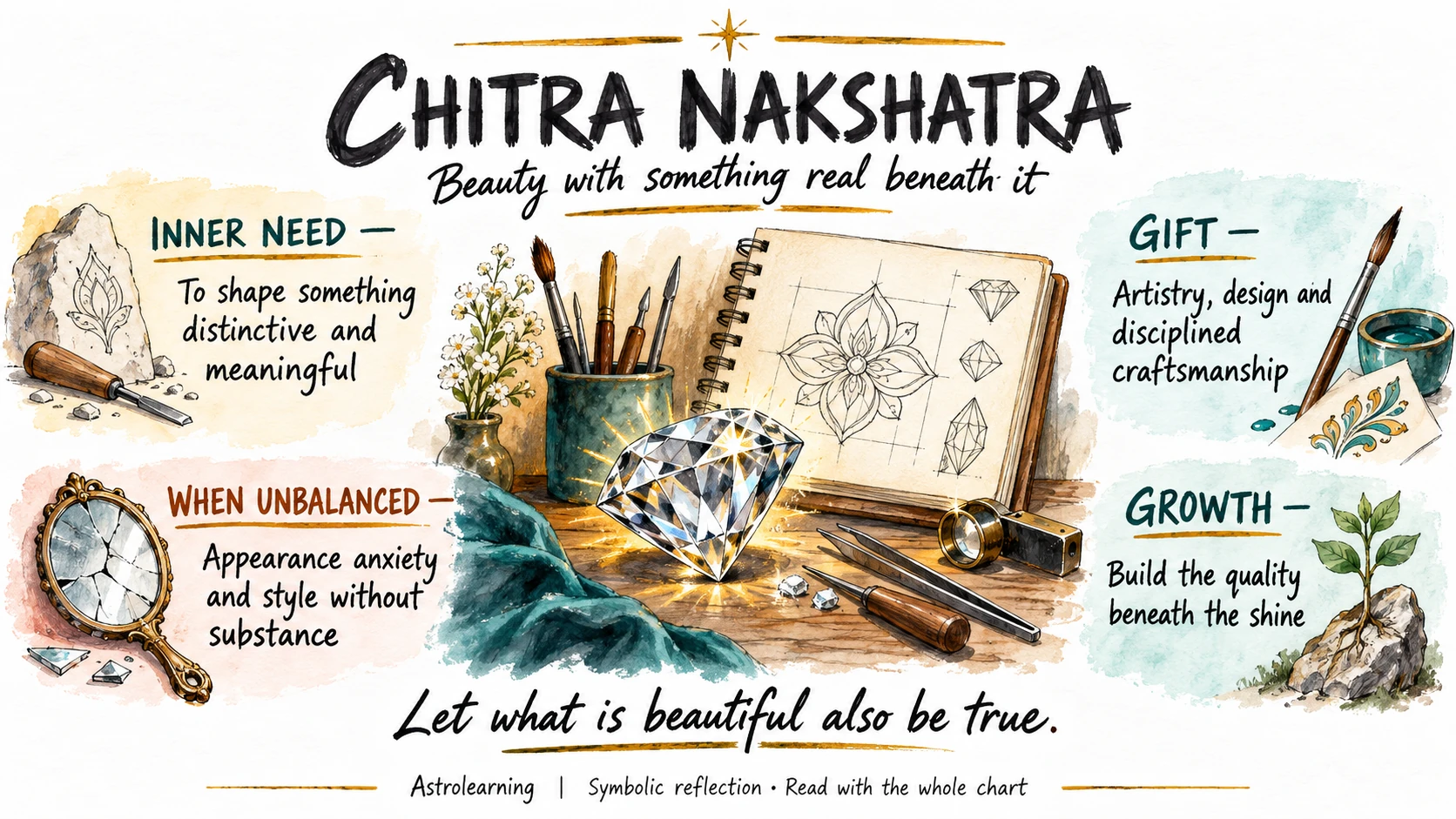
The Jewel — The Soul That Wants to Be Unforgettable
Core Details
| Factor | Chitra |
|---|---|
| Sanskrit | चित्रा |
| Nakshatra Number | 14 |
| Zodiac Span | 23°20′ Virgo – 6°40′ Libra |
| Nakshatra Lord | Mars |
| Deity | Tvashtar / Vishwakarma |
| Symbol | Bright Jewel / Pearl |
| Shakti | Punya-Chayani Shakti — the Power to Accumulate Merit |
| Gana | Rakshasa |
| Guna | Tamas |
| Main Theme | Beauty, design, individuality, illusion, the creation of striking form |
| Deity Mantra | Om Tvashtre Namah |
| Higher Expression | Artistry, magnetic charisma, creating something genuinely remarkable |
| Lower Expression | Vanity, obsession with appearance, style mistaken for substance |
The Fundamental Nature of Chitra
Chitra means “the brilliant one,” and the name is not decorative. It is the entire program.
This is the Nakshatra of the divine architect — the instinct to design, to shape, to build something so striking that it cannot be walked past unnoticed. Chitra doesn’t simply want to exist. It wants to be seen existing.
There is a deep discomfort here with blending in. Ordinary is almost a wound.
Where other Nakshatras ask, “Does this work?”, Chitra asks a different question entirely: “Does this stand out?”
This isn’t always vanity, though it can curdle into that. At its root, it is a creative impulse — the same force that carves a temple out of a mountain rather than settling for a shelter. Chitra can turn a face, a room, a sentence, a career into something people remember. It has an instinct for form, proportion and presence that few other Nakshatras possess so naturally.
But brilliance has a shadow. And Chitra spends a lifetime learning to tell the difference between what genuinely shines and what merely catches the light.
The Jewel — The Symbol of Chitra
A jewel is small, but it dominates the room it enters.
It doesn’t need to be large to be noticed. It needs to be cut correctly. This is the essence of Chitra — the belief that refinement, not size or volume, is what makes something unforgettable.
When this is healthy, Chitra becomes a master of detail. A single well-chosen word, a single elegant line, a single striking outfit — and the whole impression changes. This is not superficial. It is craftsmanship applied to presence itself.
But a jewel is also, fundamentally, surface. It reflects light; it doesn’t generate it.
The lower expression forgets this distinction. It becomes obsessed with the reflection and neglects what is being reflected. The person may spend enormous energy on how something appears and comparatively little on what it actually contains.
The evolutionary lesson is not: “Stop being brilliant.”
It is: “Make sure there is something real underneath the shine.”
Tvashtar and Vishwakarma — The Architect Who Builds Worlds
The ruling deity of Chitra is Tvashtar, also known as Vishwakarma — the celestial architect and craftsman who is said to have built the weapons of the gods, the palaces of the heavens, entire worlds.
This is important. Vishwakarma doesn’t merely decorate what already exists. He constructs.
Chitra, at its highest, inherits this same power — not the ability to make things look good, but the ability to make things from nothing. Design, in this sense, becomes a spiritual act. A well-built life, a well-built body of work, a well-built self: these are Vishwakarma’s true offering through this Nakshatra.
The danger arises when the architect stops building and starts merely styling. When the impulse to create gets redirected entirely toward the impulse to impress.
Chitra must continually ask itself: “Am I constructing something, or am I only decorating its surface?”
The Tension Between Originality and Performance
Chitra carries a Rakshasa Gana and a Tamasic Guna, and this combination tells its own story. There is intensity here, a willingness to bend convention, sometimes a magnetism that borders on the theatrical.
This creates a genuine gift for originality. Chitra people often dress differently, think differently, present themselves differently — not because they are trying to rebel, but because sameness genuinely bores them.
But there is a subtle trap woven into this gift.
Being original and performing originality are not the same thing. One flows from an inner sense of self. The other flows from an audience.
Chitra can lose track of which one it is doing. It may start to curate itself the way it would curate a jewel — angling for the light, choosing the most flattering setting, editing out anything that doesn’t sparkle. Eventually the person may no longer know where the authentic self ends and the performance begins.
The mature Chitra learns to create for the sake of creation itself, not merely for the reaction it produces in others.
Past-Life Karma
From a symbolic Jyotish perspective, Chitra can carry karmic themes connected with craftsmanship, illusion, identity built through appearance, and the ethical use of charisma.
This is not a literal claim about a previous existence — it is a symbolic archetype used to explain a recurring psychological pattern. The image often associated with Chitra is someone who once held real creative or aesthetic power: an artisan, a builder, a performer, someone whose image or craftsmanship influenced others deeply.
The deeper karmic question isn’t whether that power was used. It is how it was used.
If charisma or beauty was once used to manipulate, deceive, or construct a false impression for personal gain, this life may repeatedly test the same faculty. Chitra may find itself in situations where surface appeal alone is not enough — where people eventually look past the design and ask what is really there.
The soul’s task is to learn: “My brilliance is a responsibility, not just a decoration.”
Childhood Imprint
Chitra children often discover very early that being noticed feels like being loved. A compliment on their appearance, their cleverness, their talent — it registers as warmth, as safety, as proof that they matter.
This can build a genuinely magnetic personality. But it carries a risk: an identity constructed almost entirely on how they are perceived rather than who they actually are underneath.
If admiration became conditional — praised only when impressive, overlooked when ordinary — the child may learn a quiet, exhausting rule: “I am only worth attention when I shine.”
As adults, this can become a relentless self-curation — always presenting a polished version of life, rarely showing the unfinished one.
Relationships
Chitra’s relationship lesson is one of the most demanding in the zodiac: genuine intimacy requires being seen without performing.
Being admired is easy for Chitra. It is almost native ground. But being truly known — without the styling, without the best angle, without the carefully chosen setting — can feel far more exposing than any amount of admiration ever could.
A partner who says “I love you at your most ordinary” can be strangely unsettling to Chitra, because ordinary was never supposed to be enough.
The deeper lesson is learning that real love doesn’t require a performance — and that being loved without the jewel’s polish is not a lesser form of love. It is often the truer one.
Lower Expression
The lower Chitra becomes preoccupied with image — obsessed with appearance, status, and how a moment will look rather than what it actually means.
Style begins to substitute for substance. The person may become skilled at charm precisely so that no one looks too closely at what lies beneath it. Vanity, in this expression, isn’t just about looks — it is a strategy for avoiding being truly known.
The person may think: “As long as I look remarkable, no one will notice what I lack.”
But an audience, however admiring, is not the same as connection.
Higher Expression
The higher Chitra becomes a genuine creator — not someone who merely decorates a surface, but someone who builds something so well-made that the brilliance is earned, not applied.
This is Vishwakarma’s true inheritance: the discipline to construct rather than the impulse to merely dazzle. The higher Chitra channels its love of beauty into work, relationships, and a self that can withstand close inspection — because there is real craftsmanship underneath the shine.
It learns to ask, before every act of self-presentation: “Is this real, or is this only decoration?”
When the answer is real, Chitra becomes what it always wanted to be — not merely noticed, but unforgettable for the right reasons.
“A jewel that only reflects light will eventually go dark in someone’s pocket. A jewel that is well made keeps its brilliance even when no one is looking.”