

The past-life and karmic sections below are Jyotish interpretations, not historically verifiable facts. They are best understood as symbolic karmic archetypes — a way of teaching the psychology of each Nakshatra, not a literal record of a previous life.
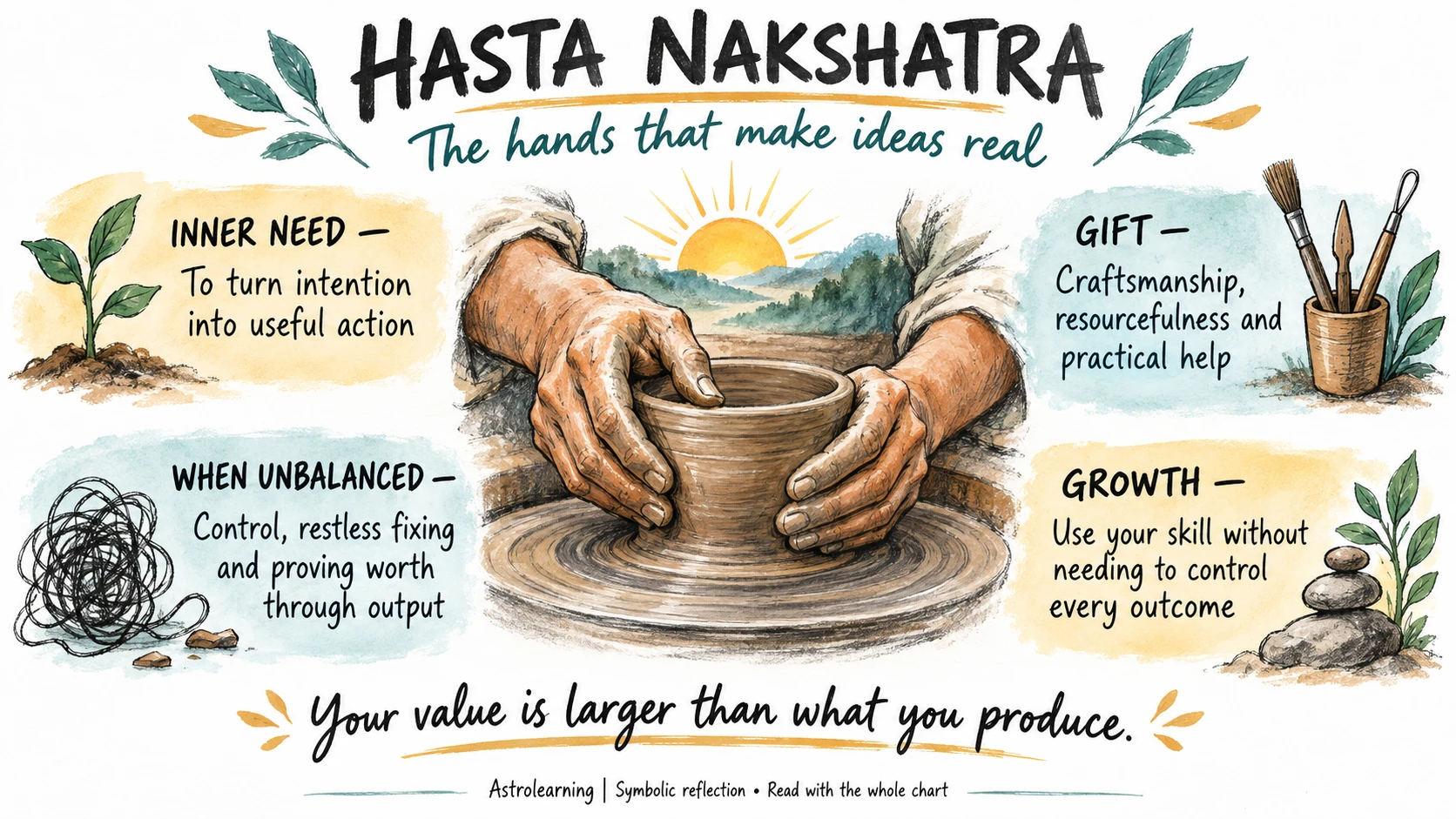
The Hand — The Soul That Makes Things Real
Core Details
| Factor | Hasta |
|---|---|
| Sanskrit | हस्त |
| Nakshatra Number | 13 |
| Zodiac Span | 10°00′ – 23°20′ Virgo |
| Nakshatra Lord | Moon |
| Deity | Savitar (the Sun as inspirer and enlivener) |
| Symbol | Hand / Fist |
| Shakti | Hasta Sthapaniya Shakti — the Power of the Hand to Achieve What Is Sought |
| Gana | Deva |
| Guna | Rajas |
| Main Theme | Skill, craftsmanship, dexterity, resourcefulness, the healing touch |
| Deity Mantra | Om Savitre Namah |
| Higher Expression | Mastery, skillful helpfulness, practical genius, hands that heal or build |
| Lower Expression | Manipulation, restlessness, using skill to control outcomes or people |
The Fundamental Nature of Hasta
By the time the zodiac reaches Hasta, something has to change. Ashwini began. Bharani carried. Krittika cut. Rohini created. Mrigashira searched. Ardra broke. Punarvasu returned. Pushya nourished. Ashlesha looked beneath the surface. Magha honored the ancestors. Purva Phalguni rested in pleasure. Uttara Phalguni made a vow.
Hasta says something much more practical: “Now make it real.”
This is the psychology of the hand. Not the mind that conceives an idea. Not the heart that feels a longing. The hand that picks up the tool and does something about it.
Hasta has very little patience for the purely theoretical. A beautiful plan that never gets built is, to this Nakshatra, not actually beautiful yet. It is only a sketch.
The person may think: “If I can touch it, I can improve it.”
This gives Hasta an instinct for competence that shows up early and shows up often. Give it a problem and its hands start moving before its mouth has finished asking questions. It learns by doing, adjusts by doing, and often understands something fully only after its fingers have been inside it.
There is a groundedness to this Nakshatra that the more visionary signs sometimes lack. Hasta doesn’t need the world to change all at once. It is content improving the piece directly in front of it — and it is very good at that.
The Hand — The Symbol of Hasta
The hand is one of the most versatile symbols in the entire Nakshatra wheel, because a hand can do almost anything. It can heal. It can build. It can write. It can hold. It can also grip too tightly.
This is Hasta’s essential paradox. The same hand that soothes a fevered forehead can also close into a fist.
At its best, the hand of Hasta is skillful, precise, and generous. It fixes what is broken. It makes something useful out of raw material. It has a kind of intelligence that lives in the fingers rather than in abstract reasoning — the intelligence of the craftsman who can feel when something is not quite right before they can explain why.
But a hand that only knows how to grasp becomes a different thing entirely. When Hasta’s need for competence curdles into anxiety, the hand stops opening. It starts closing around outcomes, around people, around situations that were never meant to be controlled.
The evolutionary lesson isn’t: “Stop using your skill.”
It is: “Learn the difference between the hand that helps and the hand that holds on.”
Savitar — Inspiration That Must Be Earned Through Action
Hasta’s deity is Savitar, an aspect of the Sun understood specifically as the inspirer, the one who enlivens and sets things in motion. Savitar doesn’t simply illuminate. Savitar animates.
This gives Hasta a quiet but important spiritual dimension underneath all its practicality. The inspiration Savitar offers is not meant to stay as inspiration. It is meant to be translated — through the hands, through the craft, through the actual work — into something that exists in the world.
A Hasta native may receive an idea, a feeling, a calling, and their very next instinct is: “What do I do with this?”
This is why Hasta rarely stays only spiritual or only philosophical for long. Even its devotion tends to become active — service, healing hands, ritual craft, the making of something sacred with the fingers rather than only the mind. Inspiration that cannot be made tangible eventually starts to feel, to Hasta, like a kind of restlessness with nowhere to go.
The Tension at the Heart of Hasta
Underneath its competence, Hasta carries a very specific psychological tension: the pride of genuine skill against the anxiety of needing to be useful in order to feel worthy.
When this Nakshatra is healthy, its skill is simply skill — a source of quiet satisfaction, offered freely, admired without needing to be proven again and again. The craftsman who has nothing left to prove can finally enjoy the craft.
But when Hasta is anxious, usefulness becomes a kind of currency it must keep earning. The person may unconsciously believe: “I am only valuable when I am producing something.”
This can create people who are extraordinarily capable and quietly exhausted — who fix everyone’s problems and privately wonder who would still want them if they stopped.
Past-Life Karma
From a symbolic Jyotish perspective, Hasta may carry karmic themes connected with craftsmanship, service rendered through skill, healing hands, and the ethical use of ability. This should not be read as a literal claim — it is a teaching archetype, a way of understanding a recurring psychological pattern, not a historical record.
The archetype may resemble someone whose value in a previous existence was closely tied to what they could produce or repair: an artisan, a healer, a builder, someone whose hands were relied upon by others.
The deeper karmic question isn’t simply: “Were you skilled?”
It is: “What did you do with your skill?” Did you use it to help people become more capable, or to make them dependent on you? Did your competence serve others, or did it quietly serve your own need to be needed?
Hasta’s evolution in this life is strongly connected to the ethical use of ability — learning that a gift for craft is not automatically a license to control what the craft touches.
Childhood Imprint
Hasta children often learn very early that being good at something earns approval. They may notice, sometimes before they can articulate it, that praise arrives reliably after achievement and arrives less reliably after simply existing.
This can produce remarkably capable children — the one who fixes the broken toy, who helps a sibling with homework, whose hands are always occupied with some small useful task.
But the risk sits quietly underneath the competence. If a child learns that usefulness is what earns love, they may grow into an adult who has never quite tested whether they are lovable without it. Self-worth becomes tethered to output, and rest can start to feel like a kind of failure.
The healthier version of this imprint teaches a child that skill is a joy to develop. The harder version teaches a child that skill is the price of belonging.
Relationships
Hasta tends to show love through practical acts of service. It cooks the meal, fixes the leaking tap, proofreads the difficult email, quietly handles the errand nobody else wanted to do. This is real love, and it deserves to be recognized as real love — not everyone can express care this concretely.
But Hasta’s relationship lesson lives in a subtle trap: the difference between helping a partner and needing to fix them.
When someone Hasta loves is struggling, the instinct is immediate: “What can I do about this?” Sometimes this is exactly right. Sometimes it isn’t what the moment is asking for at all.
A partner in pain doesn’t always need to be repaired. Sometimes they simply need someone to sit beside them without an agenda, without a solution, without hands already reaching for the next tool. This can feel almost unbearably passive to Hasta — and yet learning to simply be present, without fixing, is one of its deepest relational maturities.
Lower Expression
The lower Hasta becomes restless, fidgety, and quietly controlling. Its hands need to be doing something, and when there is nothing productive to do, an uncomfortable agitation can creep in.
This restlessness can turn outward as manipulation — a need to arrange people and outcomes the way one arranges materials on a workbench. If a situation feels beyond its control, Hasta may unconsciously start managing the people inside it, offering help that isn’t quite asked for, adjusting circumstances that weren’t really its business to adjust.
At its most shadowed, competence becomes a substitute for emotional vulnerability. It is far easier for Hasta to fix a problem than to sit with a feeling. The person may become extraordinarily good at doing things for people and strangely unavailable when it comes to simply being known by them.
Higher Expression
The mature Hasta becomes genuinely masterful — and, crucially, generous with that mastery. It helps without needing credit. It teaches without needing to remain indispensable. It builds things that quietly outlast the need for recognition.
This is the true skill of the healing hand: knowing when to act and when to simply hold space, without either one being a performance.
The highest Hasta doesn’t need to prove its worth through constant output. It has already proven it, many times over, and can now offer its skill the way a river offers water — because that is simply its nature, not because it is trying to earn anything back.
“A hand that must prove itself will always be reaching. A hand at peace has already learned that its work speaks, and lets it.”