

The past-life and karmic sections below are Jyotish interpretations, not historically verifiable facts. They are best understood as symbolic karmic archetypes — a way of teaching the psychology of each Nakshatra, not a literal record of a previous life.
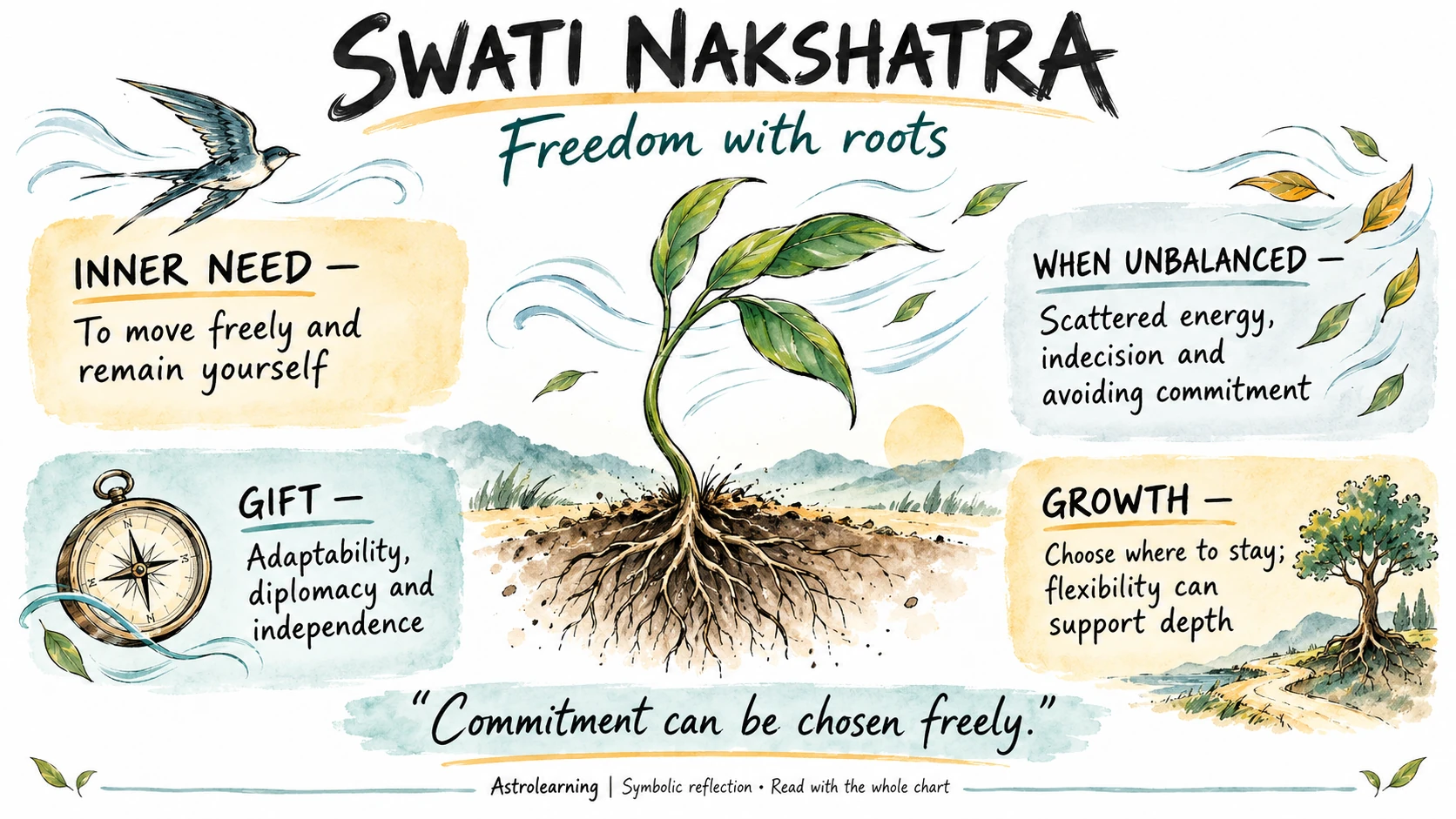
The Wind — The Soul That Bends Without Breaking
Core Details
| Factor | Swati |
|---|---|
| Sanskrit | स्वाति |
| Nakshatra Number | 15 |
| Zodiac Span | 6°40′ – 20°00′ Libra |
| Nakshatra Lord | Rahu |
| Deity | Vayu (god of wind) |
| Symbol | A young shoot of a plant swaying in the wind / coral |
| Shakti | Pradhvamsa Shakti — the Power to Scatter and Move Freely, Like the Wind |
| Gana | Deva |
| Guna | Tamas |
| Main Theme | Independence, flexibility, self-reliance, adaptability, movement |
| Deity Mantra | Om Vayave Namah |
| Higher Expression | Genuine independence, diplomacy, graceful adaptability, balance amid change |
| Lower Expression | Restlessness, indecision, difficulty committing, scattered energy |
The Fundamental Nature of Swati
Picture a young shoot in an open field. The wind arrives without warning, and the shoot has two options: resist, or bend. A rigid stalk that resists will eventually snap. The young shoot bends — sometimes almost to the ground — and then it straightens again, unharmed. Swati is built from this exact intelligence.
It doesn’t fight the wind.
It moves with it.
This is the core psychology of Swati: strength that comes from flexibility, not force. Where some Nakshatras prove their power by standing immovable, Swati proves its power by staying whole while everything around it changes. It rarely wants to be tied down, controlled, or told exactly how to move. Ask Swati to plant its feet and never shift position, and something in it will quietly rebel — not necessarily out loud, but internally, in the form of restlessness that eventually has to go somewhere.
Swati says: “I will stay standing. But I will not stay still.”
This is not indiscipline. It is a different definition of stability — one built on movement instead of rootedness.
The Swaying Shoot — The Symbol of Swati
The symbol of Swati is deceptively humble. It isn’t a weapon, a throne or a divine figure. It is a young, tender shoot, bending in the open wind. And that tenderness is the point.
A young shoot has no armor. It survives the wind not by becoming harder, but by becoming more responsive. It reads the direction of the pressure and adjusts before it can be broken.
Psychologically, this makes Swati remarkably good at reading a room, a relationship, or a shifting situation, and adjusting its approach without losing its core identity. This is often mistaken for indecisiveness by people who confuse rigidity with strength. But Swati’s bending is not weakness.
The lower expression, however, can lose the thread between adapting and dissolving. A shoot that bends too easily, in every direction, with no root beneath it, isn’t flexible — it is scattered. This is Swati’s central lesson in symbol form: bend enough to survive the wind, but keep enough root that you don’t simply blow away with it.
Vayu — The Deity of Swati
Swati’s ruling deity is Vayu, the god of wind. Vayu cannot be captured, contained, or fully seen. You know the wind only by its effects — leaves moving, hair lifting, a door swinging shut. It is invisible, yet undeniably powerful. It touches everything it passes, and yet it is possessed by nothing.
This is precisely the emotional signature of Swati. It can move through many people, many places, many ideas — touching each one, influencing each one — without ever being permanently claimed by any of them.
At its best, this gives Swati an extraordinary lightness. It doesn’t cling. It doesn’t need to dominate a room to matter in it. Like the wind, its presence can be felt even when it isn’t forcing itself to be seen.
But Vayu also explains Swati’s difficulty with being pinned down — emotionally, relationally, even professionally. The wind that never settles anywhere long enough to be known is free, yes. But it is also, in its own way, alone.
Independence Versus the Fear of Being Known
Here is Swati’s deepest psychological tension: there is a profound difference between genuine independence and using movement to avoid ever being pinned down.
Real independence is secure. It can enter closeness, commitment, or stillness, and still feel free, because the freedom was never dependent on physical distance in the first place. It was internal all along.
The wounded version looks similar from the outside but runs on a different engine. It keeps moving not because it loves movement, but because stillness feels dangerous. If someone gets too close, if a commitment starts to feel permanent, if a situation begins to require real vulnerability — the instinct is to shift, deflect, or quietly create distance, long before anyone can truly reach the person underneath.
The question Swati eventually has to sit with is not “Do I want to be free?” The answer to that is almost always yes. The real question is: “Am I moving toward something, or am I only moving away from being known?”
Past-Life Karma
From a symbolic Jyotish perspective, Swati may carry karmic themes connected with freedom, confinement, and self-reliance. Again, this is not meant as a literal historical claim — it is a teaching device, a way of illuminating a psychological pattern through the language of past lives.
The archetype may resemble a soul that once experienced being controlled, restricted, or dependent on someone else’s permission to move, speak, or choose. Perhaps that dependence was betrayed. Perhaps freedom was taken away entirely for a time. Whatever the symbolic shape, the residue carried forward is a fierce, sometimes unconscious commitment: “I will never again let my movement depend on someone else’s decision.”
This is a powerful vow. It can produce remarkable self-reliance. But an unexamined vow made out of old pain doesn’t know when it has already been honored. It keeps enforcing distance long after the original threat is gone. Swati’s karmic work is learning to tell the difference between the freedom it is protecting and the closeness it is still, quietly, afraid to trust.
Childhood Imprint
Swati children often resist being boxed in by rigid rules. Overly strict environments, or households where obedience is prized above individuality, can feel especially confining to this Nakshatra. They may not always rebel loudly — sometimes they simply learn to work around the rules quietly, finding their own path within, or beneath, the structure they were given.
Many Swati children also develop early self-sufficiency, sometimes for a less comfortable reason: they learned, at some point, that depending on others wasn’t entirely reliable. Perhaps support wasn’t consistent. Perhaps asking for help didn’t always work the way it should have. So the child quietly concludes: “I’ll manage this myself.”
This can produce an impressively capable, adaptable adult. But the underlying belief — that leaning on someone else is risky — often needs to be gently unlearned later in life, so that self-reliance becomes a strength Swati carries, rather than a wall it hides behind.
Relationships
Swati’s central relationship lesson is learning to feel free within commitment, rather than needing distance from it in order to feel like itself. It genuinely needs space — time alone, room to think, permission to change its mind, freedom to come and go without being interrogated about it. This isn’t a lack of love. It is simply how Swati stays whole.
The difficulty arises when this need for space is quietly powered by fear rather than security — when space isn’t used to recharge and return, but to avoid the vulnerability of truly being known. A partner who feels perpetually kept at arm’s length may sense that something is being withheld, even when Swati insists nothing is wrong.
The mature Swati learns that closeness doesn’t have to mean confinement. A good partner doesn’t hold the wind in a fist. They simply build a home sturdy enough that the wind keeps choosing to pass through it.
Lower Expression
The lower Swati becomes restless, indecisive, and scattered — energy pulled in too many directions at once, with none of them getting the depth of attention they need. New ideas, new plans, new people can feel endlessly exciting in the beginning, but the follow-through often falters right around the point where real commitment is required.
Decisions can become surprisingly difficult, not from a lack of options but from an excess of them. Every choice quietly forecloses other possibilities, and Swati’s instinct recoils from closing doors. This can leave the person circling important choices — a career, a relationship, a move — for far longer than the decision itself warrants.
Underneath it all is often a simple, unspoken fear: “If I commit to this, will I lose myself?” Learning that commitment and identity are not actually in competition is one of Swati’s most important tasks.
Higher Expression
The higher Swati becomes genuinely balanced — able to move fluidly through change without being destabilized by it. It is diplomatic, able to see multiple sides of a situation and adjust its approach without losing its center. It doesn’t need to control the wind. It has simply learned how to move with it, gracefully, on its own terms.
This is Swati’s mature gift: freedom that no longer needs to run from depth. It can stay in a relationship, a commitment, a single place, and still feel unmistakably like itself, because the freedom was never really about the door being open. It was about knowing, quietly and securely, that it always could be — even when it chooses to stay.
At its highest, Swati becomes the wind that chooses where to settle, not because it must, but because it finally trusts that settling and freedom were never opposites at all.
“The wind that fears nothing does not need to keep moving — it moves because it chooses to, and rests for the very same reason.”