

The past-life and karmic sections below are Jyotish interpretations, not historically verifiable facts. They are best understood as symbolic karmic archetypes — a way of teaching the psychology of each Nakshatra, not a literal record of a previous life.
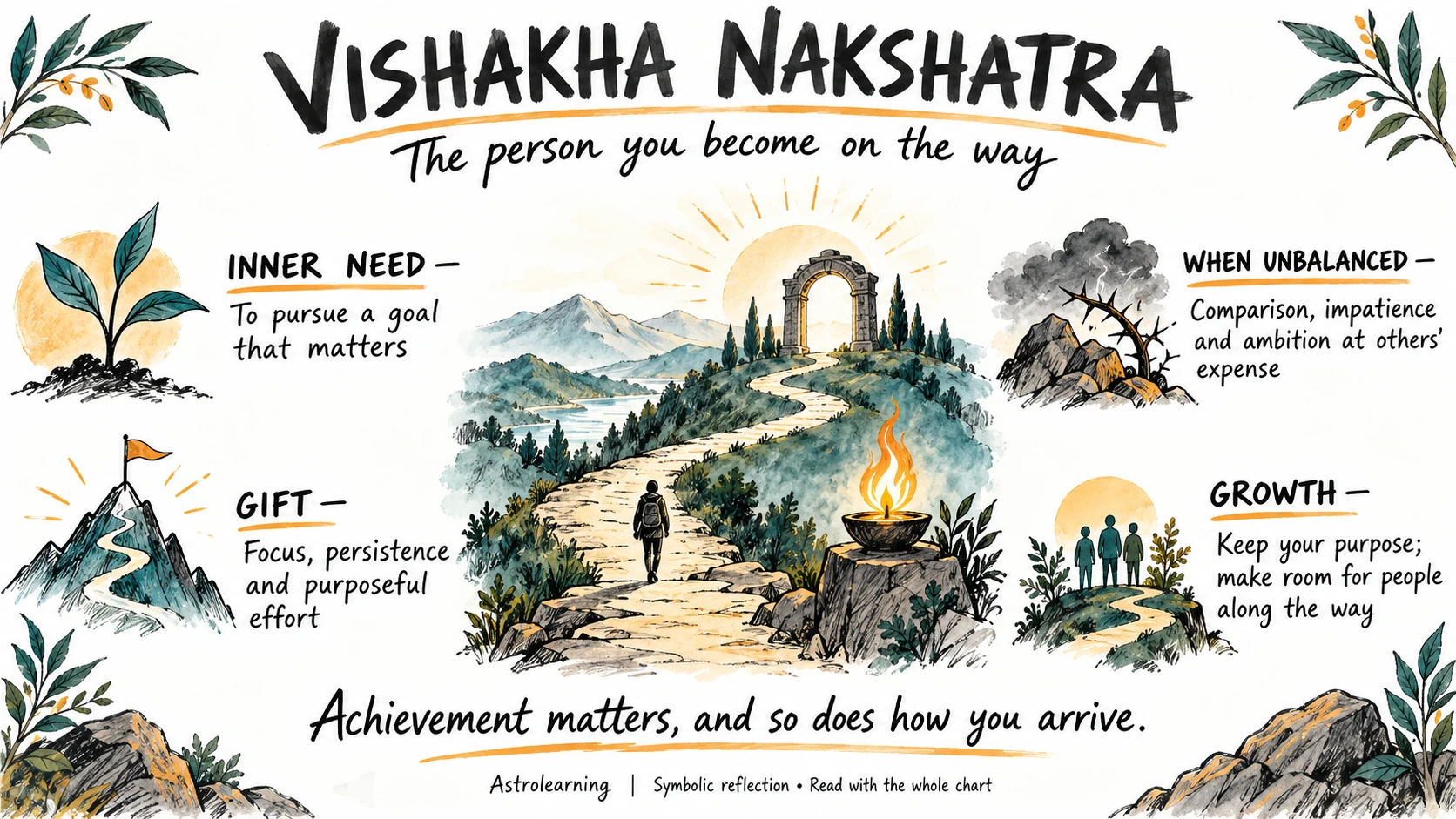
The Archway — The Soul Fixed on the Goal Beyond
Core Details
| Factor | Vishakha |
|---|---|
| Sanskrit | विशाखा |
| Nakshatra Number | 16 |
| Zodiac Span | 20°00′ Libra – 3°20′ Scorpio |
| Nakshatra Lord | Jupiter |
| Deity | Indra-Agni (the dual deity of kingship and fire) |
| Symbol | A triumphal archway / a potter’s wheel |
| Shakti | Vyapana Shakti — the Power to Achieve Many Goals Through Sustained Effort |
| Gana | Rakshasa |
| Guna | Rajas |
| Main Theme | Determination, ambition, goal-focus, a dual nature balancing patience and urgency |
| Deity Mantra | Om Indragnibhyam Namah |
| Higher Expression | Focused achievement, purposeful drive, patience in service of a larger goal |
| Lower Expression | Impatience, jealousy, single-minded ambition pursued at others’ expense |
The Fundamental Nature of Vishakha
Vishakha means “forked” or “two-branched.” Before we even reach the mythology, the name itself is telling us something. This is not a Nakshatra of one clean impulse. It is a Nakshatra of two forces sharing the same body.
Its ruling deity is not one god but two: Indra and Agni, fused into a single presence. Indra is the king who wants the outcome now — the conqueror, the one who wields the thunderbolt and expects the battle to end in his favor today. Agni is the fire that burns slowly, patiently, purifying whatever it touches over time, transforming raw material into something refined.
Put those two together inside one psyche and you get Vishakha: a person torn between urgency and patience.
Part of them says: “I want it now.”
Part of them says: “Some things can only be earned through sustained effort.”
Vishakha rarely feels neutral about goals. It feels goals the way other people feel hunger. There is almost always something being pursued — a career milestone, a relationship, a transformation of the self — and the pursuit itself becomes a kind of identity.
This is why Vishakha natives are so often described as ambitious. But ambition is really just the surface word for something deeper: an inability to feel at rest until the goal is reached.
The Triumphal Archway — The Symbol of Vishakha
The archway is not a wall. It is not a destination in itself. It is a threshold — something you pass through on the way to somewhere else, usually built to commemorate a victory already imagined before it has occurred.
This is precisely how Vishakha experiences life. The goal is visible from a great distance. Everything — time, energy, relationships, even rest — gets quietly oriented around reaching it.
The alternate symbol, the potter’s wheel, adds another layer. A potter’s wheel doesn’t produce a finished vessel in one motion. It requires the hands to stay engaged, turn after turn, shaping something gradually until the form holds. Sudden force ruins the clay. Only sustained, patient pressure shapes it correctly.
So the two symbols together describe the whole arc of Vishakha’s task: see the archway in the distance, then have the discipline of the potter’s wheel to actually get there. Most Vishakha natives are gifted at the first half. The second half is where the real growth happens.
Indra-Agni — Ambition Paired With Fire
It matters that Vishakha’s deity is not Indra alone. Indra alone would simply be will — forceful, immediate, sometimes reckless. Agni tempers that will with heat that refines rather than merely consumes.
Psychologically, this means Vishakha’s drive is not meant to be unleashed raw. It is meant to be refined, the way fire refines ore into metal. Ambition that skips this refining process becomes something harder and colder — force without purpose, hunger without direction.
The mature Vishakha understands: willpower is a tool, not a virtue in itself. A blade is not good simply because it is sharp. It matters what it is used for, and how much of the wielder it costs to swing it.
The Tension at the Center — Gift and Blind Spot
Vishakha’s single-minded drive toward a goal is genuinely rare. Many people want things. Fewer people can organize an entire life around actually getting them. This capacity for sustained, undistracted pursuit is Vishakha’s great gift.
But the same intensity that makes the goal reachable can make everything else invisible.
What gets sacrificed when the goal becomes everything? Sometimes it is rest. Sometimes it is a relationship that needed attention Vishakha didn’t have room to give. Sometimes it is simply the present moment — the ability to enjoy what already exists because the mind is fixed three steps ahead, on the archway not yet reached.
Vishakha must eventually ask itself: “Am I living, or am I only ever arriving?”
Past-Life Karma
From a symbolic Jyotish perspective, Vishakha may carry karmic themes connected with unfinished ambition, rivalry, and the ethical cost of pursuing a goal. This should not be read as: “Vishakha people were ruthless in a past life.” That is far too simple, and it misses the actual lesson.
The archetype often resembles someone whose life was organized around reaching something important — a position, a victory, a legacy — and who either fell just short, or reached it at a cost they didn’t fully reckon with. Perhaps a rival was outpaced without regard for what it took from them. Perhaps a goal was achieved but the achievement itself never delivered the peace it promised.
The deeper karmic question is not “did you win?” It is “what did winning cost, and did you notice?”
This life often repeats the same structure — a goal placed directly in front of the person — so the soul can practice pursuing it differently this time: with the same intensity, but without the same blindness.
Childhood Imprint
Vishakha children can become fiercely competitive early, sometimes astonishingly so for their age. They may fixate on being first, being best, winning the approval that comes with visible achievement.
Often this isn’t simply temperament. It is strategy. Somewhere along the way, the child may have learned that achievement was the surest way to earn attention — that praise arrived reliably after a prize, a rank, a result, in a way it didn’t arrive for simply being present.
This can produce an impressively driven adult. It can also produce someone who has never quite learned that they are allowed to be loved for existing, not only for accomplishing.
Relationships
Vishakha’s relationship lesson is deceptively simple to state and genuinely difficult to live: ambition and partnership can coexist, but only if the relationship itself is never treated as another goal to conquer.
A partner is not a milestone. A partner is not something to win and then move past on the way to the next objective. When Vishakha applies its conquering energy to love — pursuing intensely, achieving the commitment, then quietly redirecting all that focus back toward career or ambition — the relationship starts to feel less like intimacy and more like a completed transaction.
The mature Vishakha learns to bring the same sustained, patient effort it gives its goals into the relationship itself — to treat closeness not as something conquered once, but as something tended continuously, the way Agni tends its own flame.
Lower Expression
The lower Vishakha becomes impatient, restless with anything that doesn’t move fast enough, and quietly — sometimes not so quietly — jealous of other people’s progress. Someone else’s success can feel like a personal referendum on their own pace.
This can curdle into ruthlessness: pursuing goals at others’ expense, treating collaborators as competitors, mistaking someone else’s win as evidence of their own loss.
Perhaps most tellingly, the lower Vishakha has real difficulty celebrating anyone’s success but its own. Even a friend’s good news can trigger a flicker of: “Why not me?” before any genuine joy for them arrives, if it arrives at all.
Higher Expression
The higher Vishakha channels its intensity into sustained, purposeful achievement. It stays ambitious — that never goes away, nor should it — but the ambition stops being corrosive. It becomes clean fuel instead of a fire that burns whatever stands nearby.
It learns Agni’s patience without losing Indra’s will. It can hold a distant goal in view for years without losing heart, and it can also put the goal down for an afternoon to actually be present with the people who are already there.
The highest Vishakha understands that the fire is meant to refine, not merely burn — that the point of all that discipline was never simply to reach the archway, but to become someone capable of walking through it with something intact.
“The goal will still be there tomorrow. The question is who you become on the way to it.”