

The past-life and karmic sections below are Jyotish interpretations, not historically verifiable facts. They are best understood as symbolic karmic archetypes — a way of teaching the psychology of each Nakshatra, not a literal record of a previous life.
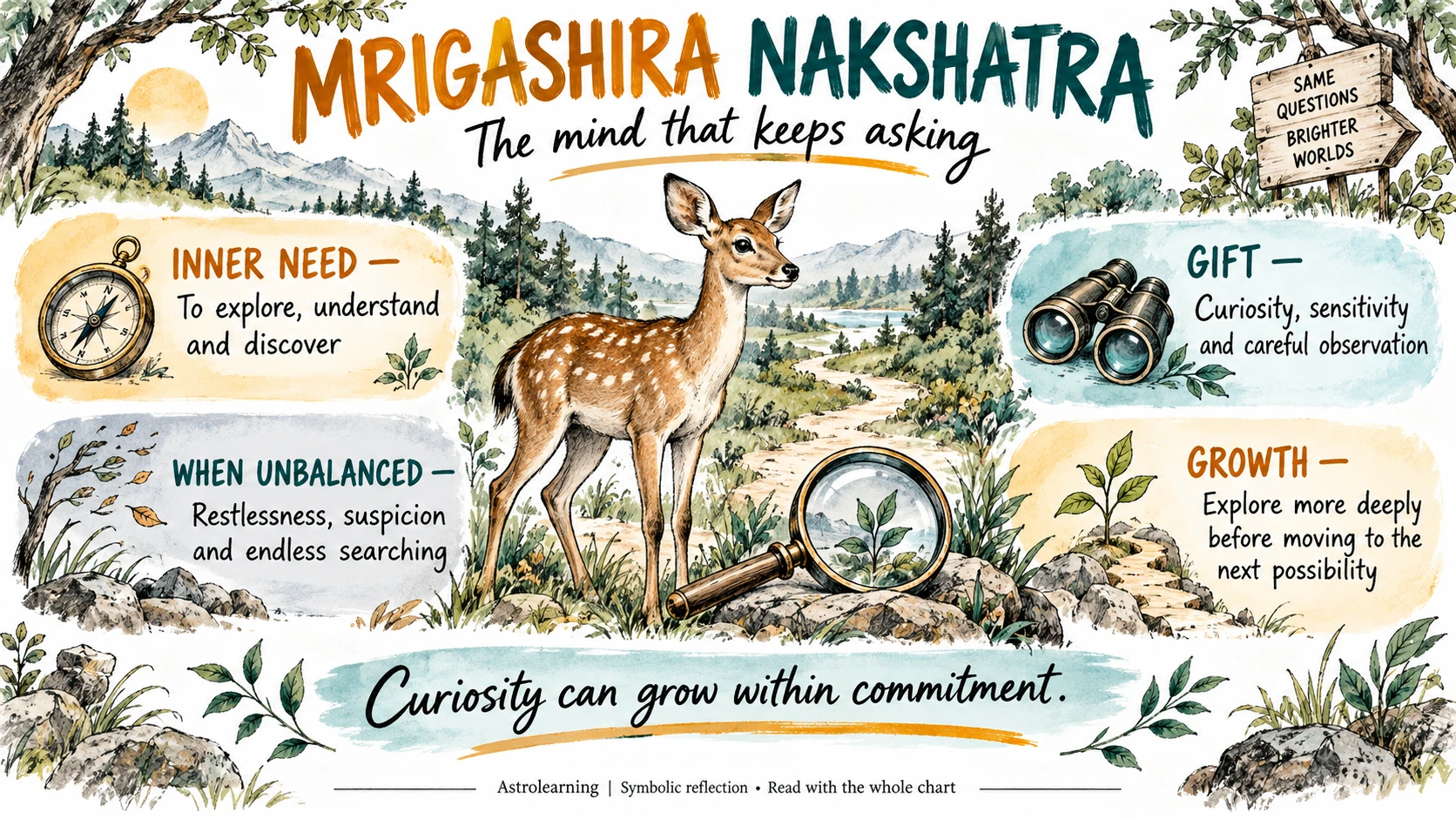
The Seeker — The Mind That Keeps Asking
Core Details
| Factor | Mrigashira |
|---|---|
| Sanskrit | मृगशिरा |
| Nakshatra Number | 5 |
| Zodiac Span | 23°20′ Taurus – 6°40′ Gemini |
| Nakshatra Lord | Mars |
| Deity | Soma |
| Symbol | Deer’s Head |
| Shakti | Prinana Shakti — Power of Fulfillment |
| Gana | Deva |
| Guna | Sattva |
| Main Theme | Searching, curiosity, sensitivity, exploration |
| Deity Mantra | Om Somaya Namah |
| Higher Expression | Curiosity, observation, research, adaptability |
| Lower Expression | Restlessness, suspicion, overthinking, dissatisfaction |
The Fundamental Nature of Mrigashira
Mrigashira is where the consciousness that was comfortable in Rohini begins to question. Rohini says: “This is beautiful.” Mrigashira asks: “What else is there?”
This is why the deer is such an appropriate symbol. The deer hears something in the distance. It becomes curious. It moves toward it. Then something else catches its attention. It moves again. Mrigashira therefore represents the searching mind. The person may rarely be satisfied with the first answer. They want to know what lies behind it.
The placement in the zodiac tells this same story. Mrigashira begins in the last degrees of Taurus and crosses into Gemini — the exact threshold between the fixed, sense-satisfied earth of Rohini and the mutable, idea-hungry air Gemini will fully embody. It is the moment appetite turns into inquiry: Rohini wants to possess the beautiful thing, Mrigashira wants to know what makes it beautiful, and whether something else might be more beautiful still. Give this mind a finished project and it will ask what the next one is. Give it a satisfying answer and it will quietly start looking for the question underneath that answer — not because the answer failed, but because one answer never feels like the whole territory.
The Deer’s Head
The deer is sensitive, alert and observant. It survives by detecting subtle environmental changes. This makes Mrigashira psychologically perceptive. It can notice tone, facial expression, changes in behavior, small inconsistencies, subtle emotional shifts.
But the same sensitivity can become hypervigilance. The person may begin to interpret everything. A simple change in someone’s tone becomes: “Are they upset with me?” Curiosity becomes over-analysis.
There is a reason a deer never fully relaxes even in a safe-looking field — its nervous system keeps scanning because missing one real signal costs more than a hundred false alarms. Mrigashira carries a psychological version of this same wiring, keeping part of itself on watch even in stable jobs and long-settled friendships — noticing the exact moment a colleague’s enthusiasm cools by half a degree, long before anyone else registers a shift. That is a genuine gift for reading rooms, provided each signal is treated as information to check rather than a verdict to believe. The deer that bolts from every rustling leaf never gets to actually eat.
Soma
Soma represents the Moon and the nourishing, experiential dimension of consciousness. Mrigashira therefore doesn’t merely want information. It wants experience. It wants to taste life. To see. To understand. To explore. To compare. This is why it can possess a youthful quality regardless of age.
Soma is also, traditionally, the nectar that never quite runs out — the cup that refills itself the moment it is emptied. That fits Mrigashira’s inner experience of desire: satisfaction arrives briefly, and then the cup is somehow full of wanting again, not out of greed but out of a genuine sense that something more is worth tasting. Healthy, this becomes a person who stays perpetually interested in life, picking up new skills at forty with the appetite they had at fourteen. Unhealthy, it becomes restlessness dressed up as curiosity — changing jobs or hobbies not because the old one failed, but because the felt intensity of novelty simply wore off.
The Tension Between Searching and Settling
Every Nakshatra carries one central paradox, and Mrigashira’s is this: the searching that makes it wise is the same searching that can keep it from ever arriving anywhere. There is a real difference between exploration that deepens and exploration that avoids, but from the inside they can feel identical — both produce the same restless pull of “I just need to look a little further.” Deepening exploration circles back and builds on what it finds. Avoidant exploration never circles back; it simply moves to the next question before the current one has changed anything.
Committing to one answer, one partner, one path means closing off every other possibility that path could have led to, and for a mind wired around the pleasure of possibility, that closing-off can register as a small loss even when the chosen path is right. Picture someone who researches every major decision exhaustively — reads every review, spends months getting to know a person, compares a job offer against three hypothetical ones that haven’t materialized. The research is not the problem; it is often useful. The problem is when it becomes a way of postponing choice indefinitely, since as long as more information might exist, the decision can always wait one more day. Mrigashira’s real maturity is not learning to stop searching. It is learning to recognize when enough has been found, and letting that moment count.
Past-Life Karma
Symbolically, Mrigashira can represent previous-life themes of searching, wandering, exploration, intellectual curiosity or dissatisfaction with established answers. The soul may have repeatedly sought something without fully finding it. Therefore this life may continue the search.
But the karmic lesson becomes: “At what point does searching become an inability to commit?” There is a difference between curiosity and avoidance.
Because Mars rules this Nakshatra, the karmic pattern often carries an active, restless quality rather than a passive one — not a soul that merely wondered, but one that kept moving, kept starting over in pursuit of something it could sense but never quite name. That momentum becomes, in this life, the pull toward new subjects and new places, and this life’s task is simply learning to notice when a genuine answer has already arrived.
Childhood Imprint
Mrigashira children often ask: Why? And then: But why? And then: Okay, but what about this? They need explanations. Blind authority may not satisfy them. If they are told: “Because I said so,” their mind may continue questioning internally.
This can exhaust caregivers who expect a child to accept an answer and move on, but the child is not being difficult — they are building an internally consistent picture of the world, and an unexplained rule is a loose thread that keeps tugging at their attention. Met with patience, willing to say “that’s a good question, let’s find out,” the curiosity tends to mature into real intellectual confidence. Consistently dismissed as disrespect, the same curiosity can turn inward into chronic private doubt — quietly distrusting what they are told, without ever feeling safe enough to ask out loud again.
Relationships
Mrigashira needs mental stimulation. It wants to discover the person. But there is a hidden danger. Sometimes it can become addicted to the chase rather than the relationship itself. Once the mystery disappears, the excitement may decline.
Its maturity is learning that intimacy is not about constantly discovering something new. Sometimes intimacy is about discovering new depth in something familiar.
This shows up in an ordinary way. Early on, everything is new information, and Mrigashira thrives there. The trouble tends to arrive a year or two in, once the major discoveries have been made — a restless Mrigashira may feel a faint, hard-to-name flatness at exactly the point most relationships are supposed to deepen, and mistake that flatness for incompatibility when it is really just the absence of novelty. The more mature response redirects the same seeking instinct inward, toward the partner already there: a new skill learned side by side, unfamiliar places visited together, conversations allowed to go somewhere neither person expected. The search does not have to end. It only has to be aimed at what is already committed to, rather than used as a reason to leave it.
Lower Expression
Restlessness. Overthinking. Suspicion. Constant comparison. Fear of settling. The person may always wonder: “Is there something better?”
At its lowest, this stops being curiosity and becomes low-grade dissatisfaction that follows the person everywhere — jobs left just as they start to feel routine, relationships quietly undermined by the sense that the grass elsewhere must be greener. Because Mrigashira is so good at noticing small inconsistencies, it can also manufacture meaning out of neutral events — an unanswered text becomes evidence of withdrawal. The mind built to detect real danger starts detecting danger everywhere, simply because an idle radar will eventually convince itself it has found something.
Higher Expression
The higher Mrigashira becomes a genuine seeker. It asks questions not because it distrusts everything, but because it wants deeper truth. It can become extraordinarily observant.
At this level, the same sensitivity that once produced hypervigilance becomes something closer to wisdom. The higher Mrigashira can sit with a partial answer without panicking, notice a shift in someone’s mood without spiraling into worst-case interpretation, and stay in one career or one relationship for decades — not because the searching stopped, but because it learned to search within commitment rather than as an escape from it. The deepest discoveries, it finally understands, are rarely found by moving to the next field. They are found by going one layer deeper into the one already standing in front of it.
“The seeker does not become wise because every question is answered; the seeker becomes wise because every answer creates a deeper question.”