

The past-life and karmic sections below are Jyotish interpretations, not historically verifiable facts. They are best understood as symbolic karmic archetypes — a way of teaching the psychology of each Nakshatra, not a literal record of a previous life.
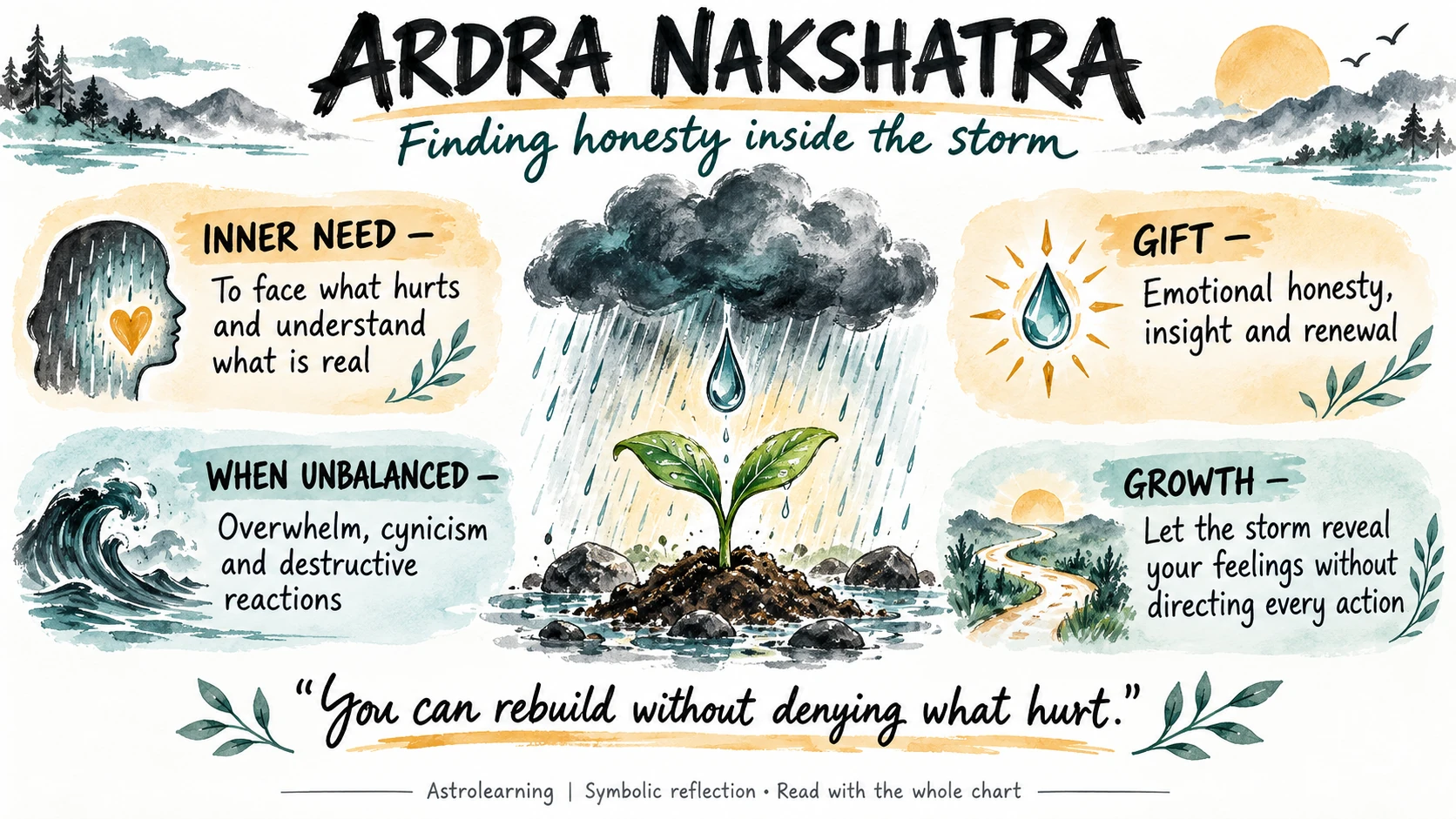
The Storm — The Soul That Learns Through Breaking Open
Core Details
| Factor | Ardra |
|---|---|
| Sanskrit | आर्द्रा |
| Nakshatra Number | 6 |
| Zodiac Span | 6°40′ – 20°00′ Gemini |
| Nakshatra Lord | Rahu |
| Deity | Rudra |
| Symbol | Teardrop / Diamond / Storm |
| Shakti | Yatna Shakti — Power of Effort |
| Gana | Manushya |
| Guna | Tamas |
| Main Theme | Storm, grief, disruption, truth, transformation |
| Deity Mantra | Om Rudraya Namah |
| Higher Expression | Resilience, truth, transformation, psychological depth |
| Lower Expression | Cynicism, emotional destruction, chaos, pessimism |
The Fundamental Nature of Ardra
Ardra is one of the most psychologically misunderstood Nakshatras. People often see: Rahu + Rudra + storm + tears, and conclude: “Ardra means suffering.” But that is incomplete.
A storm does not only destroy. It moves stagnant energy. It clears the atmosphere. It changes the landscape. It brings rain. It forces structures that were already weak to reveal themselves. Ardra therefore represents breaking open. The person may experience situations that force them to confront realities they would rather avoid.
Rahu, as the ruling lord, adds a particular flavor to this breaking. Rahu is never satisfied with the surface explanation — it wants more contact with what is real, even when what is real is uncomfortable. Combined with Rudra’s fierce, storm-like energy, this produces a person who cannot simply live inside a comfortable illusion for very long. Something in them keeps pressing on the walls of whatever story they’ve been told, looking for the place where it gives way.
This is why Ardra so often arrives at truth through disruption rather than calm reflection. Life doesn’t whisper the lesson to this Nakshatra; it tends to announce it — a sudden diagnosis, a relationship that ends without warning, a career that collapses just as it seemed most secure. The pattern can look cruel from the outside; from the inside, once understood, it starts to look more like a teacher who only has one very loud voice.
The Teardrop
The teardrop is important because Ardra is not emotionally dry. It can feel intensely. The tears represent emotional release. Sometimes the psyche holds something for years. Then something happens. The structure breaks. The person cries. And afterward they realize: “I could no longer carry what I had been carrying.”
This is why Ardra can have profound emotional intelligence once it has matured. It knows what pain feels like.
The second symbol, the diamond, completes the picture the teardrop begins. A diamond is carbon subjected to extraordinary pressure deep underground for a very long time — nothing about the process is gentle, and yet what emerges is one of the hardest, most light-filled substances that exists. The pressure is not incidental to the brilliance; it is the mechanism that produces it.
The teardrop and the diamond are two stages of one process. The tears come first — the softening, the admission that something hurts. The diamond comes after, if the person stays with the process instead of hardening prematurely. Ardra’s task is learning not to skip from pressure straight to a shell; the shell protects nothing worth protecting, while the diamond is what forms when the pressure finishes its work.
Rudra
Rudra represents the fierce, storm-like dimension of Shiva. Rudra doesn’t politely preserve structures that have become false. It destroys. But destruction creates space. Therefore Ardra’s deepest spiritual lesson is: “What is being destroyed may be the structure preventing your transformation.”
It matters that Rudra is also a healer in the older mythology — the same deity invoked to send the storm is invoked to withdraw it, once the necessary damage has been done. Ardra inherits this double nature: the same intensity that tears something down in one season of a life is often, a little later, the very thing that clears the ground for what comes next. Destruction and healing are not opposites here; they are two phases of the same event.
This is difficult to trust while it is happening. In the middle of the storm, Ardra rarely feels like a healer is at work — it feels like everything is simply falling apart. Only afterward does the shape of what was cleared away become visible.
The Psychological Tension — Storm or Self-Destruction
Ardra’s central difficulty is that constructive breaking and destructive breaking can feel almost identical from the inside. Both involve intensity. Both involve things falling apart. Both can arrive with tears.
The mature expression uses the storm the way weather uses it — to clear something that had already become stagnant, and then to settle. It can say, “This needed to end,” and mean it, without needing to keep the wreckage stirred up afterward.
The immature expression, by contrast, can start generating storms out of habit, even when nothing actually needs to break. Calm starts to feel suspicious to a nervous system that learned to associate intensity with being alive. So it manufactures a crisis — a fight, a dramatic exit — not because the situation demanded it, but because the storm has become the only weather this person knows how to feel at home in.
Not every structure that Ardra wants to break actually deserves to fall. Learning to tell the difference — between the storm that clears something false and the storm that is simply repeating an old wound — is the heart of this Nakshatra’s growth.
Past-Life Karma
Symbolically, Ardra can carry karmic themes around sudden change, destruction, loss, rebellion, grief and intense transformation. The soul may have experienced environments where stability was repeatedly interrupted. This can create a deep survival intelligence. The person may become extremely good at adapting to chaos.
The archetype resembles someone who lived through repeated upheaval — sudden loss, forced relocation, an environment where the ground kept shifting without warning. Such a life builds an extraordinary capacity to read a room the instant it changes, to sense danger before it arrives. That capacity does not disappear; it carries forward.
But the karmic lesson is learning that chaos does not have to become your identity. You can survive the storm without becoming the storm.
The deeper karmic question is what this survival intelligence gets used for once the original danger has passed — whether it stays permanently switched on, scanning every calm room for a threat that is no longer there, or whether the soul learns to set the vigilance down and use that same sharp perception to help others find steadiness inside their own storms.
Childhood Imprint
Ardra children may notice emotional instability around them. They can become extremely observant because understanding the environment helps them feel safe. Sometimes humor becomes a coping mechanism. Sometimes intelligence becomes a defense. Sometimes emotional detachment develops because feeling everything becomes overwhelming.
A young Ardra often learns to read a household’s emotional weather before anyone speaks a word — the quality of silence that means an argument is coming, the tone underneath a parent’s “I’m fine.” This is not paranoia; it is an accurate skill, built out of necessity, and it usually works.
The cost shows up later. A nervous system trained to expect disruption doesn’t simply relax once the disruption stops — it keeps watching. Adult Ardra often has to consciously relearn what most people never had to learn deliberately: that a quiet room can just be a quiet room.
Relationships
Ardra generally needs emotional honesty. It may struggle with people who pretend everything is fine when it isn’t. It wants the real conversation. The uncomfortable conversation. The conversation underneath the conversation. But Ardra must learn not to create storms simply because calmness feels emotionally unfamiliar.
This can show up as a specific pattern: a relationship is going smoothly, and yet some part of Ardra starts picking at a small thing — a tone of voice, a delayed reply — until it becomes a real argument, simply because the stillness beforehand didn’t feel trustworthy.
The mature version learns to separate two signals: the discomfort that means something genuinely needs to be said, and the restlessness that just means peace still feels unfamiliar. A partner who can be met with honesty rather than provoked into crisis is one of the rarest, most healing bonds Ardra can find.
Lower Expression
The lower Ardra can turn cynical. Destructive speech comes easily — the sharp comment, the remark designed to wound rather than to clarify. Pessimism sets in, a quiet conviction that things will eventually fall apart anyway, so why invest in them fully.
Emotional volatility and self-sabotage often travel together here. Just as something good is stabilizing — a job, a relationship, a fragile sense of peace — some part of the lower Ardra starts looking for the crack in it, almost testing whether it’s allowed to last. Crisis can start to feel more emotionally real than peace, simply because it is more familiar. Left unexamined, this becomes self-fulfilling — a habit that manufactures instability long after the original danger is gone.
Higher Expression
The higher Ardra becomes extraordinarily resilient. It can look at pain without running away. It can tell uncomfortable truths. It can transform suffering into insight.
This is often the person others quietly seek out during their own crises — not because this Ardra offers easy comfort, but because they don’t flinch. They can sit with someone’s grief, or say the hard thing that needs saying, without softening it into something smaller than it is.
At its best, the storm that once threatened to define this Nakshatra’s life becomes a source of steadiness for everyone around it — proof, by example, that a person really can break open and still come back together.
“The storm does not always come to destroy your life; sometimes it comes to expose the life that can no longer remain.”