

The past-life and karmic sections below are Jyotish interpretations, not historically verifiable facts. They are best understood as symbolic karmic archetypes — a way of teaching the psychology of each Nakshatra, not a literal record of a previous life.
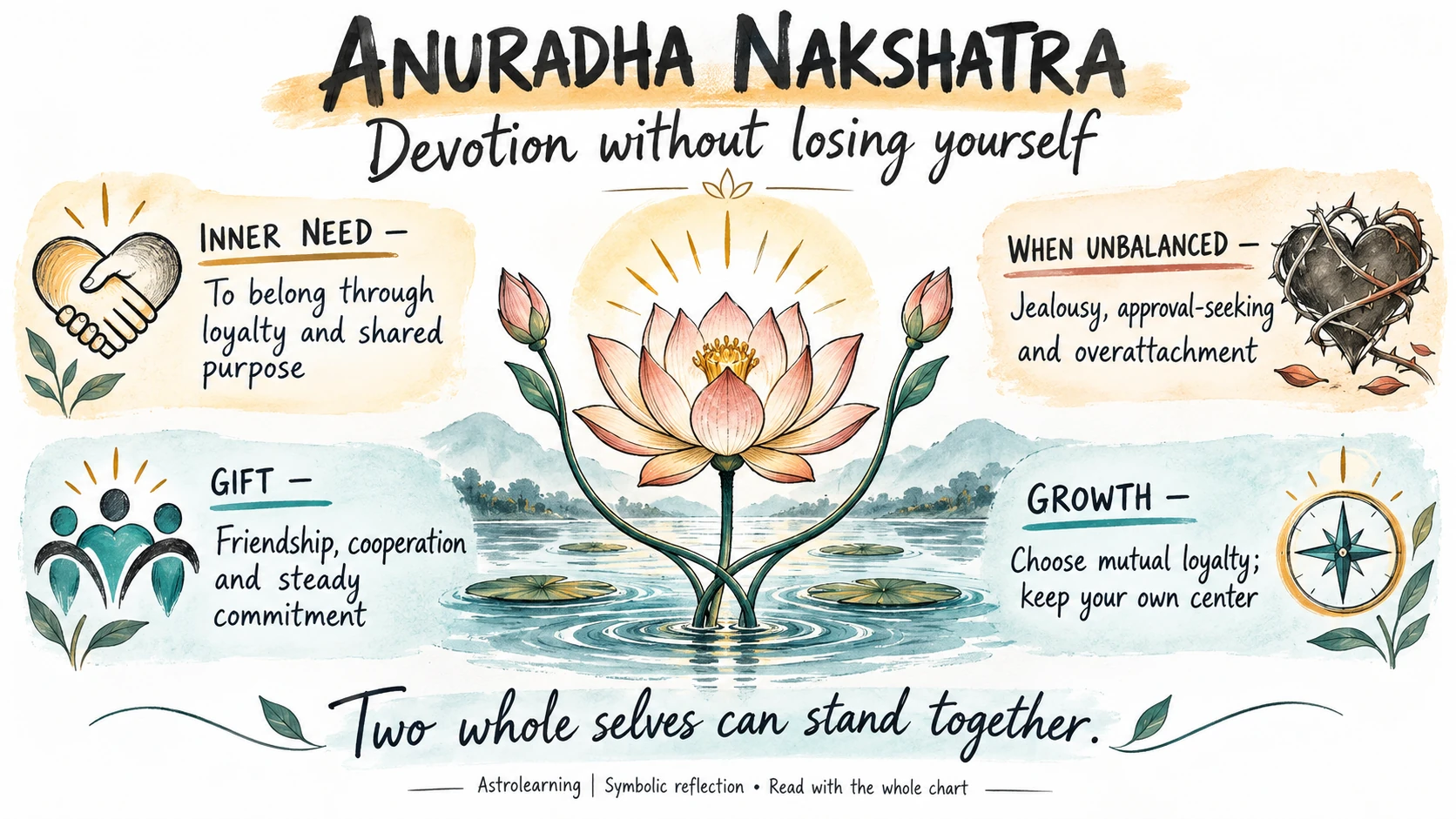
The Lotus — The Soul That Devotes Itself Fully
Core Details
| Factor | Anuradha |
|---|---|
| Sanskrit | अनुराधा |
| Nakshatra Number | 17 |
| Zodiac Span | 3°20′ – 16°40′ Scorpio |
| Nakshatra Lord | Saturn |
| Deity | Mitra |
| Symbol | Lotus Flower / Triumphal Archway |
| Shakti | Aradhana Shakti — Power of Devotion and Worship |
| Gana | Deva |
| Guna | Tamas |
| Main Theme | Devotion, friendship, loyalty, disciplined success through cooperation |
| Deity Mantra | Om Mitraya Namah |
| Higher Expression | Deep loyalty, organizational skill, success achieved through genuine partnership |
| Lower Expression | Jealousy, obsessive devotion, difficulty functioning outside group approval |
The Fundamental Nature of Anuradha
Vishakha, the Nakshatra before it, is single-minded. It wants a goal and it is willing to burn through nearly anything to reach it. Vishakha says: “I will achieve this myself.”
Anuradha arrives with a quieter, more mature realization.
Some things cannot be achieved alone.
Where Vishakha strains forward as an individual, Anuradha discovers the strength of alliance. It understands, almost instinctively, that sustained success is rarely a solo act — it is built, brick by brick, through relationships. Trust. Loyalty. The willingness to stand beside someone for the long haul, not just for the exciting part.
This is why Anuradha often becomes the person who quietly organizes what others cannot. The one who remembers everyone’s birthday. The one three people privately call their closest friend. The one who somehow keeps a group together long after the original reason for the group has dissolved.
Anuradha says: “We will get there together, or I’m not sure I want to get there at all.”
The Lotus — The Symbol of Anuradha
The lotus grows in mud. It does not deny the mud, or pretend to be above it. It simply reaches upward anyway, patiently, one layer of petal at a time, until it opens into something luminous.
This is Anuradha’s deeper nature. It is not naive about difficulty. It knows relationships involve disappointment, effort, waiting. But it believes something beautiful can still be cultivated from that ground — if there is enough devotion to stay with the process.
The lotus doesn’t bloom overnight. Neither does Anuradha’s success. There is a slow, Saturnine discipline underneath the devotion — a willingness to keep showing up, keep tending, keep watering something long before anyone else can see what it will become.
The triumphal archway, Anuradha’s other symbol, adds something important: this patient devotion is eventually rewarded with genuine, visible accomplishment. Anuradha is not devotion for its own sake. It is devotion that builds something real.
Mitra — The Deity of Sacred Friendship
Mitra is the god of friendship, contracts, and alliance — not the casual friendship of convenience, but the ancient, almost sacred kind: the bond sealed by mutual respect, upheld even when it costs something.
This gives Anuradha a very particular relational instinct. It doesn’t collect acquaintances. It builds alliances. It asks, often unconsciously: “Can I trust you? Will you still be here when it’s difficult?”
When Anuradha commits to someone — a friend, a partner, a cause, a team — the commitment tends to be total. This is its great strength. People with Anuradha prominent often become the glue inside families, companies, and movements: the ones who hold the alliance together when everyone else is ready to walk away.
But Mitra’s bond is meant to be mutual. It is not meant to be one-sided devotion poured endlessly into someone who never reciprocates. This is where Anuradha’s deeper lesson begins.
The Tension Between Devotion and Self
Anuradha’s central psychological challenge is this: how do you devote yourself fully to another person, a group, or a cause — without disappearing inside it?
Genuine devotion is one of the most beautiful capacities a human being can develop. But Anuradha, ruled by Saturn and carrying a Tamasic guna, can also collapse into something heavier: an identity that only exists in relation to what it serves.
The person may quietly think: “Who am I, if not the person who holds this together?”
This is Anuradha’s lifelong negotiation — devotion that enriches versus devotion that erases. The lotus, again, is instructive: it stays rooted in the mud, but it does not become the mud. Its identity is not lost in what it grows out of.
Past-Life Karma
As with all karmic material in this series, what follows is a symbolic archetype, not a literal claim about a previous life.
From a Jyotish perspective, Anuradha may symbolically carry karmic themes involving loyalty, alliance, and betrayal. The archetype may resemble someone whose life was organized around a bond — a companion, a cause, a court, a cherished friendship — and whose fate was deeply shaped by whether that bond was honored or broken.
Perhaps devotion was given and repaid with betrayal. Perhaps devotion was withheld out of fear, and something was lost because of that withholding. Perhaps the soul once served a person or cause so completely that its own identity nearly vanished inside the service.
The recurring karmic question for Anuradha is: “Can you devote yourself fully and still remain yourself?”
This life often becomes the arena where that question gets asked again — through friendships that test loyalty, partnerships that require negotiation between togetherness and independence, and alliances that succeed only once devotion and self-respect learn to coexist.
Childhood Imprint
Anuradha children often form intense, loyal friendships early — sometimes with one best friend rather than a wide circle. That single bond can matter enormously to them, more than adults around them may realize.
When that bond holds, the child develops a beautiful capacity for closeness and cooperation. But when a trusted friendship breaks — a betrayal, a falling out, a friend who moves away or moves on — the wound can run surprisingly deep.
The child may quietly conclude: “Trust is dangerous.” Or, just as often: “I must try even harder to keep people close.”
As adults, this can become either a gift for genuine, sustaining friendship — or an anxious over-investment in maintaining bonds that have already run their course.
Relationships
Anuradha loves with real devotion. This is genuinely one of its finest qualities — the capacity to stand beside someone through years, through difficulty, through the unglamorous middle of a long commitment.
But its relationship lesson is balance: devotion is a strength only when it is not the entirety of the self.
A partner, friend, or cause should not become the only source of identity or worth. Anuradha must learn to keep something of its own — interests, friendships, a sense of self — that exists independent of what it is devoted to. Mature Anuradha builds alliances that are strong precisely because both sides remain whole people inside them.
Lower Expression
The lower Anuradha can become jealous, possessive, and anxiously attached — devotion curdling into control. It may struggle to trust anyone outside a small, closed circle, viewing outsiders with wariness bordering on suspicion.
It can lose itself in service to a person or a cause, defining its entire worth by usefulness to others. When that devotion goes unreciprocated, the wound can turn to quiet resentment, or an obsessive need to secure the bond at any cost.
The person may think: “If I just give more, they will finally see how loyal I am.” But devotion offered from fear of abandonment is not the same as devotion offered from wholeness.
Higher Expression
The mature Anuradha becomes a genuinely powerful collaborator — the organizer, the unifier, the one who sustains alliances long enough for them to accomplish what no individual could alone.
It builds institutions, friendships, and partnerships that last, not through force, but through consistent, patient trustworthiness. It knows how to give devotion generously without losing its own center — the lotus that blooms fully while staying rooted in itself.
The highest Anuradha understands that real alliance is mutual: it gives loyalty, and it also knows its own worth. It is not diminished by devotion. It is completed by it.
“True devotion does not erase the self — it is two selves, fully intact, choosing to stand together.”