

The past-life and karmic sections below are Jyotish interpretations, not historically verifiable facts. They are best understood as symbolic karmic archetypes — a way of teaching the psychology of each Nakshatra, not a literal record of a previous life.
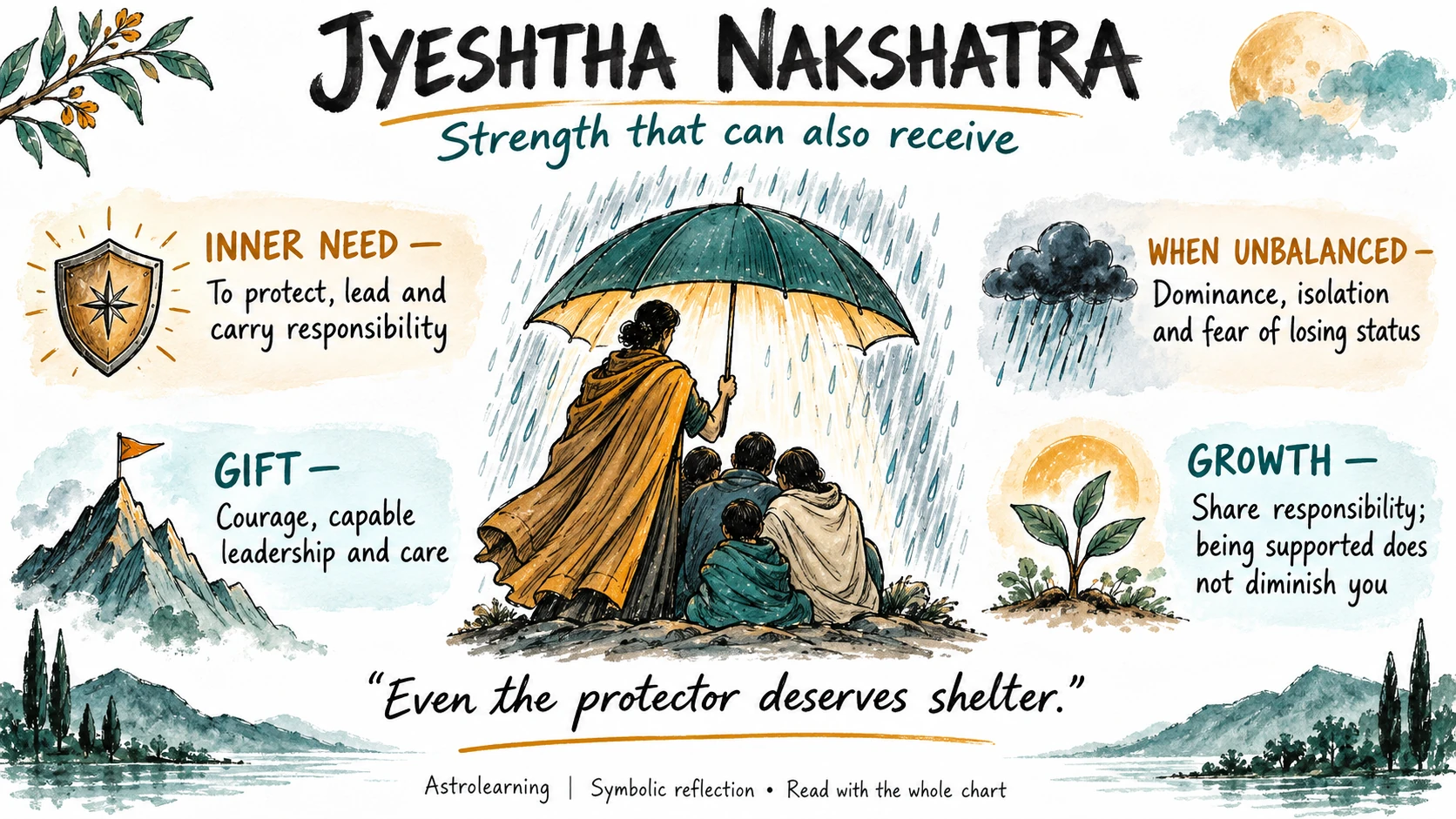
The Elder — The Soul That Carries the Weight of Being First
Core Details
| Factor | Jyeshtha |
|---|---|
| Sanskrit | ज्येष्ठा |
| Nakshatra Number | 18 |
| Zodiac Span | 16°40′ – 30°00′ Scorpio |
| Nakshatra Lord | Mercury |
| Deity | Indra (king of the gods) |
| Symbol | A circular protective talisman / an umbrella / an earring |
| Shakti | Arohana Shakti — the Power to Rise Above and Excel |
| Gana | Rakshasa |
| Guna | Sattva |
| Main Theme | Seniority, protection, responsibility, power, and the isolation that can come with leadership |
| Deity Mantra | Om Indraya Namah |
| Higher Expression | Protective leadership, courage, taking real responsibility for those who depend on you |
| Lower Expression | Insecurity masked as dominance, secretive control, loneliness at the top |
The Fundamental Nature of Jyeshtha
Jyeshtha means “the eldest” or “the senior.” Not the oldest in years necessarily. The oldest in responsibility.
Every family, every group, every kingdom eventually asks the same silent question: who decides? Jyeshtha is the psychology of the one who answers.
Where Anuradha found its strength through alliance, devotion, and the discipline of togetherness, Jyeshtha discovers something colder. Ultimately, someone has to be the one who decides. Someone has to stay awake while others sleep. Someone has to say “I’ll handle it” when no one else will.
That position is often lonely.
Jyeshtha rarely asks to be first. It is simply placed there — by birth order, by circumstance, by an unspoken sense that it is more capable than the moment requires anyone to be. And once placed there, it rarely gets permission to step down.
This is why Jyeshtha carries a quiet gravity. There is nothing careless about it. Even its play has an edge of watchfulness, as though some part of it is always counting heads, checking the perimeter, making sure everyone is accounted for.
The Umbrella — The Symbol of Jyeshtha
The symbol of Jyeshtha is a circular talisman, an earring, or — most tellingly — an umbrella.
An umbrella protects. That is its entire purpose. It stands between the people beneath it and whatever is falling from above.
But notice something the umbrella never gets to do: it cannot shelter itself.
This is the paradox at the center of Jyeshtha. It offers protection outward while remaining exposed itself. It holds the shield so others don’t have to. And the very structure that keeps everyone else dry is the thing standing directly in the storm.
Psychologically, this becomes a pattern. Jyeshtha often becomes the person others run to. The one who is called at 2 a.m. The one who is expected to have already thought of the problem before anyone else noticed it existed.
Being needed like this can feel meaningful. It can also become a cage. The umbrella that never gets to close, never gets to rest, never gets to be held by someone else for a while — that umbrella eventually forgets it was ever anything other than a shield.
Indra — The King Who Must Keep Winning
The deity of Jyeshtha is Indra, king of the gods. And Indra’s mythology is unusual among the deities of the Nakshatras: he is not a god who simply is powerful. He is a god who must constantly defend his throne.
Indra is challenged again and again — by demons, by rival powers, by his own insecurities about losing his seat. His story is full of moments where he must prove, once more, that the crown still belongs to him.
This tells us something important about Jyeshtha’s relationship with power: power that is real is also precarious. The higher the position, the more there is to lose, and the more energy goes into simply holding on to what has already been earned.
A healthy Jyeshtha channels this into vigilance and genuine responsibility — the seriousness of someone who understands that leadership is a duty, not a decoration. An unhealthy Jyeshtha becomes consumed by the fear behind Indra’s throne: “What if someone takes this from me?”
The Tension Between Protection and Control
This is Jyeshtha’s central psychological fault line, and it is a thin one.
Genuine protective strength and controlling behavior can look almost identical from the outside. Both involve stepping in. Both involve taking charge. Both involve saying “let me handle this.”
The difference is what is driving it.
Protection says: “I am doing this because you matter to me.”
Control says: “I am doing this because I cannot bear to feel powerless.”
When Jyeshtha is secure, it leads because leading is necessary and it is willing. When Jyeshtha is afraid, it dominates because losing authority feels like losing identity itself. The lower Jyeshtha may not even recognize the difference. It will call its control care, and its secrecy discretion, and its refusal to be questioned experience.
The evolutionary work is learning to ask, honestly: “Am I protecting them, or am I protecting my position?”
Past-Life Karma
From a symbolic Jyotish perspective, Jyeshtha may carry karmic themes connected with leadership, protection of others, the misuse of power, and the burden of seniority. As always, this is not a literal claim about a previous existence — it is a teaching device for understanding a recurring inner pattern.
The archetype often resembles someone who once held real authority — a commander, an elder, a guardian, a person entrusted with the safety of others. Perhaps that authority was used well. Perhaps, at some point, it was used to control rather than to protect.
The recurring karmic question for Jyeshtha is: “What did you do with the power that was placed in your hands?” Did you shield people, or did you make them dependent on you so they could never leave? Did you lead with courage, or did you rule through fear because fear was easier to manage than trust?
This life often returns Jyeshtha to positions of seniority again — the eldest child, the one relied upon at work, the one everyone defers to — so the soul can finally answer that question with integrity.
Childhood Imprint
Jyeshtha children are frequently pushed into responsibility before they are ready for it. Sometimes literally, as the eldest sibling, handed the care of younger ones almost as soon as they can walk. Sometimes psychologically, treated as more mature, more capable, more “together” than their actual age.
A parent under strain looks at this child and thinks: “At least I don’t have to worry about this one.”
The child hears it differently: “I am not allowed to fall apart.”
This creates a young person who is competent early, composed early, reliable early — and quietly convinced that being needed is the price of belonging. If they stop being the strong one, some part of them fears, they stop mattering.
As adults, this becomes an identity built almost entirely around being the person others can lean on. Which is admirable. It is also exhausting, and it often leaves Jyeshtha with almost no practice at leaning on anyone in return.
Relationships
Jyeshtha in relationships is often the caretaker, the stabilizer, the one who organizes everyone else’s crisis while quietly managing its own alone, later, in private.
Its deepest relationship lesson is this: real intimacy requires letting go of control. It requires allowing itself to be cared for, not just being the one who protects.
This is genuinely difficult for Jyeshtha. Being protected by someone else can feel, unconsciously, like a demotion — as though needing help is proof that the umbrella has failed at its one job.
But a partner cannot truly meet someone who never shows them the underside of the umbrella. Love that only flows outward, never inward, eventually becomes management rather than intimacy. The mature Jyeshtha learns to say the harder sentence: “I need you to hold this for a while.”
Lower Expression
The lower Jyeshtha becomes controlling, secretive, and quietly insecure behind a mask of dominance. It may need to be the one who knows first, decides first, and is deferred to without question. Being challenged can feel less like disagreement and more like a threat to its entire standing.
It may withhold information as a form of power. It may struggle to say “I don’t know” or “I need help,” because both sentences feel like cracks in the throne.
Underneath the dominance is usually fear — fear of being replaced, overlooked, or discovered to be ordinary. And the tragedy is that the harder it grips authority, the more isolated it becomes, because people stop offering real closeness to someone who never admits to needing any.
Higher Expression
The mature Jyeshtha becomes a genuinely protective, courageous leader. It uses its position to shield and support others rather than to control them. It is secure enough in itself that it no longer needs constant deference to feel real.
It can say “I was wrong” without feeling diminished. It can ask for help without feeling exposed. It can share the umbrella, hand it over for a while, and trust that its worth was never in holding it alone.
The highest Jyeshtha understands that true seniority isn’t about being above others. It is about standing where the weather is worst so someone else doesn’t have to — and doing it not out of fear of losing status, but out of love for the ones standing beneath.
“The umbrella was never meant to prove it was strong. It was only ever meant to keep someone else dry — and it is allowed, sometimes, to come in out of the rain.”