

The past-life and karmic sections below are Jyotish interpretations, not historically verifiable facts. They are best understood as symbolic karmic archetypes — a way of teaching the psychology of each Nakshatra, not a literal record of a previous life.
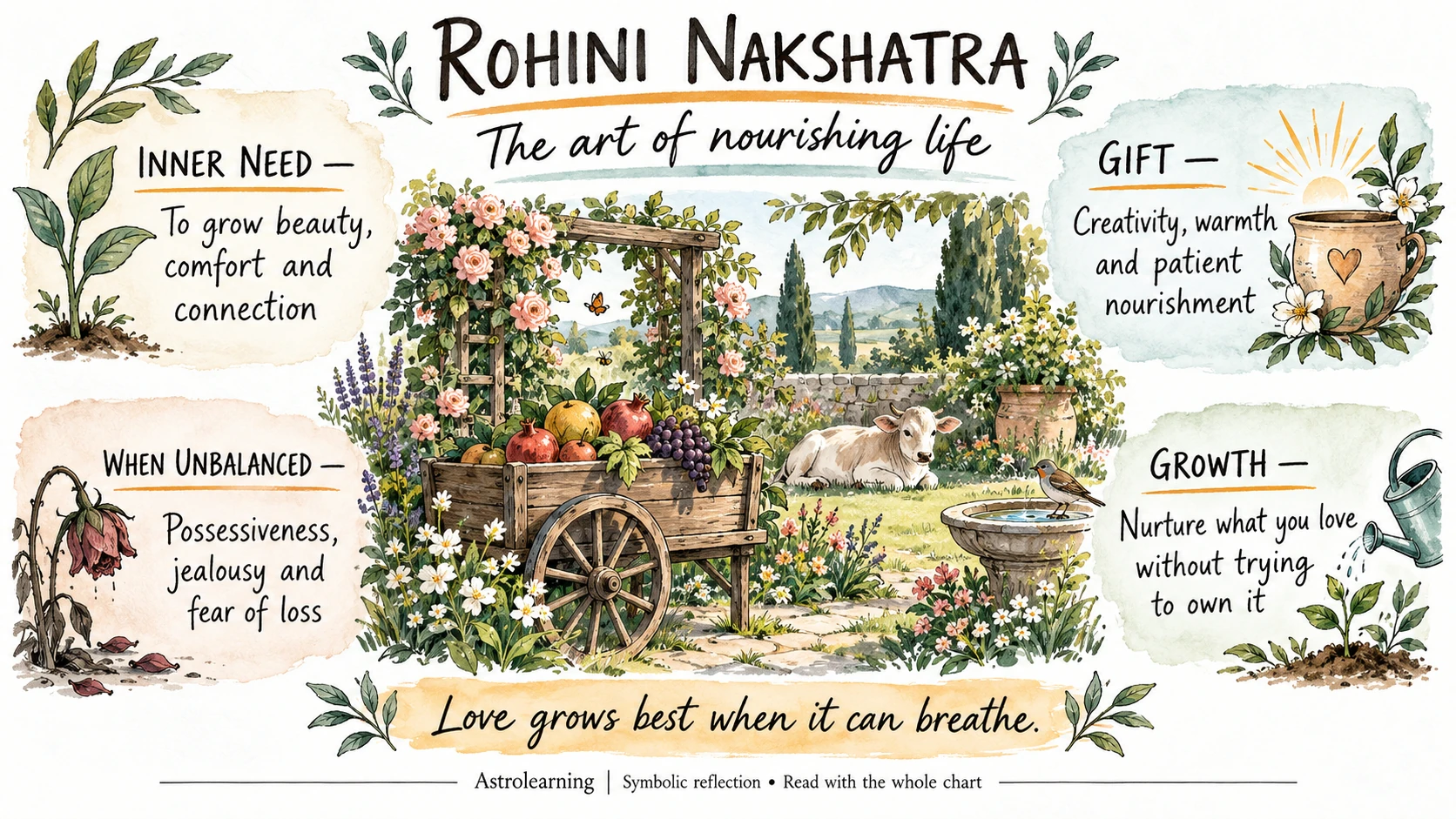
The Garden — The Consciousness That Makes Life Beautiful
Core Details
| Factor | Rohini |
|---|---|
| Sanskrit | रोहिणी |
| Nakshatra Number | 4 |
| Zodiac Span | 10°00′ – 23°20′ Taurus |
| Nakshatra Lord | Moon |
| Deity | Prajapati / Brahma |
| Symbol | Chariot / Cart |
| Shakti | Rohana Shakti — Power of Growth |
| Gana | Manushya |
| Guna | Rajas |
| Main Theme | Growth, beauty, fertility, attraction, nourishment |
| Deity Mantra | Om Prajapataye Namah |
| Higher Expression | Creativity, nurturing, beauty, abundance |
| Lower Expression | Attachment, possessiveness, indulgence, jealousy |
The Fundamental Nature of Rohini
After Krittika removes what is unnecessary, Rohini begins to grow something beautiful. This is an important sequence. The universe doesn’t only destroy. It creates.
Rohini is therefore deeply connected with fertility, attraction, nourishment and growth. Its psychological instinct is: “Let this become more.” More beauty. More comfort. More life. More love. More creation. More emotional richness.
This is why Rohini often has a strong sensory relationship with existence. It notices beauty. It appreciates atmosphere. It responds to food, touch, music, aesthetics, comfort and emotional warmth.
This sensory attunement is not superficial vanity, though it can look that way from the outside. It is closer to a form of intelligence — the ability to sense, almost instantly, whether an environment is nourishing or depleting, whether a relationship is warm or merely polite, whether a meal was made with care or assembled without thought. Rohini registers these differences in the body before the mind has named them.
Because this sensitivity runs so deep, Rohini people often become natural custodians of quality. They are the ones who notice when a room needs better light, when a gathering needs better food, when a friendship needs more warmth and less efficiency. Where Krittika sharpens by removing, Rohini enriches by adding — and the psychological question underneath all of it is simple: does this make life more alive, or less?
The Chariot
The chariot represents movement through the material world. But unlike Ashwini’s horse, Rohini is not primarily concerned with speed. It is concerned with the experience of the journey. The chariot carries something valuable.
Therefore Rohini asks: What are you cultivating while moving through life? This is the difference between movement and growth.
A chariot, unlike a horse running free, is built for someone. It is decorated. It is meant to carry something — a person, an offering, a value worth protecting — from one place to another without damaging it along the way. This is a quietly different relationship to time than most of the early Nakshatras have. Rohini is not trying to arrive first. It is trying to arrive intact, and ideally, more beautiful than when it started.
This shows up practically as a kind of unhurried thoroughness. A Rohini-influenced person may take longer to build a home, a career, or a relationship than someone driven purely by ambition — not from laziness, but because speed and cultivation are different instincts. You cannot rush a garden into bloom. You can only tend it, season after season, until it is ready.
Prajapati — The Creator
Prajapati represents creation. Therefore Rohini carries a powerful creative instinct. Creation can be literal, artistic, emotional or psychological. A Rohini person may want to build an environment where something can flourish. This can be a home. A relationship. A family. An artistic expression. A personal identity. A body. A lifestyle. The fundamental impulse is: Cultivate.
Prajapati is not merely a maker of things — the deity is the origin of the whole reproductive, generative order of the cosmos, the force by which one thing becomes many, by which a seed becomes a forest. This is a different kind of divinity than a warrior god or a destroyer. It is patient, fertile, and endlessly interested in continuation.
A person carrying this energy strongly often feels most alive in the middle of a creative or nurturing process — not necessarily at the finished result, but in the ongoing act of tending something into existence. This is why Rohini rarely feels finished with what it builds. A home can always be made warmer. A relationship can always be made deeper. A body can always be cared for more attentively. The creative instinct here has no natural stopping point, which is both its gift and, unmanaged, its exhaustion.
The Discipline of Enjoyment
It is tempting to think of Rohini’s growth as simply “learning not to be attached.” But that framing misses something important: Rohini’s capacity for pleasure and beauty is not the problem. It is the gift. The real discipline is not in feeling less, but in feeling fully without needing the feeling to last forever.
Consider a Rohini person savoring a meal, a piece of music, or a season of a relationship that they know, on some level, will not stay in this exact form. The immature response is to grip — to overeat, to replay the song until it loses its magic, to hold a relationship so tightly it can’t breathe. The mature response is to be fully present with the pleasure while it lasts, trusting that more beauty will come, in other forms, later.
This is a genuinely difficult psychological skill, and one most other Nakshatras never have to develop in quite the same way. Rohini’s task is not asceticism. It is enjoying richly and releasing gracefully — treating each bloom as complete in itself, rather than as something that must be preserved forever to have mattered.
Past-Life Karma
Symbolically, Rohini may carry karmic patterns involving beauty, pleasure, fertility, attachment, resources and creation. The soul may have experienced abundance before and therefore possess a strong attraction toward comfort and sensory enjoyment. But the karmic lesson is: “Can you enjoy without becoming dependent upon what you enjoy?” Rohini must learn the difference between appreciation and attachment.
This archetype can resemble a soul who once lived close to real abundance — a life of fertile land, comfort, artistry, or plenty — and grew, somewhere along the way, to equate having with being safe. The lesson carried forward is rarely about giving up pleasure. It is about locating the self underneath the pleasure, so that the loss of a comfort does not feel like the loss of identity itself.
Childhood Imprint
Rohini children can be highly sensitive to their environment. The emotional atmosphere of the home can deeply affect them. They may remember smells, food, physical surroundings, voices and sensory experiences vividly. If they receive security, they can flourish. If security is unstable, they may become strongly attached to familiar people and environments.
Because their nervous systems are tuned so finely to atmosphere, Rohini children often become quiet barometers of a household’s emotional weather before anyone else notices a shift. A tense dinner table, a parent’s unspoken worry, a home that has stopped feeling soft — these register in the child’s body long before they could put words to what changed.
This early sensitivity often produces one of two adults: someone who becomes remarkably skilled at creating warmth and beauty wherever they go, having learned early how much it matters, or someone who clings tightly to whatever comfort is available, having learned early how quickly it can disappear. Frequently, it produces some of both.
Relationships
Rohini wants to feel emotionally and physically secure. It can be deeply affectionate. It can create warmth. It can nurture. But its shadow is possessiveness. The fear underneath possession is usually: “What if I lose what I love?” The healing is learning: Love does not become safer because you control it.
In practice, this can look like a partner who is generous, sensual, and devoted — and also quietly tracking, underneath the warmth, every sign that the connection might be slipping. A late reply. A change in tone. A friend who seems to be taking up more space. None of these may mean anything, but Rohini’s nervous system can treat them as evidence, because the fear of loss runs deeper than the evidence itself.
The healthier expression of this same instinct is extraordinary relational nourishment — the ability to make a partner feel genuinely cared for, physically comfortable, and emotionally seen. Rohini, at its best, does not need to hold on tightly, because it has learned that love given freely tends to come back on its own.
Lower Expression
Rohini can become excessively attached to people, comfort, beauty, money, status, familiar environments, and pleasure. The person may resist change because change threatens the world they have carefully cultivated.
Taken further, this attachment can curdle into jealousy or quiet control — not through aggression, but through a slow tightening of the grip, a reluctance to let anything or anyone move freely if it might move away. The lower Rohini may also indulge without discernment, mistaking more pleasure for more meaning, and end up surrounded by comfort that no longer actually satisfies.
Higher Expression
The higher Rohini becomes a creator of beauty and nourishment. It understands how to make life more alive. It can transform an ordinary environment into something emotionally nourishing. It can make people feel comfortable simply through its presence.
This is Rohini in its fullest form — not withholding pleasure out of fear, and not grasping at it out of insecurity, but moving through a life rich with beauty while holding all of it loosely. It becomes possible to love a person, a home, or a season of life completely, and still let it change shape without collapsing.
The highest Rohini understands: “I can enjoy beauty without needing to possess it.”
“What you continuously nourish will eventually become the garden of your life.”