

The past-life and karmic sections below are Jyotish interpretations, not historically verifiable facts. They are best understood as symbolic karmic archetypes — a way of teaching the psychology of each Nakshatra, not a literal record of a previous life.
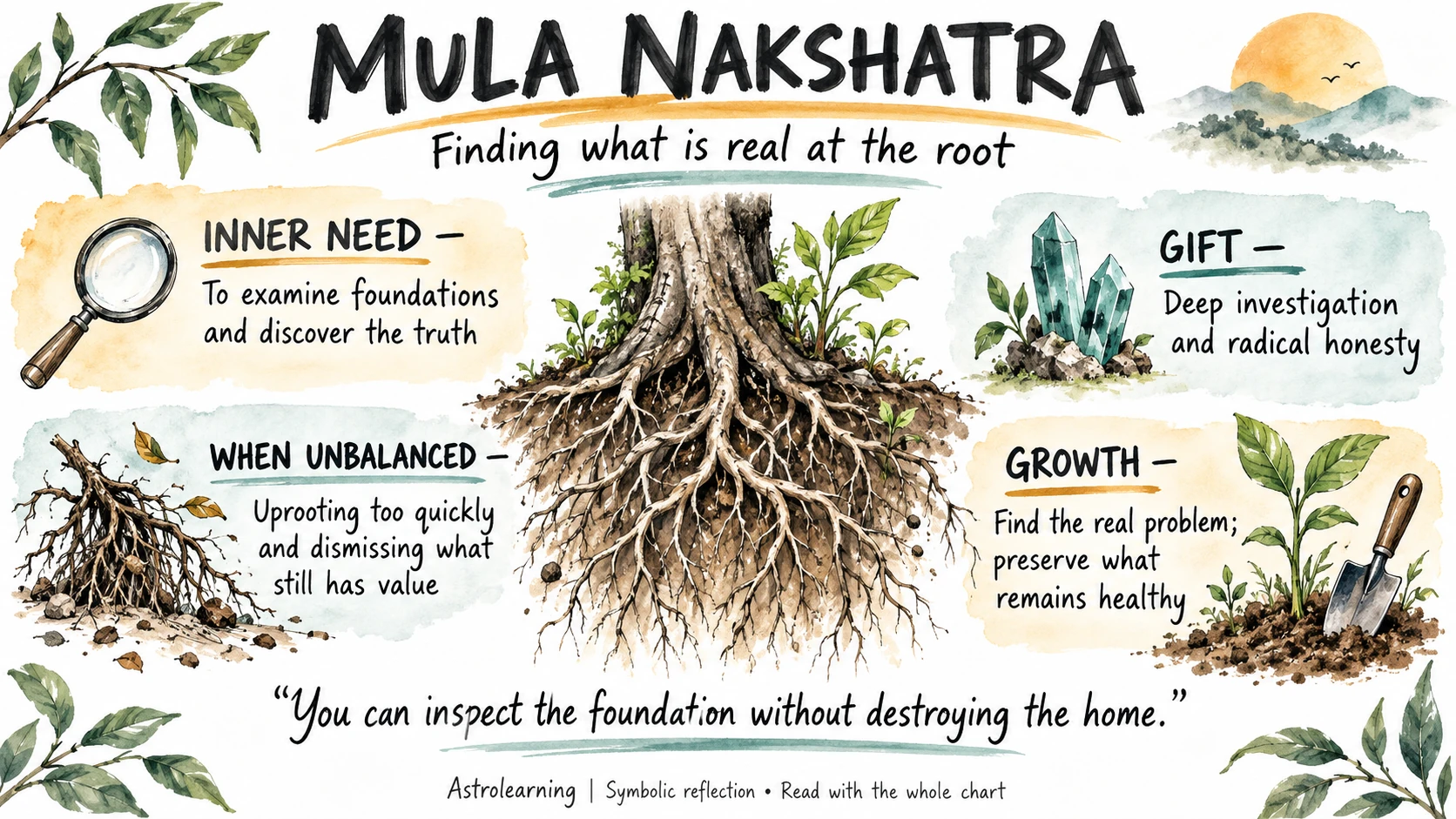
The Root — The Soul That Must Know What’s Really There
Core Details
| Factor | Mula |
|---|---|
| Sanskrit | मूल |
| Nakshatra Number | 19 |
| Zodiac Span | 0°00′ – 13°20′ Sagittarius |
| Nakshatra Lord | Ketu |
| Deity | Nirriti (goddess of dissolution and destruction) |
| Symbol | A bunch of roots tied together / a lion’s tail |
| Shakti | Barhana Shakti — the Power to Uproot and Destroy What Is False |
| Gana | Rakshasa |
| Guna | Tamas |
| Main Theme | Getting to the root, destruction of illusion, radical honesty, foundation-seeking |
| Deity Mantra | Om Nirritaye Namah |
| Higher Expression | Deep investigation, finding the real root cause, spiritual and psychological excavation |
| Lower Expression | Destructiveness, uprooting things prematurely, nihilism, ruthless dismantling of what still had value |
The Fundamental Nature of Mula
Jyeshtha carried the weight of the eldest. It stood at the top of the structure and held everything together through sheer seniority, protecting what was beneath it even when no one thanked it for the effort. Mula ends that arrangement completely.
Mula doesn’t want to stand on top of anything it hasn’t personally checked.
This is the real shift. After eighteen Nakshatras of building, refining, relating and ascending, the zodiac arrives at a mind that asks a very different question: “But is any of this actually real?”
Mula cannot simply accept that a structure is solid because it looks solid, because an authority said so, or because everyone else seems to believe it. It has to go underneath. It has to find the root — the part no one sees, the part that actually holds the weight.
This makes Mula one of the most intellectually and spiritually honest points in the entire wheel. It also makes it one of the most disruptive.
Mula says: “Show me what’s actually underneath this, or I can’t trust it.”
Sometimes what’s underneath is solid. Sometimes it isn’t. Mula’s task — and its danger — is what it does once it finds out.
The Bundle of Roots — The Symbol of Mula
A root is the part of the plant nobody admires. No one photographs a root system. No one compliments it. But without it, nothing above the ground survives a single strong wind.
This is Mula’s core symbolism: what is unseen but load-bearing.
A Mula-influenced person often has a natural instinct for locating the unseen thing that everything else depends on — the real reason a company is failing, the real wound underneath a person’s pattern, the real belief holding up an entire worldview. They go for the root, not the branches.
The symbol’s second image, the lion’s tail, adds something sharper. The tail is the part of the lion you don’t see coming. You’re watching the face, the paws, the obvious danger — and the tail moves. Mula carries this same quality of consequence arriving from an unexpected angle. Its impact isn’t always where you were looking.
Both images point to the same truth: with Mula, the visible surface is never the whole story.
Nirriti — The Deity of Dissolution
Nirriti is not a comfortable deity. She governs decay, loss, dissolution — the forces that dismantle what has run its course. In a culture that often prefers gods of creation and preservation, Nirriti is easy to misread as purely negative.
But dissolution is not the opposite of order. It is part of it.
A dead structure has to come down before a living one can be built in its place. A false belief has to collapse before a truer one can take root. A relationship built on illusion has to end before a real one can begin. Nirriti presides over this necessary unmaking.
Mula, ruled by this deity and by Ketu, carries an instinctive relationship with endings. It is often the person in the room willing to say: “This isn’t working. It hasn’t been working for a while.” That sentence, spoken at the right moment, can save years of everyone’s life.
Spoken at the wrong moment, aimed at something that was still growing, it can destroy something that only needed more time.
The Tension Between Honesty and Destruction
This is where Mula’s real psychological work happens.
Radical honesty and unnecessary destruction can look identical from the outside. Both involve tearing away a comfortable story. Both can feel, in the moment, like courage.
But they are not the same thing.
Honest excavation asks: “What is actually true here?” and stays with the answer, even an uncomfortable one, long enough to understand it.
Destruction for its own sake asks nothing. It simply pulls, because pulling feels like relief, because uncertainty is intolerable, because Mula would rather have an ending than sit with something unresolved.
The immature Mula often can’t tell the difference between the two in the moment. It only knows that something feels false, incomplete, or unproven — and the urge to rip it out is immediate. The mature Mula learns to pause between the sensing and the pulling. That pause is where wisdom lives.
Past-Life Karma
As with every Nakshatra in this series, the karmic material here is a symbolic teaching device, not a historical claim about anyone’s previous existence.
From a Jyotish perspective, Mula can symbolically carry karmic themes connected with destruction, upheaval, the search for foundational truth, and the responsibility that comes with the power to dismantle.
The archetype may resemble a soul who once held real power to bring things down — a truth-teller who exposed something that couldn’t be unseen once exposed, a force present at the collapse of a structure, a witness to upheaval on a scale larger than one life.
The deeper karmic question isn’t whether destruction happened. It’s: “What did you do with the power to destroy?” Did you use it only when something truly needed to end? Or did you use it because ambiguity was unbearable and destroying was easier than waiting?
This life often asks Mula to meet that question again, more consciously.
Childhood Imprint
Many Mula children experience some form of early instability — a move, a loss, a family rupture, a sudden change in circumstances that pulled the ground out from under an otherwise ordinary childhood. It doesn’t have to be dramatic to leave a mark. Sometimes it’s simply the discovery, younger than most children make it, that the things adults present as permanent are not always permanent.
This forces a certain kind of question early: “What can I actually rely on?” Not asked abstractly, but lived.
The child who asks this early often becomes an adult with an unusually accurate radar for what is solid and what only appears solid. But that same radar can make ordinary security hard to trust. Even when the ground is genuinely stable, some part of Mula keeps checking, keeps testing, keeps waiting to see if this, too, will give way.
Learning that some ground really can be trusted — without needing to test it into collapse — is one of Mula’s central adult tasks.
Relationships
Mula’s core relationship lesson is this: the instinct to test a foundation is not the same as the need to destroy it.
Mula in a relationship often cannot simply enjoy the surface of it. Some part of the mind keeps probing: “Is this real? Would this survive a real problem? What’s actually holding this together?” This can look, from a partner’s side, like sabotage — picking fights that don’t need to happen, pushing on things that were fine, forcing crises to see what breaks.
Sometimes it is sabotage. But underneath the sabotage is usually a legitimate need: Mula genuinely cannot rest on top of a connection it hasn’t verified.
The mature version of this instinct isn’t silence and isn’t demolition. It’s honest inquiry — the willingness to ask the hard question directly, out loud, to the person’s face, and then actually listen to the answer instead of manufacturing a crisis to get one. “I need to know this is real” is a legitimate need. Engineering a collapse to find out is not the only way to meet it.
Lower Expression
The lower Mula becomes scorched-earth. It uproots relationships, jobs, beliefs and communities impulsively, often at the exact moment something imperfect could have been repaired instead of abandoned. It confuses ending with clarity.
It can slide toward nihilism — a conviction that nothing is ultimately solid, so nothing is worth building carefully. If everything eventually falls apart, why tend to it at all?
And it can weaponize its own honesty. “I’m just being real” becomes the justification for cruelty that didn’t need to happen, for burning down what was still partly standing, for mistaking the satisfaction of destruction for the discipline of truth.
The lower Mula destroys things it hasn’t fully understood yet, simply because not-yet-understood feels the same, in the body, as false.
Higher Expression
The higher Mula becomes something rare: a fearless, trustworthy excavator of truth. It can go into the places other people avoid — the unspoken family pattern, the unexamined belief, the organizational dysfunction everyone senses but no one names — and come back with an accurate account of what’s really there.
Crucially, the mature Mula can do this without needing to burn everything else down to get there. It learns to separate the root from the rest of the plant — to name the real problem precisely, and to leave what was healthy intact.
This is Mula at its best: not the destroyer, but the one willing to dig until the truth is visible, and disciplined enough to stop digging once it is.
“You cannot build anything real on a foundation you were too afraid to inspect — but you don’t have to demolish the house to check what’s holding it up.”