

The past-life and karmic sections below are Jyotish interpretations, not historically verifiable facts. They are best understood as symbolic karmic archetypes — a way of teaching the psychology of each Nakshatra, not a literal record of a previous life.
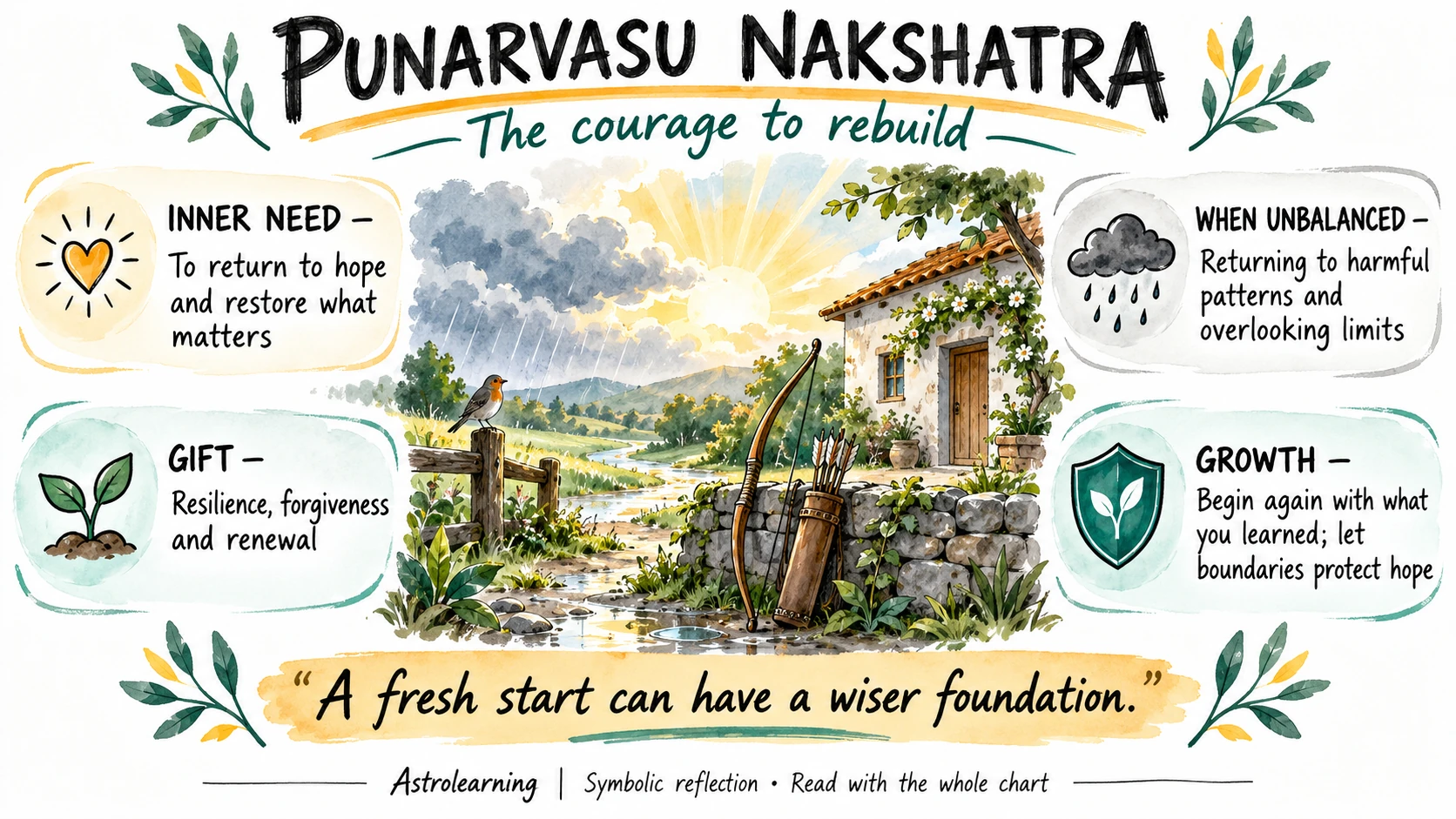
The Return of Light — The Consciousness That Rebuilds
Core Details
| Factor | Punarvasu |
|---|---|
| Sanskrit | पुनर्वसु |
| Nakshatra Number | 7 |
| Zodiac Span | 20°00′ Gemini – 3°20′ Cancer |
| Nakshatra Lord | Jupiter |
| Deity | Aditi |
| Symbol | Bow and Quiver of Arrows |
| Shakti | Vastu Apabharana Shakti — Power of Regaining |
| Gana | Deva |
| Guna | Sattva |
| Main Theme | Renewal, restoration, hope, return |
| Deity Mantra | Om Aditaye Namah |
| Higher Expression | Hope, resilience, wisdom, restoration |
| Lower Expression | Naivety, repetition, excessive forgiveness |
The Fundamental Nature of Punarvasu
Punarvasu comes immediately after Ardra. This sequence is incredibly meaningful. Ardra is the storm. Punarvasu is the sky after the storm. The Nakshatra represents the ability to return to light after darkness.
This does not mean Punarvasu never suffers. It means suffering does not permanently define it. It can lose something and rebuild. It can fail and begin again. It can experience disappointment and still retain faith. This is why Punarvasu often carries a remarkable inner optimism.
Where Ardra tears a situation down to its honest shape, Punarvasu is what comes after: not the tearing, but the assembling. It gathers what is left once the storm has passed and asks a quiet, stubborn question — “What can still be built from this?” In its mature form, this is not naive optimism. It is closer to structural faith: a trust that even a damaged situation still contains usable material.
This capacity does not arrive without cost. To rebuild again and again, something in Punarvasu has to keep believing that effort is not wasted. When this belief is grounded, it produces people who are almost impossible to permanently discourage. Ungrounded, the same belief can curdle into a refusal to accept that some things really are over.
Aditi — The Boundless Mother
Aditi represents vastness, freedom and the motherly principle. Therefore Punarvasu’s consciousness wants to return to something spacious. When life becomes psychologically narrow, Punarvasu seeks expansion. Its healing comes through remembering: “There is more life than this one experience.”
A breakup is not the entire story. A failure is not the entire story. A loss is not the entire story.
In Vedic myth, Aditi is mother to the Adityas, the twelve solar deities — the source from which multiplicity is born, without ever being diminished by what she gives birth to. That image matters psychologically. It suggests an abundance that is not used up by loss. Something can be taken from Punarvasu’s life, and the deeper source it draws from remains intact.
This is why a Punarvasu-influenced person can walk out of a genuinely painful ending — a job that dissolved, a relationship that failed, a plan that collapsed — and, often to the surprise of the people around them, begin talking about what comes next within weeks rather than years. It is not that the pain was not real. It is that the identity was never fully staked on that one outcome in the first place.
The Bow and Quiver
The bow represents intention. The arrow represents action. The quiver represents more possibilities. You can shoot one arrow and miss. There are still others. This is the psychology of Punarvasu. It does not allow one failure to become the final definition of the self.
Look closely at what the symbol is not. It is not a single arrow, already loosed, frozen mid-flight. It is a quiver — a container of potential, of shots not yet taken. Many Nakshatra symbols in this series are defined by an action already committed: a sword drawn, a fire lit, a threshold crossed. Punarvasu’s symbol is defined by readiness. It exists in the moment before the next attempt, not the moment of the last one.
This produces a particular relationship to failure worth naming directly. For most people, a missed shot narrows the sense of what is possible. For Punarvasu, at its healthiest, a missed shot simply confirms that the quiver still has arrows in it, and the bow is still in hand. The failure is data, not verdict.
The shadow side of the same symbol is a person who never really commits to any single shot, because there is always another arrow to try instead. Endless retries can quietly become a way of avoiding the discomfort of a final, binding choice.
The Discipline of Hope
Punarvasu’s central tension is the distance between two things that can look nearly identical from the outside: faith that has been tested and survived, and optimism that has simply never looked hard enough at the evidence.
The mature expression has usually been through real loss. It has grieved honestly, felt the full weight of what did not work, and still arrived, afterward, at hope — not instead of grief, but on the other side of it. This hope has texture. It knows exactly what it survived.
The immature expression skips the grieving. It reaches for optimism as a way of not feeling the loss fully, insisting “everything happens for a reason” before the reason has actually been earned through honest reckoning. This is hope used as anesthetic rather than hope arrived at through experience.
Real hope and premature hope can sound identical in a sentence. The difference is what happened underneath, before the sentence was spoken. Punarvasu’s growth lies in resisting the urge to reach for renewal before the ending has actually been allowed to finish.
Past-Life Karma
Symbolically, Punarvasu may represent karmic patterns involving loss, restoration, rebuilding, homecoming and repeated cycles of beginning again. The soul may have experienced situations where things were taken away and later restored in another form. The lesson is developing faith without attachment to a particular form. Something may return. But it may not return in the same shape.
The archetype often resembles a soul who once lost something significant — a home, a position, a family, a way of life — and had to rebuild from very little. Perhaps there was exile before return, displacement before resettlement, ruin before reconstruction. The soul may carry an old familiarity with starting over that this lifetime is asking it to use consciously rather than merely repeat.
The deeper karmic question is not whether the loss happened. It is what the soul concluded from it. Did it learn that rebuilding is possible, and carry that forward as quiet confidence? Or did it learn only that nothing lasts, and carry that instead as a low-grade dread beneath every new beginning? Punarvasu’s task in this life is often to metabolize the old loss into wisdom rather than into permanent vigilance.
Childhood Imprint
Punarvasu children can recover remarkably well after disappointment. They may have an internal belief that things will eventually improve. But this can become avoidance if they refuse to acknowledge difficult realities. The mature lesson is: “Hope must coexist with realism.”
This resilience is often visible early. A Punarvasu child who loses a game, a friendship, or a favorite toy tends to bounce back faster than the adults around them expect — sometimes faster than seems entirely credible. Where another child might need days to process a disappointment, this child may already be talking, with real sincerity, about what comes next.
Handled well, the adults around this child validate both halves of the pattern — the resilience and the reality underneath it. Handled poorly, adults praise only the quick recovery, inadvertently teaching the child that its worth lies in never appearing troubled. This can produce an adult who has become extremely skilled at bouncing back, and only quietly aware of how rarely they let themselves actually land.
Relationships
Punarvasu can be incredibly forgiving. Sometimes too forgiving. It may give people multiple opportunities. Its lesson is understanding that forgiveness does not require repeated exposure to the same behavior. You can forgive someone and still maintain distance.
This forgiving quality often makes Punarvasu a deeply healing presence in relationships. It rarely holds a grudge the way many people do, and genuinely believes people can change. A partner who has been harshly judged elsewhere can find, in a Punarvasu-influenced relationship, an unusual amount of room to be imperfect and still be welcomed back.
The risk sits exactly where the gift does. Because Punarvasu is so genuinely capable of starting over, it can mistake a partner’s cycle of harm-and-repair for an ordinary rhythm rather than a pattern that needs to end. “We always work it out” can be true and still not be a reason to stay. The mature version learns to ask a harder question before extending the next chance: not “Can I forgive this?” — the answer is almost always yes — but “Should this continue?”
Lower Expression
Excessive optimism. Naivety. Repeatedly returning to unhealthy situations. Avoiding endings because of the belief that everything will somehow become okay.
At its most depleted, this shows up as a kind of chronic non-arrival — always about to rebuild, never quite settled long enough to test whether the new foundation holds. Endings get postponed indefinitely, because acknowledging one honestly would mean sitting, for a while, without the comfort of an immediate next chapter.
Higher Expression
Resilience. Faith. Forgiveness. Renewal. The ability to rebuild without becoming bitter.
At its best, Punarvasu becomes proof, simply by example, that beginning again is genuinely possible — not as a slogan, but as something people can watch happen in a real life, with real losses in it. Most people need to see resilience modeled by someone who has actually been through something before they can believe it is available to them too. Punarvasu, having rebuilt more than once, can offer exactly that.
“Beginning again is not returning to who you were; it is returning to the light with everything you have learned.”