

The past-life and karmic sections below are Jyotish interpretations, not historically verifiable facts. They are best understood as symbolic karmic archetypes — a way of teaching the psychology of each Nakshatra, not a literal record of a previous life.
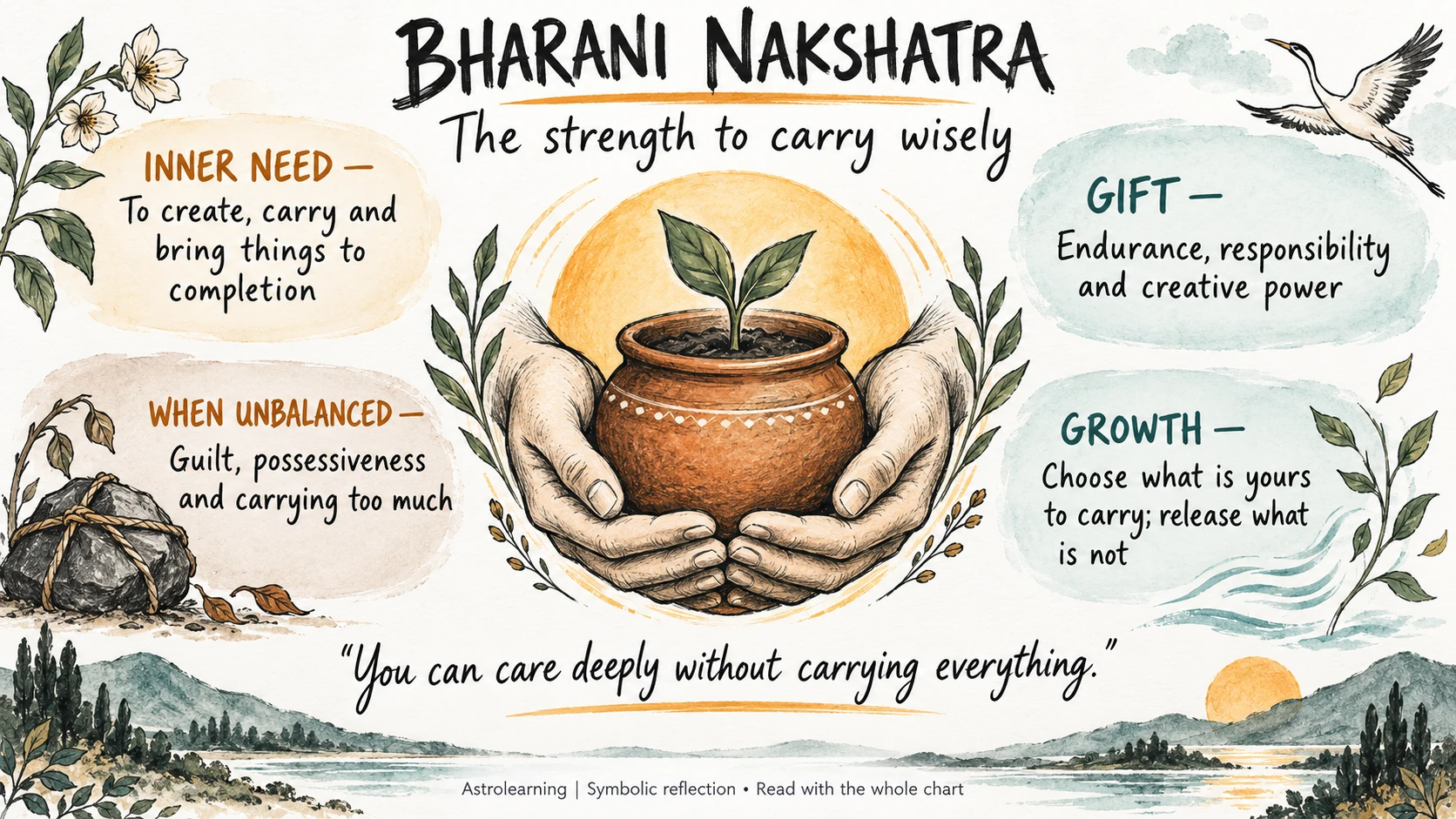
The Womb — The Soul That Learns to Carry
Core Details
| Factor | Bharani |
|---|---|
| Sanskrit | भरणी |
| Nakshatra Number | 2 |
| Zodiac Span | 13°20′ – 26°40′ Aries |
| Nakshatra Lord | Venus |
| Deity | Yama |
| Symbol | Yoni / Womb |
| Shakti | Apabharani Shakti — Power to Bear/Carry |
| Gana | Manushya |
| Guna | Rajas |
| Yoni | Elephant |
| Main Theme | Creation, responsibility, endurance, transformation |
| Deity Mantra | Om Yamaya Namah |
| Higher Expression | Maturity, responsibility, creative power |
| Lower Expression | Possessiveness, guilt, control, emotional burden |
The Fundamental Nature of Bharani
If Ashwini represents the beginning, Bharani represents the responsibility of carrying what has begun. This is why the womb is such a profound symbol. A womb does not create something and immediately release it. It carries. It protects. It nourishes. It waits. And it waits until the process is complete.
This gives Bharani an understanding that many things in life cannot be rushed. You cannot force emotional maturity. You cannot force transformation. You cannot force creation. You cannot force birth.
There is also a quieter tension built into Bharani that most people never notice. The sign is Aries — ruled by Mars, built for speed and the thrill of starting. But the Nakshatra’s own ruler is Venus, the planet of relationship, pleasure and completion. So Bharani lives inside a contradiction from the very beginning: the impulse to act immediately, paired with a planet that insists on staying close to what has already been touched. This is precisely why Bharani feels heavier than the rest of Aries. It is Aries energy asked to slow down and stay.
In practice, this shows up in ordinary places: the excitement of a wedding followed by the unglamorous work of an actual marriage, the joy of conceiving an idea followed by months of unremarkable labor before it becomes anything real. Ashwini gets to feel the spark. Bharani has to live with what the spark started — long after the spark itself has stopped being interesting.
Bharani therefore carries the psychological message: “What is worth creating must sometimes be carried through discomfort.”
The Yoni — Creation and Transformation
The yoni is a powerful symbol of creation, sexuality, birth and generative potential. Bharani therefore has a deep relationship with desire. It understands that desire itself is not necessarily negative. Desire creates movement. But desire also creates responsibility. If you create something, you must take responsibility for what you create.
This makes Bharani a Nakshatra of consequences. It asks: What are you willing to carry after getting what you wanted? That question is central to Bharani.
Many spiritual frameworks treat desire with suspicion, as something to be renounced or transcended. Bharani does not take that route. It treats desire as sacred material — the same generative force that creates a child, a work of art, a business, a bond between two people. The Nakshatra’s discomfort is never with wanting. It is with what people do once they actually receive what they wanted.
This is where the real test begins. Wanting something is easy — almost effortless, almost pleasurable in itself. Living with the reality of having gotten it is harder. The person who desperately wanted the relationship must now do the daily work of being in one. The person who desperately wanted the child must now be responsible for a whole human life, indefinitely. Bharani understands, on some instinctive level, that desire is only the doorway — what happens on the other side of it is the actual life.
Yama — The Deity of Bharani
Yama introduces a completely different dimension. Yama represents death, boundaries, morality, justice and consequences. So Bharani contains an apparent contradiction: birth + death, creation + limitation, pleasure + responsibility, desire + consequence.
This is why Bharani people can have a mature understanding of life. They may intuitively understand that everything created eventually changes. Everything possessed eventually has to be released. Every beginning contains an ending. The person therefore has the potential to develop tremendous psychological maturity.
It is worth sitting with how unusual this pairing actually is. Venus, the Nakshatra’s ruler, wants pleasure, closeness, beauty, union. Yama, its presiding deity, wants boundaries, accounting, the end of things. Most people experience these as opposites — they either chase pleasure and avoid thinking about endings, or become so fixated on endings that pleasure feels pointless. Bharani is asked to hold both at once.
The result, when it matures, is a rare kind of desire — one that already knows it will end, and chooses to want anyway. This is not cynicism. It is closer to the opposite: a willingness to love or build something fully aware that nothing lasts, without letting that awareness cheapen the wanting. A parent who knows their child will grow up and leave, and loves them completely anyway, is living out Bharani’s deepest lesson.
Past-Life Karma of Bharani
Symbolically, Bharani can indicate karmic themes around responsibility, sexuality, creation, power, moral consequences and carrying burdens. The archetype may resemble someone who previously had significant responsibilities over people, resources, family or important transitions.
This should be read the way every karmic section in this series is meant to be read — as a symbolic teaching tool, not a historical record. The value of the image is psychological: it explains why some people arrive already fluent in responsibility, already aware that actions have weight.
The karmic question becomes: “What did you create, and what did you do with the consequences?”
Bharani may therefore repeatedly experience situations where life asks for maturity. It may receive something it strongly desires — and then discover that obtaining it is easier than carrying it. This is not punishment. It is development.
Childhood Imprint
Bharani children may sometimes feel older internally than their age suggests. They can observe emotional situations and understand that something serious is happening even when adults don’t explain it. They may therefore develop a strong internal world.
This often looks like a specific kind of child — the one who becomes the emotional anchor in a household without ever being asked to. The child who quietly makes sure a younger sibling is fed, who reads a parent’s mood before anyone else notices it has shifted. From the outside, this can look like maturity. From the inside, it often feels like there was no other option.
In difficult circumstances, they may learn: “I have to handle this.” That can become extraordinary emotional strength later. But it can also produce the belief: “I must carry everything myself.” The healing is learning that responsibility does not mean carrying every burden.
What makes this pattern so persistent is that it usually works. The Bharani child who takes on responsibility early is frequently rewarded for it — praised for being reliable, trusted with more than their age would warrant. Undoing it later in life does not mean becoming irresponsible. It means learning that being loved does not require being useful.
Relationships
Bharani does not generally want completely superficial intimacy. It wants depth. When emotionally attached, it can become intensely loyal. But because Bharani understands possession and attachment deeply, it can also struggle with letting go.
This intensity is easy to misread, from the outside, as simple possessiveness. It rarely feels that way from the inside. What Bharani actually fears is not losing control of another person — it is the experience of having poured itself fully into someone, the way a womb pours itself into what it carries, and then discovering that devotion offers no guarantee of permanence. The grip is not about power. It is about the terror of loving something you cannot ultimately keep.
A Bharani partner in a secure relationship is often extraordinarily devoted — the kind of presence that shows up during illness and failure, the versions of a person that are hardest to love. But the same intensity, left unexamined, can turn into quiet surveillance: tracking a partner’s moods, needing constant reassurance. The work is learning that a bond can be deep without being a leash.
The lower expression may say: “If I love you, I need to have you.” The higher expression learns: “If I love you, I must allow you to exist as yourself.” This is one of Bharani’s greatest relationship lessons.
Lower Expression
Bharani can become possessive, controlling, emotionally intense, secretive, resentful, burdened, guilt-driven, and attached to suffering. Sometimes the person carries something simply because they have become psychologically identified with being the one who carries it.
This can show up as the person who stays in a draining job, or a relationship that ended years ago in every way but the paperwork — not because leaving is impossible, but because leaving feels like a betrayal of everything already carried. Guilt becomes the reason to keep carrying, long after the original reason for carrying has disappeared. The lower Bharani mistakes endurance itself for virtue.
Higher Expression
The higher Bharani becomes someone who can hold enormous emotional and creative power without being destroyed by it. They can sit with difficult realities. They can endure transformation. They can create something and take responsibility for it. They understand that discomfort is sometimes part of growth.
This is the Bharani who can raise a child or finish a difficult creative project without becoming bitter, without needing credit for the sacrifice, without secretly waiting for someone to notice how much they are carrying. They carry because the thing being carried matters, not because carrying has become their identity. The weight stays the same; the relationship to the weight transforms completely.
Bharani becomes the consciousness that says: “I can carry this without allowing it to define me.”
“Strength is not merely the ability to carry a burden; it is knowing which burdens are yours to carry.”