

The past-life and karmic sections below are Jyotish interpretations, not historically verifiable facts. They are best understood as symbolic karmic archetypes — a way of teaching the psychology of each Nakshatra, not a literal record of a previous life.
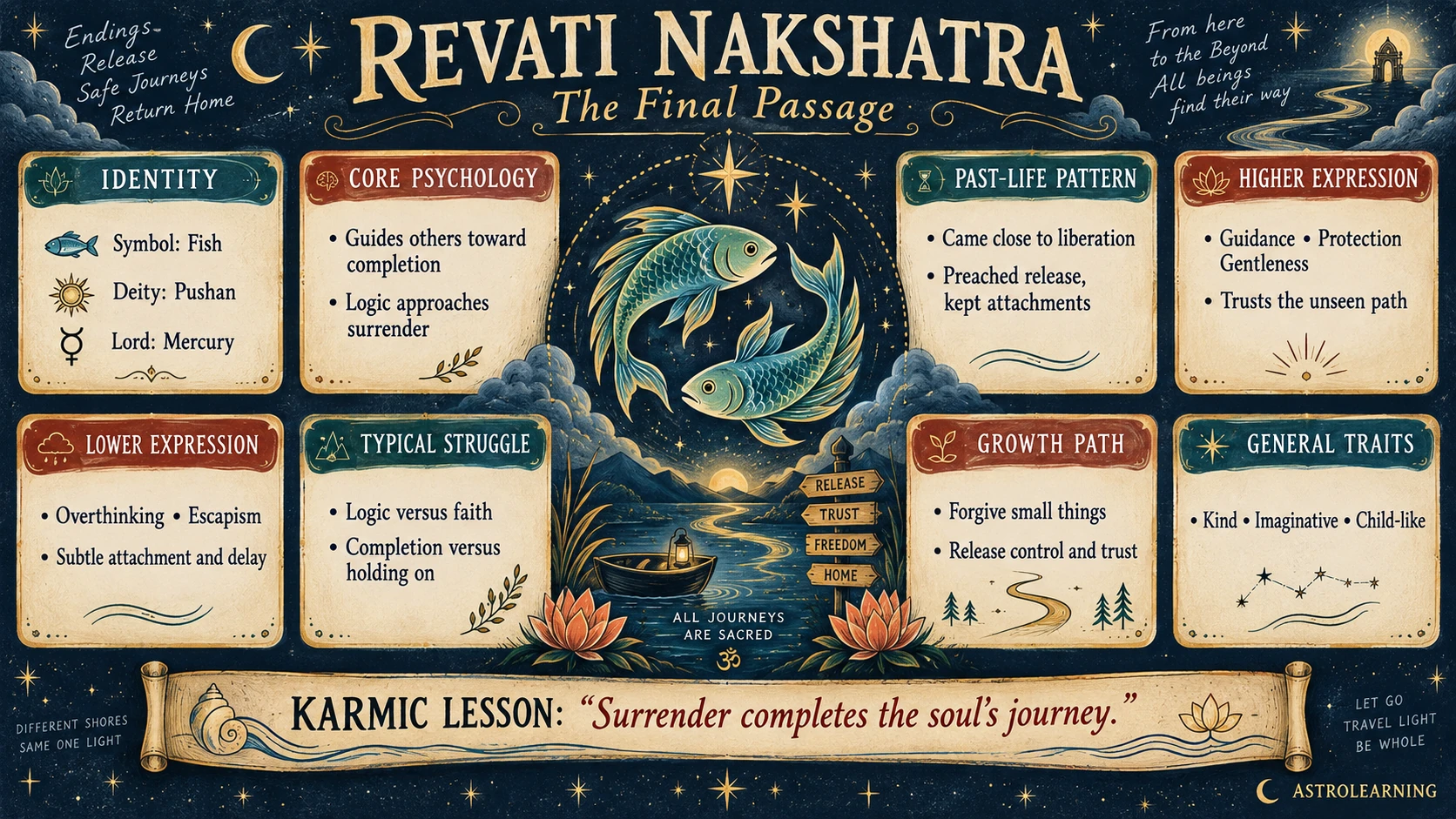
The Last Fish — The Soul That Guides Everyone Safely Home
Core Details
| Factor | Revati |
|---|---|
| Sanskrit | रेवती |
| Nakshatra Number | 27 |
| Zodiac Span | 16°40′ – 30°00′ Pisces |
| Nakshatra Lord | Mercury |
| Deity | Pushan (the nourisher, protector of travelers and herds, guide of safe passage) |
| Symbol | A fish / a drum |
| Shakti | Kshiradyapani Poshani Shakti — the Power to Nourish and Ensure Safe Passage |
| Gana | Deva |
| Guna | Sattva |
| Main Theme | Completion, compassion, gentle guidance, nourishment, safe transitions and endings |
| Deity Mantra | Om Pushne Namah |
| Higher Expression | Compassionate guidance, gentle completion, unconditional care especially for the vulnerable |
| Lower Expression | Over-giving to the point of self-neglect, difficulty setting boundaries, naive over-trust |
The Fundamental Nature of Revati
Revati is the last of the twenty-seven Nakshatras. Ashwini says: “Let me go.” Revati says: “Let me make sure everyone arrives.”
That single difference contains its entire psychology.
Its deity is Pushan, the guide who ensures safe passage — the shepherd who walks behind the herd, not ahead of it, making sure nothing and no one is lost along the way. Pushan doesn’t lead through force. Pushan leads through presence. He is the one who notices the traveler who has fallen behind, the animal that has wandered off the path, the soul that is quietly struggling to keep up.
This gives Revati an instinct that is almost impossible to switch off: every ending should be handled gently, and every traveler should be brought safely home.
Where other Nakshatras are organized around beginning, building, fighting or acquiring, Revati is organized around a much quieter question: “Has everyone made it through?”
The Fish — The Symbol of Revati
The fish belongs to water, and water is the realm of feeling, memory and the unconscious. But a fish also moves fluidly between what is visible and what is hidden — gliding just beneath the surface, sensing currents the eye cannot see.
This makes the fish a transitional creature. It doesn’t fully belong to the world of hard edges and fixed forms. It belongs to movement between states.
Psychologically, this gives Revati a natural sensitivity to thresholds. It often knows, almost before anyone says anything, when a relationship is ending, when a chapter is closing, when someone is quietly grieving something they haven’t named yet.
Revati doesn’t fight the tide. It moves with it, sensing where the current is taking things, and trying to make sure the crossing is as gentle as possible for everyone caught in it.
Pushan — Nourishment Without Conditions
Pushan is often described as a nourisher of herds and a protector of those on the road. What is important here is not just that he gives — it is how he gives.
Pushan doesn’t ask the traveler to prove they deserve safe passage. He simply offers it.
This is Revati’s deepest gift: compassion that doesn’t require qualification. It doesn’t need someone to be a good person, a deserving person, or a person who will pay it back. It sees someone struggling, and something in it simply responds: “Let me help you through this.”
This is beautiful. It is also where Revati’s central tension begins.
The Central Tension — Boundless Compassion Versus Self-Erasure
Because Revati gives without conditions, it often forgets to ask a second question: “What about me?”
Its compassion is genuine. It is not performed, not strategic, not a way of earning approval. But genuine compassion, offered without limit, can quietly turn into self-neglect. The person keeps nourishing everyone around them and slowly stops noticing that their own reserves have run dry.
And because Revati trusts so readily — the same openness that lets it guide strangers safely home — it can also be the last to notice when someone is taking advantage of that trust.
The evolutionary lesson is not “Stop caring.”
It is: “You are also one of the travelers who deserves safe passage.”
Past-Life Karma
From a symbolic Jyotish perspective, Revati may carry karmic themes connected with endings, farewells, guiding others through transition, and the completion of long cycles. Again, this is not meant as a literal record — it is a teaching device, a way of describing a psychological signature that feels ancient.
The archetype may resemble someone whose role, in a symbolic past, involved caring for the dying, guiding the displaced, tending to those who had nowhere else to turn, or standing at the threshold where one phase of life closed and another began.
The deeper karmic question isn’t simply “Did you help others through their endings?” It is: “Did you let anyone help you through yours?”
Revati’s evolution often depends on learning to receive the same gentle passage it has spent lifetimes offering to everyone else.
Childhood Imprint
Revati children are often gentle, empathetic, and quick to notice when someone nearby is upset. They may comfort a crying classmate before a teacher even reaches them. They may sense a parent’s hidden sadness long before it is spoken aloud.
This can be a beautiful quality. But it can also come at a cost. If a Revati child learns, early on, that attention and affection arrive most reliably when they are taking care of someone else, they may quietly absorb a belief: “My worth comes from what I give.”
As adults, this can become a pattern of anticipating everyone’s needs while struggling to identify their own.
Relationships
Revati loves generously and without much calculation. It is the partner who notices when you’re exhausted before you say a word, who shows up quietly during hard transitions, who never makes love feel conditional.
This is real, and it is rare. But Revati’s relationship lesson is learning that generosity without boundaries eventually becomes invisible. If it never says what it needs, the people around it may never learn to ask.
The mature Revati understands: Love that erases you is not the same as love that includes you. Gentleness must be paired with a voice.
Lower Expression
The lower Revati becomes the one who gives until there is nothing left. It struggles to say no. It stays in situations far past the point where leaving would be healthier, because leaving might mean someone is left unguided.
It can trust too readily, mistaking someone’s need for goodness, and be quietly taken advantage of by people who sense how boundless its kindness is. It may lose track of its own direction entirely, so occupied with everyone else’s crossing that it forgets it is also on a journey.
The person may unconsciously believe: “If I stop giving, I stop mattering.”
Higher Expression
The higher Revati becomes a genuinely wise guide — someone who can walk beside others through their hardest transitions without losing themselves in the process. It nourishes without depleting itself, because it has learned that protecting your own wellbeing is not a betrayal of compassion — it is what allows compassion to continue.
It can sit with someone at the end of something — a marriage, a job, a life — and offer exactly what Pushan offers: presence, without needing anything in return.
The highest Revati doesn’t just help people leave gently. It helps them arrive gently, too.
Revati and the Completion of the Zodiac Wheel
Revati is the last stop of the entire cycle. After its final degree, the wheel does not simply stop. It begins again, at Ashwini’s first spark, at “Let me go.”
This is why Revati carries a wisdom none of the other Nakshatras quite hold in the same way: it understands that endings and beginnings are not opposites — they are neighbors. Nothing that closes gently is ever truly lost. It simply makes room for what comes next.
Revati, in this sense, is not only about personal completion. It is the quiet reminder, at the close of the whole wheel, that every safe passage delivered eventually becomes someone else’s first spark.
“The gentlest endings are not the ones that hold on the longest, but the ones that let go with enough love to make the next beginning possible.”