

The past-life and karmic sections below are Jyotish interpretations, not historically verifiable facts. They are best understood as symbolic karmic archetypes — a way of teaching the psychology of each Nakshatra, not a literal record of a previous life.
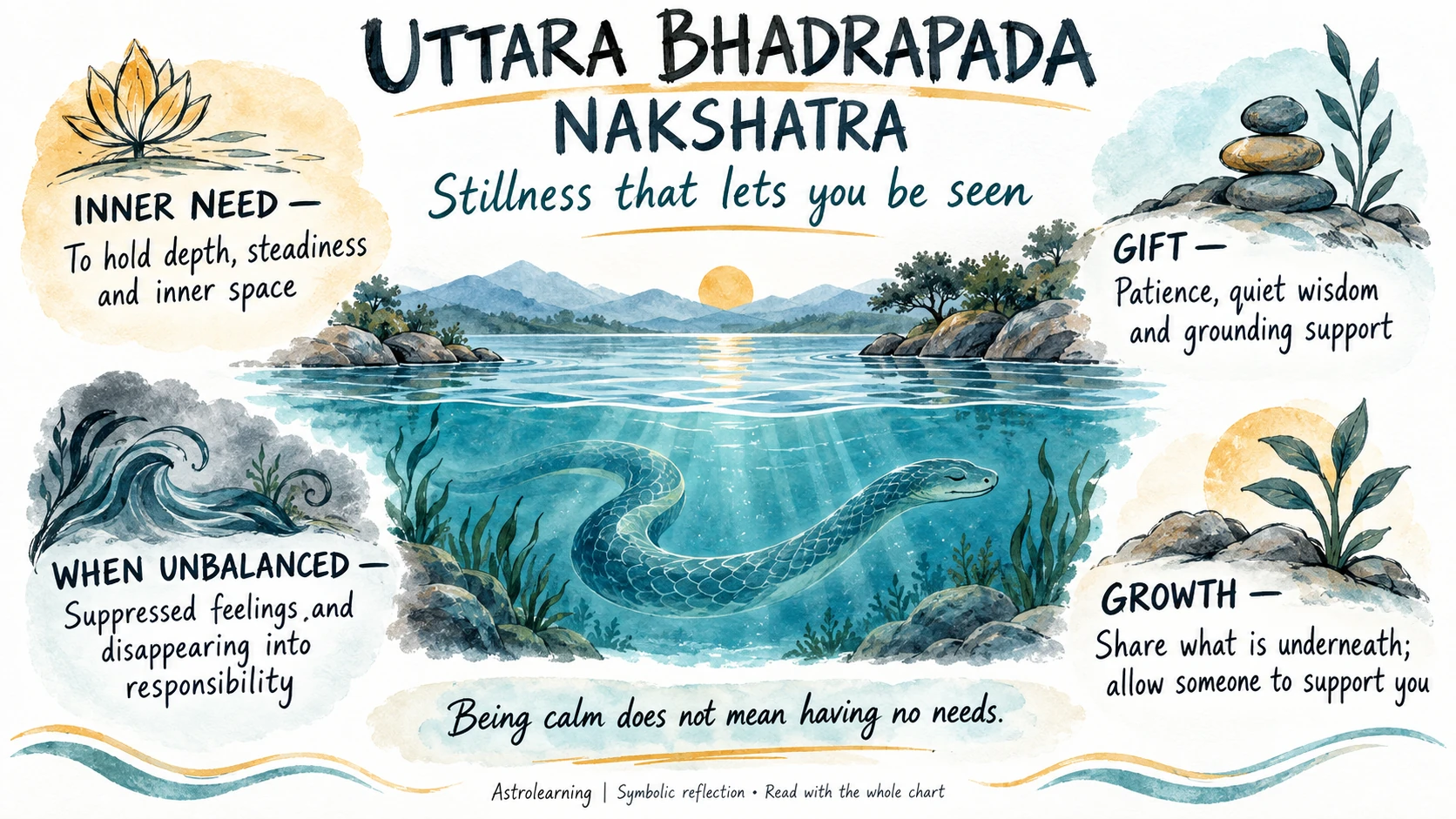
The Serpent in the Deep — The Soul That Holds Still Water
Core Details
| Factor | Uttara Bhadrapada |
|---|---|
| Sanskrit | उत्तरभाद्रपदा |
| Nakshatra Number | 26 |
| Zodiac Span | 3°20′ – 16°40′ Pisces |
| Nakshatra Lord | Saturn |
| Deity | Ahir Budhnya (the serpent of the deep) |
| Symbol | Back legs of a funeral cot / twin serpents in the water |
| Shakti | Varshodyamana Shakti — the Power to Bring Life-Sustaining Support, Like Rain |
| Gana | Manushya |
| Guna | Tamas |
| Main Theme | Deep stillness, hidden wisdom, quiet strength, spiritual depth beneath the surface |
| Deity Mantra | Om Ahirbudhnyaya Namah |
| Higher Expression | Calm, grounded wisdom; quiet strength that supports others without needing recognition |
| Lower Expression | Suppressed emotion, withdrawal, appearing cold or detached while quietly overwhelmed underneath |
The Fundamental Nature of Uttara Bhadrapada
Purva Bhadrapada burns. It faces the end of the zodiac cycle through fire — intensity, urgency, the fierce heat of a soul that knows it is running out of road. Uttara Bhadrapada inherits the same territory, the same dissolving edge of Pisces, but it does not burn.
It sinks.
Where Purva Bhadrapada is a flame, Uttara Bhadrapada is still water over an unknown depth. Nothing on the surface tells you what is underneath. That is the point.
This Nakshatra doesn’t need urgency to be profound. It doesn’t need drama to be real. Its instinct is toward a wisdom that has already stopped performing — the kind that has sat with itself long enough that it no longer needs to explain itself to anyone.
Ask Uttara Bhadrapada what it knows, and it may simply say: “I’m not in a hurry to tell you.”
Not because it is withholding. Because some truths only surface when the water is ready.
The Twin Serpents in the Water — The Symbol
The symbol of Uttara Bhadrapada is sometimes shown as the back legs of a funeral cot, sometimes as twin serpents resting in water. Both point at the same psychological truth: what carries the greatest weight is often the part you don’t see.
A funeral cot’s back legs bear the load quietly, without ceremony, while the front carries the visible procession. The serpents beneath the water’s surface don’t announce their presence — the water simply looks calm, undisturbed, ordinary.
This is Uttara Bhadrapada’s essential paradox. The surface is composed. Underneath, there can be enormous depth, enormous feeling, enormous capacity — coiled and patient, waiting for the right moment rather than the first one.
People often underestimate Uttara Bhadrapada at first meeting. The calm reads as simplicity. It rarely is.
Still water is not empty water. It is water that has learned not to show you the current.
Ahir Budhnya — The Serpent of the Deep
The presiding deity, Ahir Budhnya, is the serpent of the ocean floor — the unseen foundation believed to hold up the depths themselves. He is not a deity of spectacle. No thunderbolt, no chariot, no visible drama. He simply holds.
This gives Uttara Bhadrapada a very particular relationship with strength: strength that doesn’t need to be witnessed to be real.
Somewhere is falling apart. Uttara Bhadrapada says, quietly: I’ll hold this.
Someone needs steadiness and nobody else is offering it. Uttara Bhadrapada becomes the floor beneath the room, without asking to be thanked for it.
This is wisdom that doesn’t announce itself. It doesn’t need to be recognized as wise to know that it is. And that is both its great dignity and, eventually, its great cost — because a foundation that is never acknowledged can start to wonder if it is even seen at all.
The Psychological Tension — Depth Versus Disappearance
Every Nakshatra carries a shadow that is simply its gift, unmanaged. For Uttara Bhadrapada, the gift is genuine emotional and spiritual depth — the capacity to sit with difficulty, to hold complexity, to remain calm where others would fracture.
The shadow is that this same stillness can become a place to hide rather than a place to dwell.
There is a real difference between quiet strength and quiet suppression, and from the outside they can look identical. One is a soul that has made peace with its depths. The other is a soul that has simply stopped visiting them.
Uttara Bhadrapada’s ongoing work is learning to tell the two apart in itself — because feeling something and burying it so completely that even you lose track of it is not the same as feeling something and choosing, wisely, not to broadcast it.
Past-Life Karma
From a symbolic Jyotish perspective, Uttara Bhadrapada may carry karmic themes connected with carrying burdens silently, holding hidden wisdom, and the long discipline of patience.
The archetype can resemble a soul that, in a previous existence, occupied a role requiring restraint — someone who held a family, a community, or a secret together through sheer steadiness, often without credit. A quiet elder. A silent guardian. Someone who learned that speaking too soon could break what needed to stay whole.
This should not be read as a literal biography. It is a teaching device — a way of describing a soul that has practiced holding weight for a very long time.
The karmic question this life keeps returning to is not: “Can you hold this?” Uttara Bhadrapada has already proven it can hold almost anything.
The real question is: “Are you willing to be held, occasionally, by someone else?”
Childhood Imprint
Uttara Bhadrapada children can become very still, very early. Sometimes this stillness is natural temperament. Sometimes it is adaptation — a response to a home where their emotional world wasn’t fully seen, or wasn’t entirely welcome.
A child who cries and is told to calm down enough times eventually stops crying where anyone can see it.
They learn, early, that going quiet is safer than being expressive. They become the composed one, the reliable one, the child who didn’t need managing. Adults often praised this. Nobody asked what it cost.
What was gained was genuine self-containment — a real inner steadiness that most adults never develop. What was sometimes lost was the felt sense that their inner world mattered enough to be spoken.
As adults, this can surface as a quiet ache: an unusually calm, capable person who has never quite believed that anyone wants to know what’s underneath.
Relationships
Uttara Bhadrapada’s presence in a relationship is, at its best, a genuine gift. It is the partner who doesn’t panic. Who stays steady through the storm everyone else is reacting to. Who can be relied upon precisely because they don’t require constant reassurance themselves.
But this same steadiness can become a wall if it is never lowered.
Intimacy is not built on composure alone. It is built on occasionally letting someone see the water move. A partner cannot meet what is never shown to them. A relationship where one person is always calm and never vulnerable is not balance — it is quiet loneliness wearing the shape of stability.
The mature Uttara Bhadrapada learns that surfacing what’s underneath — sometimes, deliberately, even when it feels unnecessary — is not weakness. It is what turns a steady presence into a truly close one.
Lower Expression
The lower Uttara Bhadrapada can become emotionally suppressed, withdrawn, and difficult to reach. The stillness that was once a strength calcifies into distance.
The person may appear cold, detached, or unreadable — while quietly, internally, being overwhelmed by exactly the feelings they refuse to show.
They may carry enormous emotional or practical burdens entirely alone, believing on some unspoken level that this is simply what they are for — the back legs of the cot, built to hold weight, not to be noticed doing it. Asking for help can feel almost foreign, even shameful, as though needing support were a failure of the very steadiness that defines them.
The lesson is not to stop being deep. It is to stop mistaking invisibility for strength.
Higher Expression
The higher Uttara Bhadrapada becomes something rare: a genuinely grounding presence for everyone around it. Deep, calm, wise — and quietly supportive without ever needing to perform strength or announce its own depth.
It has learned to hold others without disappearing into the holding. It can offer stillness as a gift rather than a defense. It can say, honestly: “I am not withholding this — I am simply at peace with letting it surface in its own time.”
This is the mature serpent of the deep: wisdom that has stopped needing to prove itself, strength that has learned to let itself be seen, and stillness that is finally, fully, a home — not a hiding place.
“The deepest water is not the water that hides the most — it is the water that has finally learned it is safe to let something rise.”