

The past-life and karmic sections below are Jyotish interpretations, not historically verifiable facts. They are best understood as symbolic karmic archetypes — a way of teaching the psychology of each Nakshatra, not a literal record of a previous life.
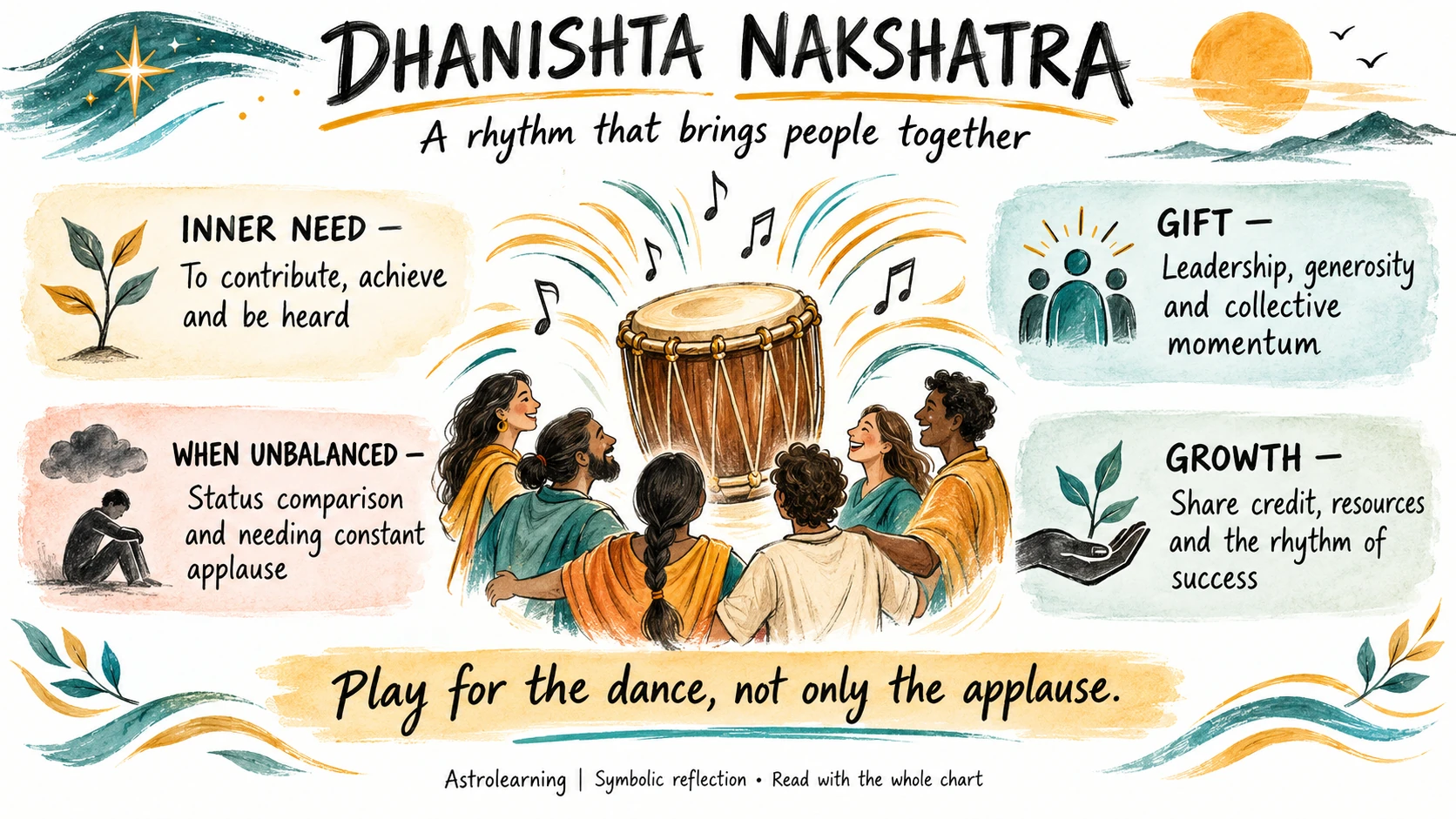
The Drum — The Soul That Wants Everyone to Hear It
Core Details
| Factor | Dhanishta |
|---|---|
| Sanskrit | धनिष्ठा |
| Nakshatra Number | 23 |
| Zodiac Span | 23°20′ Capricorn – 6°40′ Aquarius |
| Nakshatra Lord | Mars |
| Deity | Ashta Vasus (the eight elemental gods) |
| Symbol | A drum (damaru) |
| Shakti | Khyapayitri Shakti — the Power to Give Fame and Prosperity |
| Gana | Rakshasa |
| Guna | Tamas |
| Main Theme | Rhythm, fame, wealth, group recognition, a restless drive for status |
| Deity Mantra | Om Vasubhyo Namah |
| Higher Expression | Generosity, natural leadership, shared prosperity, rhythm and music that brings people together |
| Lower Expression | Materialism, showing off, restless craving for recognition, insensitivity to others’ pace |
The Fundamental Nature of Dhanishta
A drum is not a private instrument. Nobody sits alone in a quiet room and plays the damaru softly for their own ears. A drum is struck to be heard — across a courtyard, over a crowd, above the noise of everything else competing for attention. That is the psychology of Dhanishta.
This is the Nakshatra of wealth, fame and recognition. But it isn’t interested in wealth or fame that stays hidden.
Dhanishta says: “Come closer. Listen to this.”
There is an instinct here toward visibility, toward status, toward being the one whose beat other people move to. This can look like tremendous charisma, natural leadership, magnetic success. It can also look like something more restless — a hunger to be noticed that never quite settles, no matter how much applause arrives.
Dhanishta doesn’t simply want to have. It wants to be seen having. And underneath that, quietly, it wants to be admired for it.
The Drum — The Symbol of Dhanishta
The damaru is a rhythm instrument. Rhythm has a strange power: it doesn’t just express something, it organizes people. A crowd that hears a strong beat starts moving together, almost without deciding to.
This is exactly what Dhanishta does psychologically. It sets a pace. It creates a rhythm — in a family, a workplace, a community — and other people, often without noticing, start moving to it.
When this is healthy, Dhanishta becomes the person who energizes a room, who gets a stalled project moving again, who turns a scattered group into something coordinated and alive.
But the lower expression can become impatient with anyone who can’t keep up. The drummer doesn’t always slow down for the dancers who are struggling to find the beat. Dhanishta may unconsciously believe: “If you can’t match my pace, that is your limitation, not mine.”
The evolutionary lesson is not: “Stop setting the rhythm.”
It is: “Notice who you are setting it for.”
The Ashta Vasus — The Eight Gods of the Elements
The ruling deities of Dhanishta are the Ashta Vasus, the eight Vedic gods associated with the material elements — earth, water, fire, wind, sky, and the subtler forces that hold the physical world together. Their name itself comes from the root vasu, meaning wealth or that which dwells and sustains.
This gives Dhanishta a very specific relationship with material life. Wealth here is not treated as something shameful to renounce, nor as something to hoard privately. It is treated as an elemental force — something that flows, distributes, sustains a whole community, the way earth and water and fire sustain the whole of physical existence.
The Vasus don’t keep the elements to themselves. They distribute them. That is the higher template Dhanishta is built on: prosperity that circulates rather than prosperity that sits locked in a vault.
When Dhanishta forgets this, wealth stops being elemental and starts being personal — a private scoreboard, a way of proving something to a room rather than sustaining it.
The Tension Within Dhanishta
Here is Dhanishta’s central paradox. It carries a real, genuine gift for generosity and leadership. It can gather people, energize them, share success with them, make an entire group feel wealthier and more alive simply by being near it.
But it also carries a restless hunger to be seen and admired — and that hunger can quietly override sensitivity to the people it claims to be leading.
A person can be generous and still be performing generosity for an audience. A person can lead a group forward and still be more interested in being recognized as the leader than in whether the group actually needed to move at that pace.
Dhanishta’s growth depends on being honest about which of these is happening in any given moment. Not to shame the desire for recognition — it is natural, even useful — but to notice when it has quietly become the whole point.
Past-Life Karma
From a symbolic Jyotish perspective, Dhanishta may carry karmic themes connected with wealth, fame, group leadership and the responsibility that comes with influence over other people. This should not be read as a literal record — it is a teaching device, a way of describing a recurring inner pattern, not a historical claim.
The archetype often resembles someone who once held a position of visible influence: someone whose word carried weight over a group, whose success or failure was watched by many, whose rhythm others depended on.
The deeper karmic question isn’t simply “did you gain fame and wealth?” It is: “What did you do with the people who were listening to your drum?” Did you use your position to lift others, or did you use others to build your position?
Dhanishta’s recurring lesson in this life is often some version of: “Influence that isn’t shared eventually turns hollow, no matter how loud it sounds.”
Childhood Imprint
Dhanishta children often discover early that being noticed feels like belonging. A round of applause, a compliment in front of others, being chosen first — these moments can imprint deeply: “When people admire me, I matter.”
This can create a genuinely magnetic, achievement-oriented child — one who works hard, performs well, and lights up a room.
But if love and attention in that household arrived mainly in response to accomplishment, applause, or material success, the child may quietly learn a more fragile equation: “I am worth what I am praised for.”
As an adult, this can become a restless engine that never fully switches off — achieving, acquiring, performing, but rarely resting in a sense of worth that doesn’t require an audience.
Relationships
Dhanishta brings something wonderful into relationships: genuine generosity, a talent for celebration, an instinct for making shared success feel like everyone’s success. Life with Dhanishta can feel abundant, festive, energizing.
But intimacy asks for something a drum was never built for: quiet.
Not every moment between two people is meant to be witnessed, celebrated, or turned into a story worth telling later. Some of the deepest connection happens in unremarkable, unwitnessed minutes — nothing performed, nothing announced, no rhythm anyone else needs to hear.
Dhanishta’s relationship lesson is learning to sit in those minutes without needing them to matter to anyone but the two people in the room. Love does not always need an audience to be real.
Lower Expression
The lower Dhanishta becomes materialistic, showy, restless for recognition, and quietly (or not so quietly) competitive about status. Wealth becomes something to display rather than share. Success becomes something to announce rather than simply live.
This version of Dhanishta sets a pace and expects others to match it, growing impatient or dismissive toward anyone who moves slower — a partner who needs more time, a colleague who works differently, a friend who isn’t as driven. There can be an undercurrent of resentment: “Why is everyone so far behind me?”
Underneath the display is often a simpler, more vulnerable fear: that without the applause, without the wealth, without the visible markers of success, there might be nothing left worth noticing.
Higher Expression
The mature Dhanishta becomes a genuinely generous leader. It shares wealth instead of hoarding it. It shares rhythm instead of demanding everyone keep pace alone. It shares recognition instead of collecting it all for itself.
This version of Dhanishta can walk into a struggling group and, simply by its energy, get everyone moving together again — and then, crucially, step back and let the group feel that the success belongs to all of them.
It has learned that a drum’s real purpose was never to be admired. It was to gather people. The highest Dhanishta plays for the dance, not for the applause — and finds, almost paradoxically, that this is when the applause becomes real.
“A drum that plays only to be praised eventually plays alone; a drum that plays for the dance gathers the whole village around it.”