

The past-life and karmic sections below are Jyotish interpretations, not historically verifiable facts. They are best understood as symbolic karmic archetypes — a way of teaching the psychology of each Nakshatra, not a literal record of a previous life.
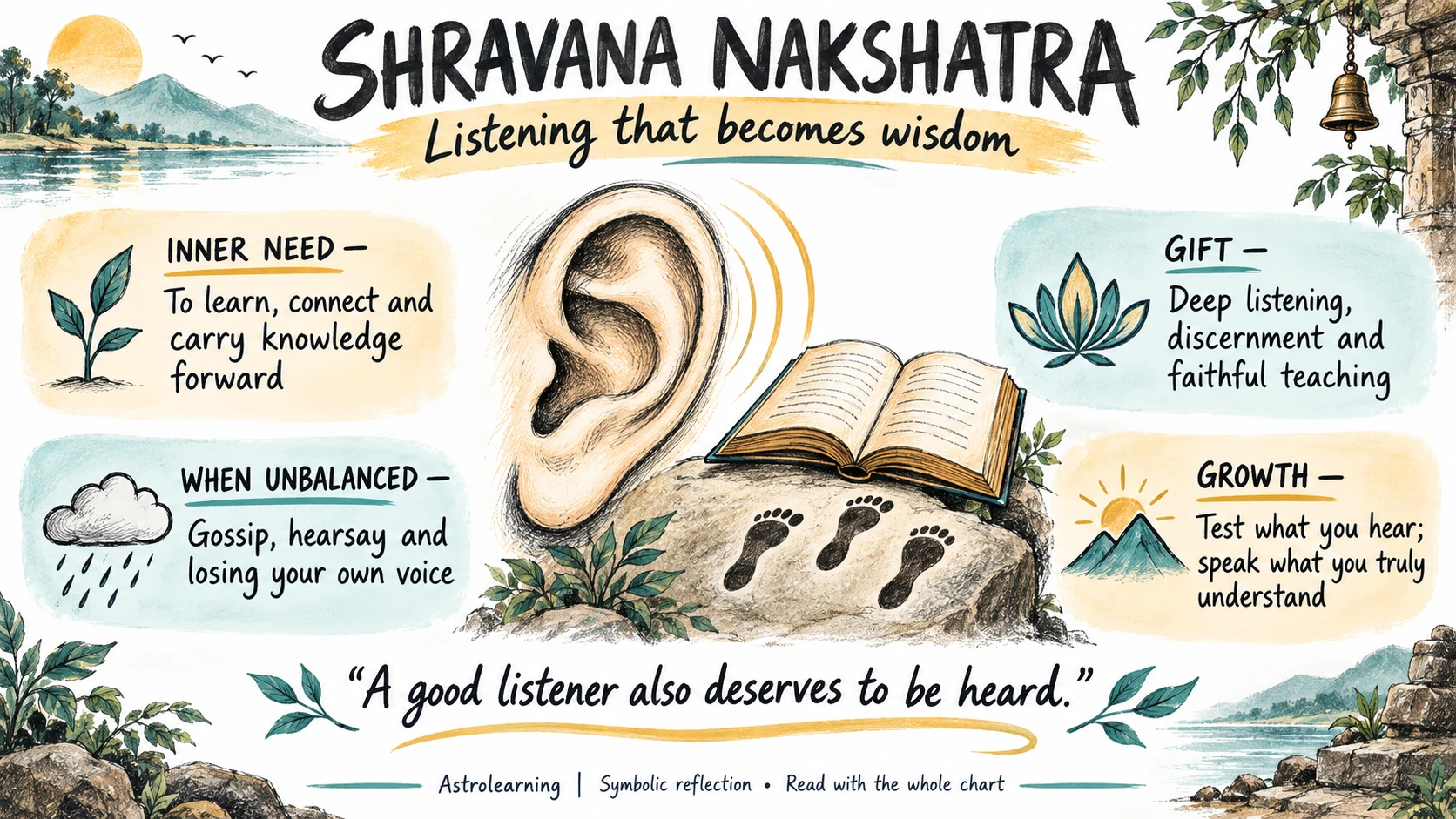
The Ear — The Soul That Learns by Listening
Core Details
| Factor | Shravana |
|---|---|
| Sanskrit | श्रवण |
| Nakshatra Number | 22 |
| Zodiac Span | 10°00′ – 23°20′ Capricorn |
| Nakshatra Lord | Moon |
| Deity | Vishnu |
| Symbol | An ear / three footprints |
| Shakti | Samhanana Shakti — the Power to Connect and Gain Access Through Listening |
| Gana | Deva |
| Guna | Rajas |
| Main Theme | Listening, learning, connection, wisdom transmitted through hearing and story |
| Deity Mantra | Om Vishnave Namah |
| Higher Expression | Deep listening, genuine wisdom, learning and faithfully passing on knowledge |
| Lower Expression | Gossip, hearsay, uncritically believing everything heard, superficial information-collecting |
The Fundamental Nature of Shravana
Shravana literally means “hearing” or “that which is heard.” Before there was writing, before there was proof, there was this: someone spoke, and someone else listened, and a piece of wisdom survived one more generation.
That is the entire psychology of Shravana in a single image.
It is the part of consciousness that does not need to touch the fire to know it burns. It can be told. It can be shown. It can hear a story once, in childhood, and carry it for sixty years.
Shravana doesn’t insist on direct experience as the only valid teacher. It trusts transmission. A teacher’s voice, a grandmother’s story, a scripture recited aloud — these are not lesser forms of knowing to Shravana. They are the primary form.
This makes Shravana quietly one of the most educable placements in the zodiac. It absorbs. It retains. It reveres what has been said and passed down, sometimes more than it reveres what it has personally seen.
Shravana says: “Tell me, and I will remember.”
The Ear — The Symbol of Shravana
The ear cannot close itself. It has no lid, no shutter. It simply receives, whether the sound is worth receiving or not.
This is Shravana’s great gift and its great vulnerability in a single organ.
At its best, the ear represents true receptivity — the rare discipline of actually listening rather than waiting for a turn to speak. Most people listen only long enough to formulate their reply. Shravana, when mature, listens the way a good student listens: fully, without interrupting, without rushing to be understood in return.
But an open ear takes in everything nearby. Wisdom and rumor arrive through the same channel, at the same volume.
The three footprints add another layer. They suggest a path already walked, tracks left by someone who came before. Shravana instinctively follows what has already been proven true by others — which is wisdom when the path is sound, and a quiet abdication of one’s own judgment when it isn’t.
Vishnu — The Preserver
Vishnu, the preserver, sustains what already exists rather than creating something new or destroying what has run its course. This gives Shravana its deep, almost sacred relationship with continuity.
Shravana is drawn to whatever keeps knowledge alive across time: teaching, storytelling, scripture, oral tradition, the passing of a lineage from one hand to the next. It can sense, almost physically, when something valuable is at risk of being forgotten.
This is why Shravana people often become natural students, and later, natural teachers. They understand instinctively that wisdom which is not transmitted eventually dies with the person who held it.
Vishnu doesn’t create the world anew each day. He holds it together. Shravana carries this same quiet function in a life — the one who remembers what others have forgotten, who keeps the story going.
The Listener’s Dilemma
Here is Shravana’s central psychological tension: the same faculty that makes it wise can also make it credulous.
Genuine wisdom is gained by listening closely, patiently, over years, to people who have earned the right to be heard. But Shravana can just as easily absorb the opinion of a stranger, the tone of a rumor, the certainty of someone who simply spoke loudly and first.
It can mistake having heard something for knowing it is true.
The immature Shravana treats every voice with equal authority. A teacher’s insight and a neighbor’s gossip can end up occupying the same shelf in its mind, simply because both arrived through the ear.
The mature Shravana learns to ask a harder question before repeating anything: “Is this actually true, or did I just hear it enough times to believe it?”
Past-Life Karma
From a symbolic Jyotish perspective, Shravana may carry karmic themes connected with learning, teaching, storytelling and the responsibility of transmission. This is not a literal claim — it is a way of describing a recognizable pattern.
The archetype may resemble someone whose role once depended on carrying knowledge faithfully: a student, a scribe, a reciter of scripture, a keeper of a family or community’s stories.
The deeper karmic question, however, is not simply “what did you learn?” It is “what did you do with what you were told?”
Did the soul pass wisdom forward with care? Or did it once repeat something false, something half-understood, something that caused harm because it was never questioned?
Shravana’s recurring lesson often becomes: “Not everything you hear deserves to be repeated.” The soul must learn the difference between a story worth carrying and noise that simply passed through.
Childhood Imprint
Shravana children often learn best through story rather than instruction. Told something once, in the right voice, at the right moment, they remember it for life. Lectured at directly, they may absorb far less.
They tend to listen closely to adults — sometimes more closely than the adults realize. A tone of worry in a parent’s voice, an offhand comment at the dinner table, a piece of family gossip: the Shravana child hears all of it, and often keeps it.
This can produce an excellent student — attentive, retentive, eager to be taught. But it can also mean the child absorbs other people’s fears and opinions as though they were their own, without ever examining whether they actually agree.
As adults, some Shravana natives find they are carrying beliefs they never chose. They simply heard them often enough, early enough, for the beliefs to feel like their own voice.
Relationships
Shravana’s gift in intimacy is real and often underrated: it actually listens. Most people in a relationship are waiting to speak. Shravana is genuinely present for the other person’s words, remembers small details, and makes a partner feel truly heard.
But its lesson is the mirror of its gift. Shravana must learn to speak its own truth, not only reflect back what it has absorbed from the people around it.
A Shravana partner can become so skilled at listening, so accustomed to absorbing another’s point of view, that its own opinions quietly go unspoken. Over years, this can leave a relationship lopsided — one voice fully known, the other still waiting to be asked.
The mature Shravana understands: listening well and disappearing are not the same thing. A good listener still needs to be heard.
Lower Expression
The lower Shravana becomes a channel for gossip rather than wisdom. It hears something and repeats it, often without checking whether it is true, and without weighing the damage repetition might cause.
It can build an identity almost entirely out of secondhand information — what was said about someone, what was overheard, what everyone else seems to believe — rather than direct experience of its own.
Rumor and fact begin to sound alike when both arrive with the same conviction in someone else’s voice. The lower Shravana rarely pauses long enough to notice the difference.
It may even define itself as “in the know” — mistaking the volume of what it has heard for the depth of what it understands.
Higher Expression
The mature Shravana becomes something rarer: a genuine keeper of wisdom, not merely a collector of information.
It listens deeply — to a teacher, a text, a life — and does not rush to repeat what it hears. It waits. It tests. It discerns what is true from what is simply loud.
And then it passes forward only what is actually worth carrying.
This is Shravana at its highest: the teacher who was once a student, the storyteller whose story is finally reliable, the ear that has learned which sounds deserve to become words, and which deserve to end where they were heard.
“Anyone can hear. Wisdom begins the moment you decide what is worth repeating.”