

The past-life and karmic sections below are Jyotish interpretations, not historically verifiable facts. They are best understood as symbolic karmic archetypes — a way of teaching the psychology of each Nakshatra, not a literal record of a previous life.
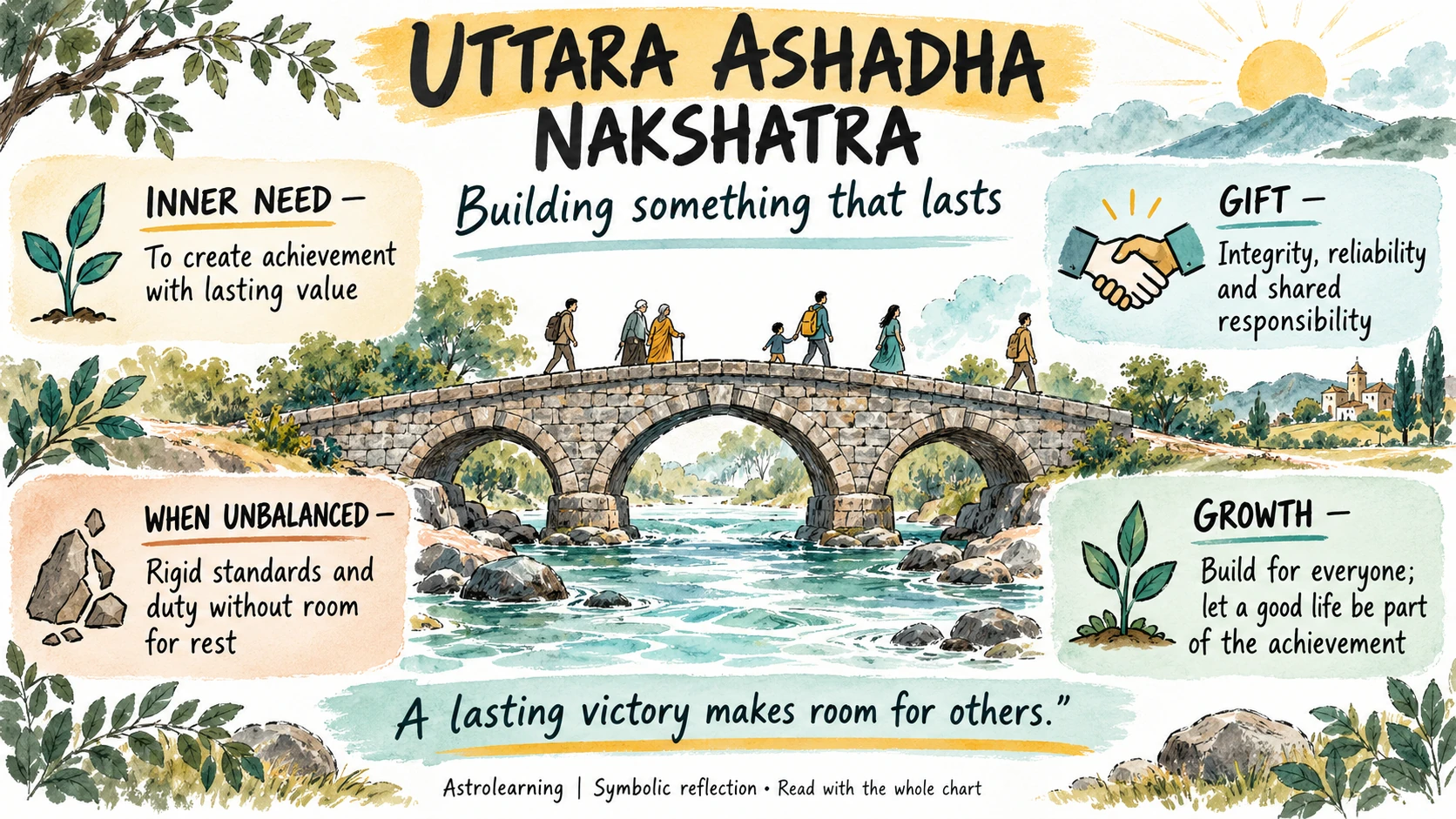
The Lasting Victory — The Soul That Builds for Everyone
Core Details
| Factor | Uttara Ashadha |
|---|---|
| Sanskrit | उत्तराषाढा |
| Nakshatra Number | 21 |
| Zodiac Span | 26°40′ Sagittarius – 10°00′ Capricorn |
| Nakshatra Lord | Sun |
| Deity | Vishvadevas (the universal gods, collectively) |
| Symbol | An elephant tusk / a small bed |
| Shakti | Apradhrishya Shakti — the Power of Unchallengeable, Lasting Victory |
| Gana | Manushya |
| Guna | Sattva |
| Main Theme | Lasting victory, universal responsibility, integrity, achievement that serves more than the self |
| Deity Mantra | Om Vishvadevaya Namah |
| Higher Expression | Enduring achievement, ethical leadership, victory that benefits everyone, not just the individual |
| Lower Expression | Self-righteous rigidity, an overly heavy sense of duty, slowness to adapt once a position is taken |
The Fundamental Nature of Uttara Ashadha
Purva Ashadha declares. It says “I believe this,” early, personally, sometimes before it has earned the right to be so certain.
Uttara Ashadha comes after.
It takes that early, unfinished conviction and asks a harder question: “Can this survive contact with time?”
This is the difference between winning and having won. Purva Ashadha wants the fight. Uttara Ashadha wants the outcome to still be standing ten years later, still be defensible, still be doing good for people who never asked for it. That single shift — from personal conviction to lasting, shared result — is the entire psychology of this Nakshatra.
It is fitting that Uttara Ashadha isn’t ruled by one god. It belongs to the Vishvadevas, the universal gods, together. No single ego gets to claim this victory. That is not incidental — it is the whole point.
The Elephant Tusk — Strength That Builds
The tusk is a strange symbol for a Nakshatra about victory. It doesn’t cut like a blade. It doesn’t strike like a weapon.
An elephant uses its tusks to clear a path, to lift, to steady, to carry weight that would break something more fragile.
This is Uttara Ashadha’s idea of strength: power used to support, not merely to prevail. The person may be immensely capable, immensely determined, and still ask, almost instinctively: “Who does this serve besides me?”
When this is healthy, it produces people who build things that outlast them — institutions, families, reputations, communities that hold together because someone was willing to carry more than their own share.
When it curdles, the tusk stops clearing a path and starts becoming a fixed position the person refuses to move from, no matter what the moment now requires.
The Vishvadevas — Victory That Belongs to No One
The Vishvadevas are not a single deity with a single agenda. They are the gods together — collective, plural, distributed.
This gives Uttara Ashadha an instinct most Nakshatras have to learn deliberately: achievement is a shared responsibility, not a private trophy.
Someone else asks: “What do I get from this?” Uttara Ashadha asks: “Does this hold up for everyone involved?”
This is why Uttara Ashadha people so often end up in positions of quiet leadership — not the loudest voice in the room, but the one others trust to still be fair when the outcome doesn’t favor them personally. Integrity, here, is not a virtue performed for an audience. It is simply what remains once the applause has stopped.
The Central Tension — Integrity or Rigidity
Every strength in this Nakshatra has a shadow standing directly behind it, and the shadow wears the same clothes.
The gift is a person who keeps their word, carries their responsibilities without complaint, and builds things that last. The distortion is a person who has decided they are right, once, and will now defend that position long after the world has moved on.
Uttara Ashadha can mistake stubbornness for principle. It can mistake heaviness for seriousness. It can carry duty so faithfully that it forgets duty was supposed to serve life, not replace it.
The lesson is not “care less.” It is: “Let your commitment stay alive enough to keep learning.”
Past-Life Karma
From a symbolic Jyotish perspective, Uttara Ashadha may carry karmic themes connected with leadership carried out on behalf of others, unfinished responsibilities, and the cost of doing the right thing when it was difficult.
The archetype can resemble someone who once held a position of collective trust — a leader, elder, judge, or steward whose decisions affected people beyond themselves, and who was measured not by a single victory but by whether their choices continued to hold up afterward.
The deeper karmic question is rarely “did you win?” It is: “did you finish what you were responsible for, and did it serve more than you?”
This life often brings Uttara Ashadha back into situations of responsibility — sometimes more than feels fair — until the soul learns that carrying weight for others and losing yourself under it are not the same requirement.
Childhood Imprint
Uttara Ashadha children can develop a sense of responsibility strikingly early — toward a sibling, a struggling parent, the general steadiness of the household.
They may be the child who quietly makes sure things are okay before anyone asks them to.
This can produce remarkable maturity, reliability, and a natural sense of fairness. But it often comes at a cost: a childhood lightness that never quite got its turn. The child who is busy being dependable can forget that they were also allowed to be silly, unfinished, and simply young.
As adults, this can surface as difficulty resting without guilt, or a nagging sense that enjoyment has to be earned first.
Relationships
Uttara Ashadha loves through commitment. It shows up. It keeps its promises. It carries its share and usually more.
This is a genuine gift, and partners often feel it as safety — “I know exactly where I stand with you.”
The danger is that commitment calcifies into a script. The relationship gets defined once, early, and Uttara Ashadha can struggle to let it be renegotiated, softened, or simply enjoyed without an agenda of duty attached.
The deeper relationship lesson is: reliability does not require rigidity. A bond can be dependable and still leave room to be imperfect, unfinished, and occasionally just fun.
Lower Expression
The lower Uttara Ashadha becomes self-righteous, excessively serious, and unable to adapt once it has decided what is “right.”
It may quietly resent how much it carries while insisting, outwardly, that the weight doesn’t bother it. It can turn responsibility into a kind of martyrdom — virtuous, exhausted, and secretly waiting for someone to notice.
Humor can feel unsafe here, as if lightness might undermine the seriousness the person has built their identity around.
But a position held out of pride, long after it has stopped serving anyone, is not integrity. It is just fear wearing integrity’s clothes.
Higher Expression
The higher Uttara Ashadha becomes exactly what its Shakti promises: a victory that cannot be challenged, because it was never built for the ego alone.
It becomes the trustworthy builder — the person others rely on precisely because their word has held steady across years, not moments. It leads without needing to dominate. It finishes what it starts, not out of obligation, but because it genuinely cares whether the outcome holds.
The highest Uttara Ashadha carries its responsibilities and still knows how to rest, still knows how to laugh, still knows that a good life was always part of what it was building.
“A victory that only serves you will fade. A victory that serves everyone becomes something no one can take away.”