

The past-life and karmic sections below are Jyotish interpretations, not historically verifiable facts. They are best understood as symbolic karmic archetypes — a way of teaching the psychology of each Nakshatra, not a literal record of a previous life.
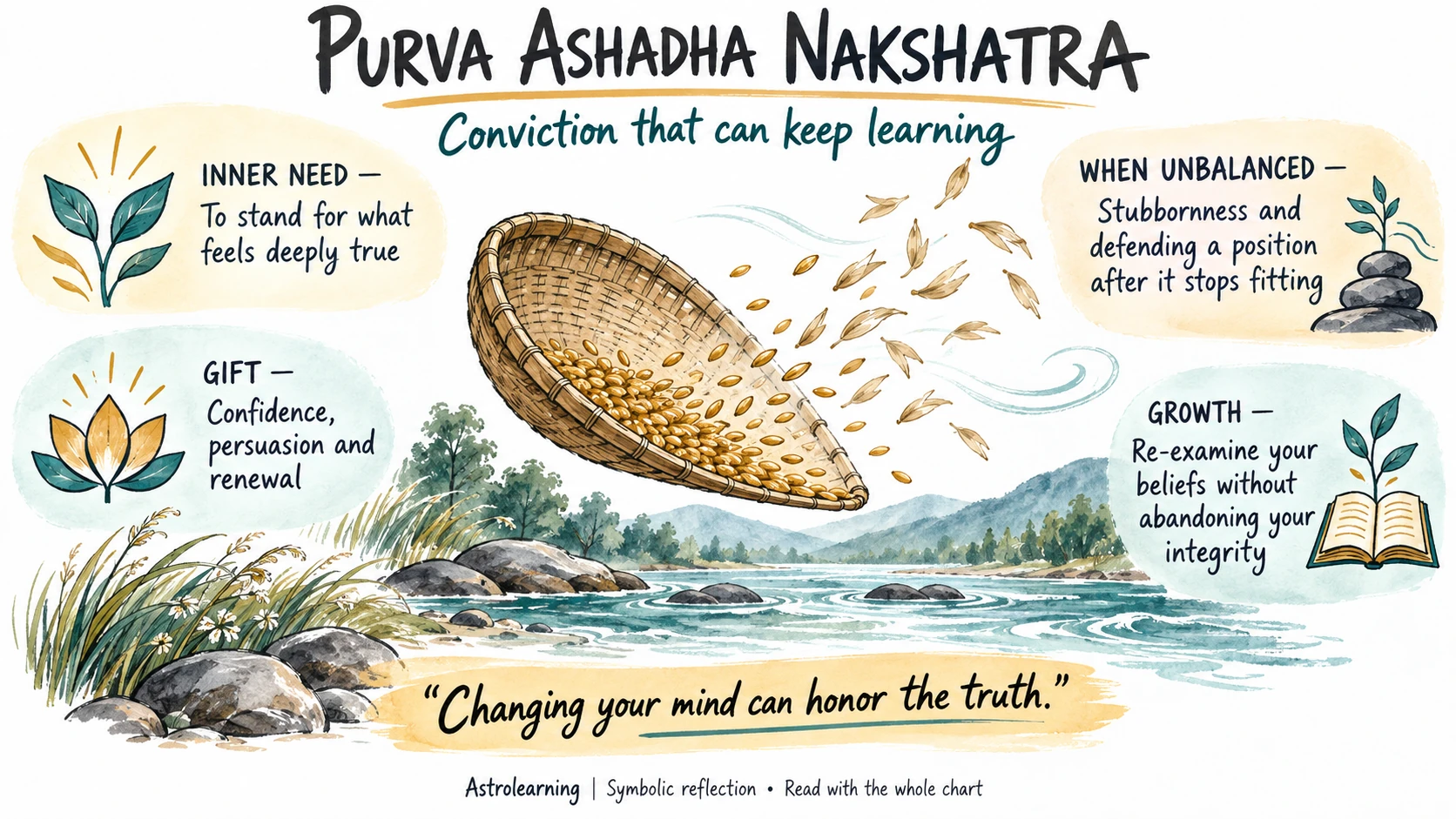
The Winnowing Fan — The Soul That Declares Its Ground
Core Details
| Factor | Purva Ashadha |
|---|---|
| Sanskrit | पूर्वाषाढा |
| Nakshatra Number | 20 |
| Zodiac Span | 13°20′ – 26°40′ Sagittarius |
| Nakshatra Lord | Venus |
| Deity | Apas (goddess of the cosmic waters) |
| Symbol | An elephant tusk / a fan / a winnowing basket |
| Shakti | Vraskana Shakti — the Power of Early, Unshakeable Victory |
| Gana | Manushya |
| Guna | Rajas |
| Main Theme | Conviction, early victory, purification, unshakeable belief |
| Deity Mantra | Om Apase Namah |
| Higher Expression | Confident persuasion, purifying old patterns, standing firm on real principle |
| Lower Expression | Stubbornness, arrogance, refusing to reconsider a position once declared, even when wrong |
The Fundamental Nature of Purva Ashadha
Mula spends itself pulling at the root of things, refusing to accept an answer simply because it is comfortable. It asks: “What is actually true, underneath everything I was told?” Mula does not stop until it finds the real root, even if the search uproots everything around it.
Purva Ashadha comes right after this excavation, and it does something Mula could never do. It stops digging.
It takes what has been found and plants a flag in it.
Purva Ashadha says: “This is my ground. I am standing here.”
This is the psychology of early victory. Not the slow, negotiated triumph that arrives after years of doubt, but the immediate, almost instinctive certainty that arrives the moment conviction crystallizes. Purva Ashadha does not wait for permission to believe something. Once it knows, it knows.
There is real strength in this. A person who can declare a position and hold it, while the rest of the room is still hedging, becomes a natural center of gravity. Purva Ashadha rarely wants to sit on the fence. It wants to choose.
But the very quality that makes it powerful — the refusal to waver — is also where its deepest lesson lives.
The Winnowing Basket — The Symbol of Purva Ashadha
The winnowing fan is an unglamorous tool. You throw the grain into the air, and the wind carries away the husk while the real seed falls back into the basket. It is not a symbol of force. It is a symbol of discernment.
This is what Purva Ashadha instinctively does with everything it encounters — ideas, people, beliefs, versions of itself. It separates what is useful from what is not, and it does this quickly, almost impatiently.
When this instinct is healthy, Purva Ashadha becomes a natural purifier. It can walk into a confused situation and say: “Here is what matters. Here is what doesn’t.” People often feel clarified simply by standing near it.
But the lower expression treats one round of winnowing as final. The basket is shaken once, a conclusion is reached, and then it is sealed — even decades later, even when new grain has entered the basket that was never sorted at all.
The evolutionary lesson is therefore not: “Stop having convictions.”
It is: “Keep winnowing. The basket is never finished.”
Apas — The Waters That Purify
The deity of Purva Ashadha is Apas, the goddess of the cosmic waters. Water is the traditional symbol of purification in nearly every spiritual tradition, and this gives Purva Ashadha’s conviction a specific flavor. It is not cold, intellectual certainty. It is moral certainty — a felt sense of being cleansed by having chosen correctly.
This is why Purva Ashadha’s beliefs often carry an emotional charge that pure logic does not explain. When this person declares a position, it doesn’t feel like an opinion to them. It feels like something has been washed clean.
But water that only flows in one direction, endlessly, without ever being renewed, eventually stagnates. The higher Purva Ashadha remembers that Apas is living water — it moves, it refreshes, it can wash away even its own earlier certainties when the truth requires it. The lower Purva Ashadha treats its water like a monument instead of a river: fixed, admired, never allowed to flow again.
Conviction Versus Rigidity — The Central Tension
Every Purva Ashadha life circles the same question: is this genuine principle, or is this simply the discomfort of admitting I might be wrong?
The two can feel identical from the inside. Real conviction and mere stubbornness both produce the same sensation — a firm, unmoving “No.” Only time, and evidence, and the willingness to actually look at that evidence, reveal which one it was.
Purva Ashadha at its best can be shown new information and say: “You’re right. I was standing on the wrong ground. Let me move.” That single sentence is one of the hardest things this Nakshatra will ever learn to say, and also one of the most liberating.
Past-Life Karma
From a symbolic Jyotish perspective, Purva Ashadha may carry karmic themes connected with declared beliefs, early triumphs, and the responsibility that comes with being believed.
The archetype may resemble someone who once won an argument, a battle, a cause, or a position of influence quickly — and who was then followed, trusted, or obeyed on the strength of that early victory. Others built their own certainty on top of this person’s declared ground.
This is not, by itself, a burden. But it becomes karmic when the conviction outlived its usefulness and the soul kept defending it anyway, because too many people had already staked their trust on it being permanently correct.
The recurring lesson is therefore not about the courage to declare a position. Purva Ashadha already has that in abundance. The lesson is about the courage to un-declare one, publicly, when the ground has genuinely shifted.
Childhood Imprint
Purva Ashadha children often arrive with opinions that seem disproportionate to their age. They will argue passionately about fairness, about what is right, about who is telling the truth — sometimes before they have accumulated the life experience needed to know when a belief should be updated.
A young Purva Ashadha may declare: “I know I’m right,” with total sincerity, about something they will later outgrow completely. This is not dishonesty. It is simply the Shakti of early victory expressing itself before the wisdom to season it has arrived.
If parents mistake this certainty for defiance and try to crush it, the child may either go underground with their convictions or dig in harder, treating every future correction as an attack rather than information. If instead the child is taught, gently, that a strong belief and a permanent belief are not the same thing, this Nakshatra’s gift matures beautifully.
Relationships
Purva Ashadha is genuinely attractive in love. The passionate conviction, the willingness to declare “I choose you” early and mean it completely, can feel like a rare gift in a hesitant world.
But a relationship is not a debate that Purva Ashadha has already won. It is a shared ground that two people are still discovering together. The lesson here is subtle: love does not require the partner to eventually agree with the Purva Ashadha person’s position on everything. It requires room for a second truth to exist beside the first.
The mature Purva Ashadha partner can hold a firm conviction about their own life while still asking: “What is true for you, even if it isn’t what I would choose?” That question, asked sincerely, is where real intimacy with this Nakshatra begins.
Lower Expression
The lower Purva Ashadha becomes stubborn, arrogant, and unwilling to reconsider a declared position, even when the evidence against it is clear. It may treat an old belief as permanent truth simply because it was once true, or once useful, or once won.
The person may say: “I already decided this,” as if a decision made years ago has the authority to overrule facts discovered today. Disagreement can be experienced as disrespect. Being shown a mistake can feel like being dethroned.
This is the basket that was never shaken again — grain and husk left sitting together, both called seed, because reopening the basket feels like admitting the first winnowing failed.
Higher Expression
The higher Purva Ashadha becomes a genuinely purifying force in the lives around it. Confident, persuasive, able to stand for real principle when everyone else is compromising out of fear — and equally able to say, without shame, “The ground has moved, and so will I.”
It doesn’t abandon conviction for the sake of flexibility. It keeps winnowing, season after season, so that what remains in the basket is always the truest grain available, not simply the first one it ever found.
This is the mature Vraskana Shakti: victory that is renewed by staying honest, not preserved by refusing to look again.
“A conviction that cannot be re-examined was never strength — it was only the fear of the winnowing wind.”