

The past-life and karmic sections below are Jyotish interpretations, not historically verifiable facts. They are best understood as symbolic karmic archetypes — a way of teaching the psychology of each Nakshatra, not a literal record of a previous life.
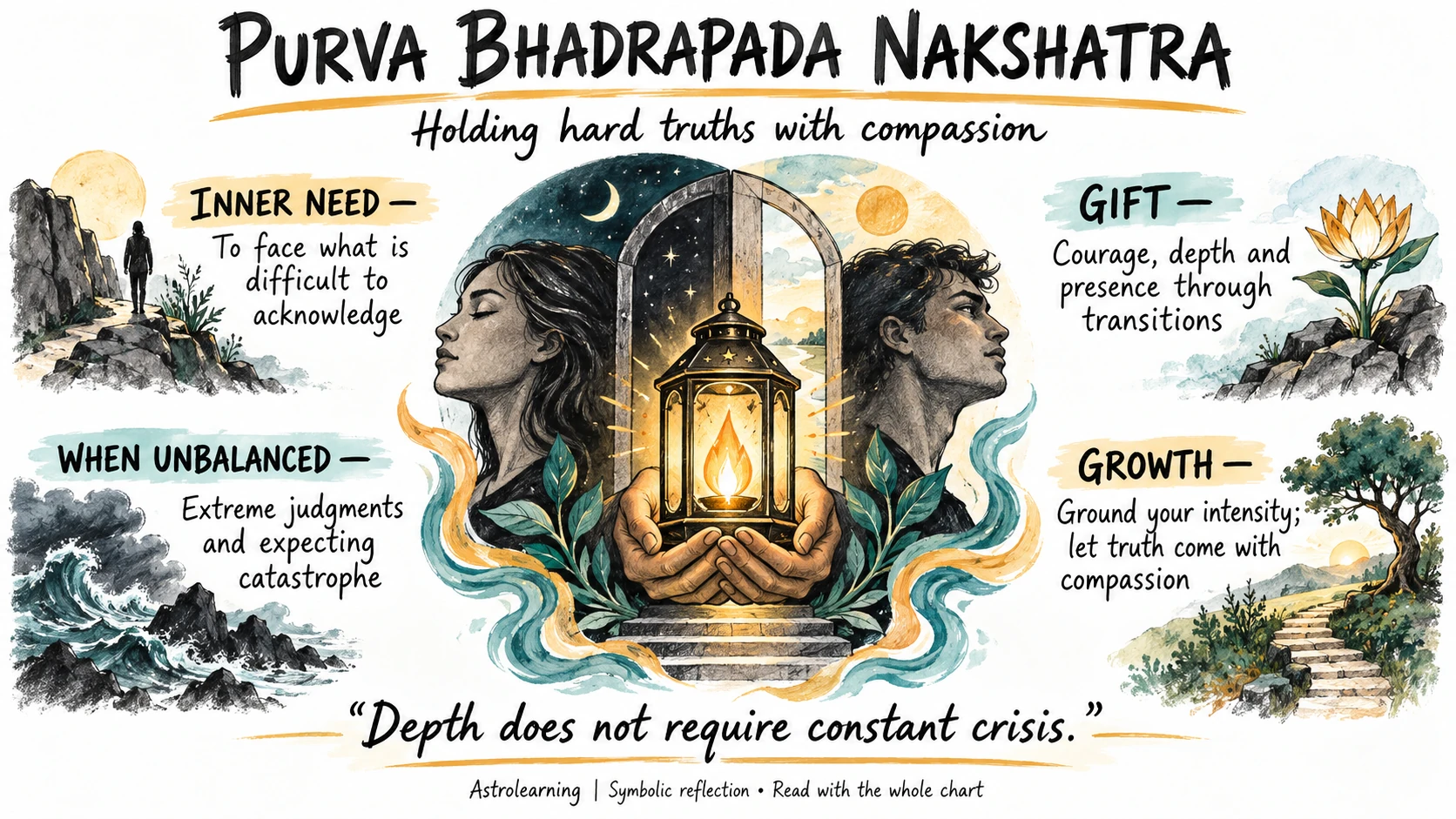
The Two-Faced Man — The Soul That Sees What Others Look Away From
Core Details
| Factor | Purva Bhadrapada |
|---|---|
| Sanskrit | पूर्वभाद्रपदा |
| Nakshatra Number | 25 |
| Zodiac Span | 20°00′ Aquarius – 3°20′ Pisces |
| Nakshatra Lord | Jupiter |
| Deity | Aja Ekapada (the one-footed goat/serpent, a fierce form of Rudra) |
| Symbol | Front legs of a funeral cot / a two-faced man / a sword |
| Shakti | Yajamana Udyamana Shakti — the Power to Elevate Through Sacrifice and Intensity |
| Gana | Manushya |
| Guna | Sattva |
| Main Theme | Spiritual intensity, transformation through fire, facing mortality, purification through hard truth |
| Deity Mantra | Om Ajaikapade Namah |
| Higher Expression | Spiritual intensity used for genuine transformation, courage to face hard truths, purification |
| Lower Expression | Extremism, anxiety, obsessive fixation on endings or catastrophe, harsh judgment of self or others |
The Fundamental Nature of Purva Bhadrapada
Purva Bhadrapada is one of the most intense Nakshatras in the entire zodiac. It is willing to stand at the place most people spend their whole lives avoiding, and look directly at it: death, ending, dissolution, the parts of existence that cannot be negotiated with.
Most of the psyche is organized around avoidance. We build routines, distractions, comfortable stories, so that we don’t have to think too hard about the fact that everything ends.
Purva Bhadrapada doesn’t build those defenses in the usual way.
Something in it says: “Look anyway.”
This gives the Nakshatra a rare kind of seriousness. There is often very little small talk in its deeper nature. It is drawn to what is real rather than what is comfortable, to the questions underneath the questions. Its instinct is toward spiritual and psychological intensity — a fire that burns away illusion, that will not let comfortable denial simply sit there unexamined.
This is a tremendous gift when it matures. It is also, in its raw and unintegrated form, exhausting to live inside — for the person carrying it, and sometimes for the people around them.
The Two-Faced Man and the Funeral Cot — The Symbols of Purva Bhadrapada
Purva Bhadrapada’s symbols are unusually stark for a Nakshatra: the front legs of a funeral cot, and a two-faced man.
The funeral cot is not a subtle image. It is the structure that carries a body toward its final rite. To be identified with its front legs is to be identified with the very edge of that threshold — the place where life is visibly, undeniably, becoming something else.
This is why Purva Bhadrapada carries such a natural relationship with endings. It doesn’t merely tolerate the subject of death and transition. Some part of it is oriented toward it, almost magnetized by it, long before it consciously understands why.
The two-faced man deepens the picture. One face looks toward what is visible, ordinary, socially acceptable. The other looks toward what is hidden, difficult, unspoken — the fear underneath the composure, the grief underneath the smile.
Purva Bhadrapada can hold both at once. It can sit at a gathering making pleasant conversation while simultaneously sensing the funeral no one is mentioning, the marriage that is quietly ending, the illness that hasn’t been named yet.
This double vision is the Nakshatra’s genius. It is also its burden.
Seeing both sides of a difficult truth at once is rarely comfortable. But it is precisely what allows Purva Bhadrapada, at its best, to stand at a threshold that terrifies everyone else and remain steady.
Aja Ekapada — The Deity of Purva Bhadrapada
The presiding deity, Aja Ekapada, is a fierce, one-footed form of Rudra — the unborn goat or serpent who stands on a single leg, associated with the fire and lightning of transformation itself.
This is not a gentle deity. There is nothing here that can be tamed, softened, or made comfortable. Aja Ekapada represents intensity that demands everything. It doesn’t offer transformation as an optional self-improvement project. It offers it as a fire that either burns through what is false, or is not really transformation at all.
This is the deeper key to Purva Bhadrapada’s psychology. It rarely wants surface-level change. It is suspicious of comfort dressed up as growth. Something in it knows that real transformation costs something, and it would rather pay that cost honestly than pretend the bill doesn’t exist.
At its healthiest, this makes Purva Bhadrapada capable of astonishing spiritual courage — the willingness to walk into a fire that other people are still negotiating with from a safe distance.
The Psychological Tension — Courage or Catastrophe
Purva Bhadrapada’s central tension is the distance between two things that can look almost identical from the outside: genuine spiritual intensity, and anxiety that has mistaken intensity for wisdom.
The mature expression sits calmly with hard truths. It can say, “This is ending, and I am not going to look away from that.” There is groundedness underneath the intensity — the fire is being used, not simply endured.
The immature expression, by contrast, can become fixated on endings that haven’t happened yet. It scans constantly for what might go wrong. It rehearses catastrophe as though rehearsing it were a form of protection. It can turn ordinary uncertainty into a private apocalypse, and mistake the resulting exhaustion for depth.
Intensity is not the same thing as truth. Purva Bhadrapada’s great work is learning to tell the difference — to distinguish the fire that clarifies from the fire that simply burns.
Past-Life Karma
From a symbolic Jyotish perspective, Purva Bhadrapada may carry karmic themes connected with confrontation with mortality, spiritual crisis, and the responsibility that comes with unusually intense insight into life’s harder truths.
This should not be read as a literal claim — it is a teaching device, a way of describing a psychological pattern in symbolic language rather than a historical record. The archetype resembles someone who once stood very close to death, or to a severe spiritual reckoning: perhaps someone who witnessed suffering others were shielded from, who was asked to hold vigil, to perform last rites, to carry difficult knowledge others were not ready to hear.
The deeper karmic question isn’t whether such intensity was endured. It is what was done with it afterward. Did the soul turn that closeness to mortality into wisdom that could steady others? Or did it turn into a private fear that colored every subsequent experience?
Purva Bhadrapada’s ongoing lesson often involves learning to carry its intensity as a gift rather than a wound — to let closeness with life’s hardest edges become a source of steadiness, not dread.
Childhood Imprint
Purva Bhadrapada children may encounter loss, fear, or intensity earlier than most children are expected to. This doesn’t always mean literal bereavement, though it sometimes does. It can also mean an early exposure to a serious illness in the family, an atmosphere of unspoken crisis, or simply a temperament that noticed mortality and impermanence long before anyone explained those concepts to them.
Where another child might ask, “What game should we play?” a young Purva Bhadrapada might quietly wonder, “What happens when things end?”
This can produce a child who seems unusually serious, who asks the questions adults would rather avoid at the dinner table, who is drawn to the probing conversation instead of the light one. Handled with patience, this becomes the foundation of real depth. Met with dismissal or ridicule, it can instead harden into private anxiety — a child who learns to carry heavy questions alone because no one seemed willing to sit with them.
Relationships
Purva Bhadrapada brings enormous emotional and spiritual intensity into its closest bonds. It doesn’t want a relationship that stays at the surface. It wants to know what is really happening underneath — the fear, the grief, the parts of a partner that don’t get shown to everyone.
This can create a rare and profound closeness. Few Nakshatras are as capable of sitting beside someone through a genuine crisis without flinching.
But its relationship lesson is a specific and important one: not to project its own anxiety about endings onto every bond it forms. A partner’s bad mood is not necessarily the beginning of the relationship’s collapse. A silence is not automatically abandonment. Purva Bhadrapada must learn to distinguish an actual ending from its own fear of one — otherwise it can unconsciously provoke the very crisis it is most afraid of, simply by treating ordinary friction as though it were catastrophic.
Lower Expression
The lower Purva Bhadrapada can become extreme — rigid in its views, harsh in its judgments, unable to tolerate the ordinary and the unremarkable. It may swing toward fanaticism of one kind or another, spiritual or otherwise, because moderate positions can feel unbearably shallow to a mind built for intensity.
It can become anxious in a specific, corrosive way: obsessively fixated on endings, on catastrophe, on what could go wrong. It may judge itself harshly for ordinary human failings, and judge others just as harshly, mistaking severity for standards.
Beneath much of this is a simple, exhausting inability to rest in safety. Even when nothing is actually wrong, some part of Purva Bhadrapada is scanning the horizon for the next ending. Peace can feel, to this Nakshatra, like something that must be earned through vigilance — never simply received.
Higher Expression
The mature Purva Bhadrapada becomes something rare: a genuine guide through life’s hardest transitions. This is the person who can sit at a hospital bedside without needing to fill the silence. Who can speak plainly about death without flinching, and thereby give everyone else in the room permission to stop pretending too.
It becomes the friend who doesn’t look away when you finally say the frightening thing out loud — who meets it instead with steady, grounded presence rather than panic.
At its highest, Purva Bhadrapada’s intensity stops being a private burden and becomes a public gift. The fire that once threatened to consume it now purifies instead — burning away denial, pretense, and false comfort, in itself and in everyone it touches.
“The fire that terrifies the unprepared becomes, in steady hands, the very light by which truth is finally seen.”