

The past-life and karmic sections below are Jyotish interpretations, not historically verifiable facts. They are best understood as symbolic karmic archetypes — a way of teaching the psychology of each Nakshatra, not a literal record of a previous life.
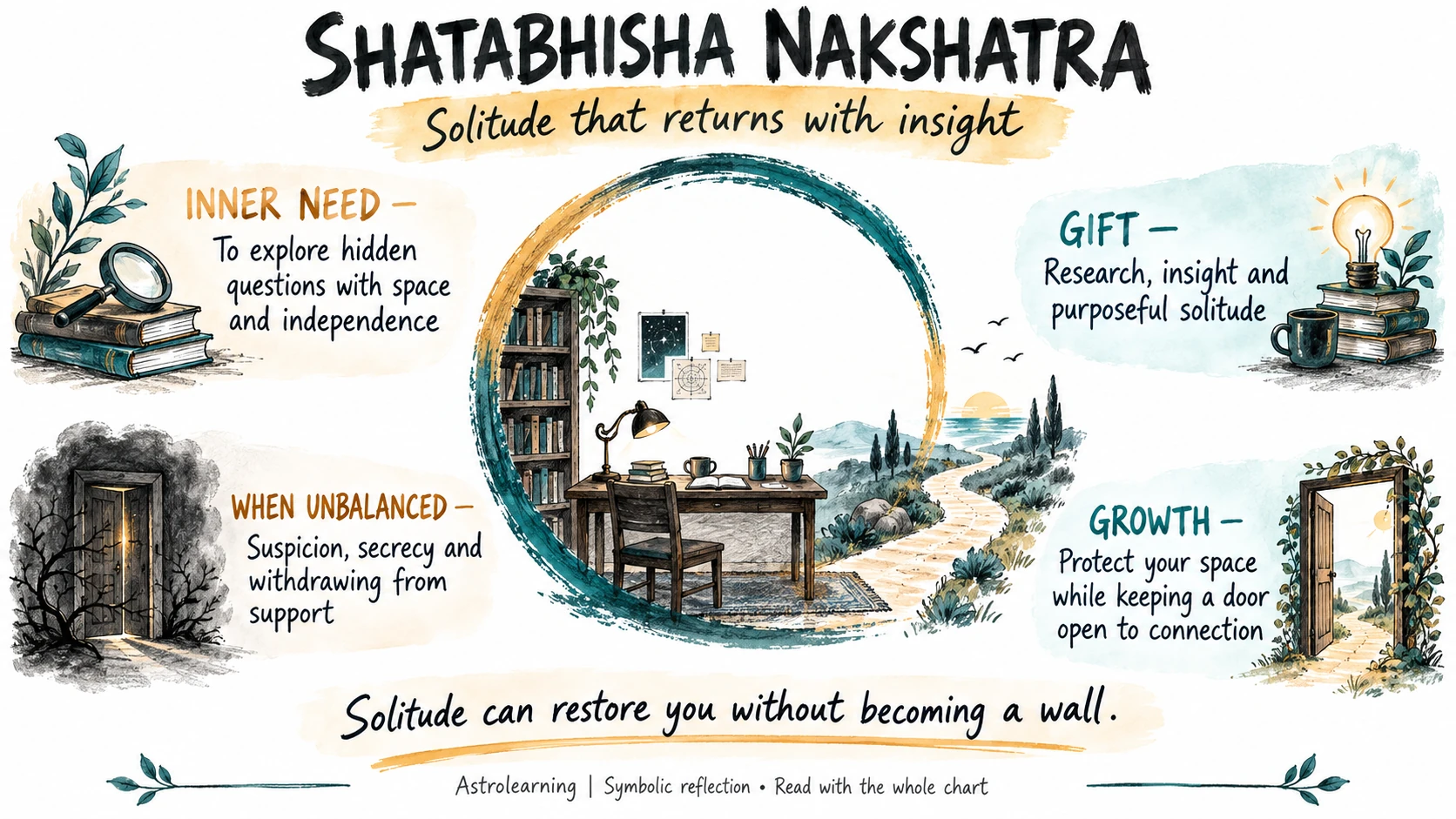
The Empty Circle — The Soul That Heals Alone
Core Details
| Factor | Shatabhisha |
|---|---|
| Sanskrit | शतभिषा |
| Nakshatra Number | 24 |
| Zodiac Span | 6°40′ – 20°00′ Aquarius |
| Nakshatra Lord | Rahu |
| Deity | Varuna (god of the cosmic waters and universal law) |
| Symbol | An empty circle / a hundred healers |
| Shakti | Bheshaja Shakti — the Power of Healing |
| Gana | Rakshasa |
| Guna | Tamas |
| Main Theme | Healing, isolation, secrecy, hidden truth, mysticism |
| Deity Mantra | Om Varunaya Namah |
| Higher Expression | Deep healing, independent research, mysticism used to genuinely help others |
| Lower Expression | Self-isolation, suspicion, secretiveness, emotional withdrawal |
The Fundamental Nature of Shatabhisha
Shatabhisha means “a hundred healers” or “a hundred stars.” Either translation points at the same truth: this is a Nakshatra of vast, scattered capacity. Not one healer standing in a crowd, but a hundred of them, each working quietly in a separate room.
Its symbol is an empty circle.
Not a broken circle. Not a closed one. Empty.
An empty circle is not nothing. It is space that hasn’t been filled yet — room for mystery, for the unknown, for whatever hasn’t revealed itself. It is also, unmistakably, a shape with no one standing inside it.
This is Shatabhisha’s whole psychology in a single image: immense capacity, held at a distance.
The person carrying this Nakshatra strongly is often the one in the room who understands the problem before anyone else does, and says nothing about it. Not because they don’t care. Because their instinct is to go and work on it alone first, and explain later — if there is a later.
The Empty Circle — The Symbol of Shatabhisha
A circle with nothing inside it can be read two ways, and Shatabhisha lives inside both readings at once.
Read one way, it is open space: the void that hasn’t been decided yet, the place where anything could still happen. This is where Shatabhisha’s mysticism comes from — its comfort with the unseen, the unmeasured, the not-yet-understood. It doesn’t need every space filled with explanation. It can sit inside a question for a long time without becoming anxious about the answer.
Read the other way, it is a boundary with no one behind it. A circle drawn around an absence. This is Shatabhisha’s isolation — not loneliness exactly, but a kind of self-contained remoteness, a wall built so early and so instinctively that the person may not notice they built it at all.
Both readings are true simultaneously. The same emptiness that makes Shatabhisha spacious enough to hold what others can’t look at is the emptiness that can leave it alone in the room.
Varuna — The Deity of Cosmic Waters and Law
Shatabhisha’s deity is Varuna, the ancient keeper of the cosmic waters and the unseen order beneath the visible world. Varuna doesn’t govern the tide you can see. He governs the current beneath it — the vast, largely invisible structure that keeps everything moving correctly, whether or not anyone is watching.
This gives Shatabhisha an instinct for what lies underneath. Beneath the symptom, the actual condition. Beneath the surface story, the real one. Beneath the polite conversation, the thing nobody is saying.
Varuna is also a deity of law — cosmic law, not the kind that gets written down and enforced by committee. Shatabhisha often carries a private, almost incorruptible sense of what is true and what is right, one it may never explain to anyone, because it doesn’t feel it needs to be explained. It simply knows.
This is where the healing gift and the secrecy come from the same root. Varuna’s waters are vast and mostly hidden. So is Shatabhisha’s knowledge of what is actually wrong with someone — and so, often, is Shatabhisha itself.
The Central Tension — Insight or Withdrawal
Shatabhisha’s core psychological tension sits between two very different uses of the same solitude.
Used well, solitude becomes the working condition for genuine insight. Shatabhisha can look directly at what others flinch from — chronic illness, hidden dysfunction, the parts of a person or a system that don’t want to be examined — without needing an audience or reassurance while it does so. Real research, real diagnosis, real healing often require exactly this: a mind willing to stay in the room with the problem after everyone else has left.
Used poorly, that same solitude becomes a retreat that never ends. The person withdraws not to work, but to avoid. They stop trusting the motives of people who could actually help them. They mistake distance for safety.
The lesson Shatabhisha keeps encountering is not “stop being alone.” It is: “know why you are alone, and choose it, rather than defaulting to it.”
Past-Life Karma
From a symbolic Jyotish perspective, Shatabhisha may carry karmic themes connected with healing, secrecy, isolation, and unconventional or hidden knowledge. This is not a claim about who anyone literally was. It is a way of naming a recurring pattern the soul seems to keep returning to.
The archetype often resembles someone who once held knowledge that couldn’t be shared openly — a healer working outside sanctioned methods, someone who understood a hidden cause that others weren’t ready to hear, or a person whose insight was distrusted precisely because it came from outside the accepted circle.
Whatever the story, the residue is consistent: a soul that learned, somewhere, that truth spoken too openly gets punished, and help offered too visibly gets refused. So it learned to work quietly. To keep its own counsel. To trust its own findings more than anyone else’s permission.
The karmic task this time is to find out whether that caution is still necessary — or whether it has hardened into a habit the soul no longer needs.
Childhood Imprint
Shatabhisha children frequently sense, quite early, that they are different. Not in a dramatic way. Just a quiet, persistent awareness that their mind moves through things differently than the minds around them — slower to trust, quicker to notice what’s hidden, less interested in the games everyone else seems to already know the rules to.
This can make ordinary childhood social life feel oddly effortful. The child may not be excluded so much as self-excluding — stepping back before anyone asks them to.
And in that stepping back, something valuable gets built. The inner world becomes a genuinely good place to be: private, spacious, uninterrupted. The child learns to think for long stretches without needing anyone else’s input. That capacity, cultivated early as a refuge, is exactly what later becomes Shatabhisha’s gift for solitary, penetrating work.
The risk is that the refuge never gets left. What began as a place to retreat to can quietly become the only place the person is willing to live.
Relationships
Shatabhisha’s need for solitude in relationships is real, and it is legitimate — not a flaw to be corrected, not evidence of unavailability. This is someone who genuinely recharges alone, thinks alone, and often heals best alone.
But the Nakshatra’s relationship lesson lives in the gap between needing space and defaulting to distance.
Left unchecked, Shatabhisha will quietly wall off even the people who have earned entry. Not out of malice — out of habit. The circle stays empty because emptiness is familiar, and familiar feels safe, even when it isn’t what the person actually wants.
Genuine intimacy asks something specific of Shatabhisha: not to abandon its solitude, but to occasionally, deliberately, let someone stand inside the circle. To say the thing instead of quietly working through it alone. To let someone see the diagnosis before it’s finished, not just the healed result.
The people who love Shatabhisha well learn not to force the door. They wait near it, patiently, until it opens on its own — and it does, for the right person, more often than Shatabhisha itself expects.
Lower Expression
The lower Shatabhisha becomes suspicious, secretive, and emotionally withdrawn. It starts to read ordinary human unpredictability as a threat. Questions feel like intrusions. Concern feels like surveillance.
At its most defended, this Nakshatra will isolate itself even from the people who are genuinely trying to help — turning away the doctor, the friend, the partner, precisely because letting them in would mean admitting something is wrong. The empty circle closes its own gate.
The person may become difficult to reach, not because they don’t want connection, but because connection now feels like exposure, and exposure feels like danger. Secrecy stops being a discipline and becomes a reflex — applied even where nothing needs to be hidden.
Higher Expression
The higher Shatabhisha becomes exactly what its name promises: a hundred healers in one. Someone capable of working with what others can’t see or won’t touch — chronic conditions, hidden causes, the quiet unglamorous research that takes years and produces no applause along the way.
It has made peace with solitude as a working tool rather than a hiding place. It can go into the depths, alone, for as long as the work requires — and then it can come back out and actually hand over what it found.
That last part is the real maturation. The gifted Shatabhisha doesn’t hoard its findings in the empty circle out of fear. It brings them back to the people who need them. The mysticism becomes usable. The healing becomes shared. The circle, once empty, finally has someone standing in it — by choice, not by accident.
“The deepest healing is often done alone, in the dark, by someone willing to look at what no one else would — but it isn’t finished until they return and hand it over.”